# Smithsonian Scientists Recreate the Universe's First 2 Billion Years in Record-Breaking Simulation
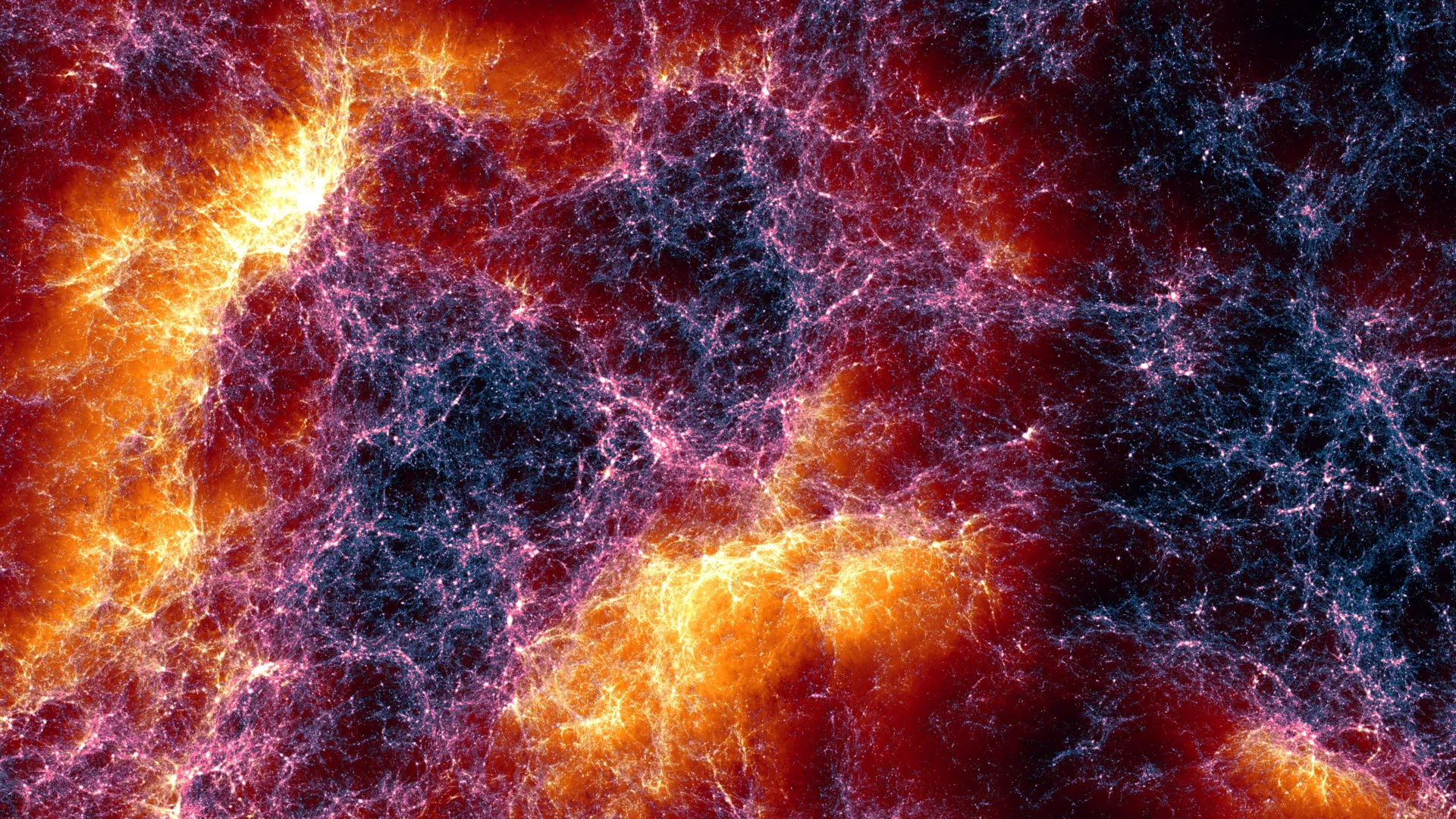
Researchers at the Smithsonian Institution have built Lumina, one of the largest and most detailed simulations of the early universe to date. The computational model recreates the cosmos during its first 2 billion years after the Big Bang, tracing how dark matter, gas, and radiation combined to form the earliest stars, galaxies, and black holes.
The simulation represents a leap forward in computational astrophysics. Previous models captured smaller volumes of space or shorter timescales. Lumina tracks both the formation of massive structures across billions of light-years and the physics governing individual processes like star birth and black hole growth. This dual-scale approach demands extraordinary computational power. The Smithsonian team ran the simulation on some of the world's fastest supercomputers, processing data on a scale that would have been impossible just a few years ago.
Understanding the early universe matters for modern cosmology. Astronomers observe ancient galaxies and quasars through space telescopes like James Webb, but observations alone cannot explain how the structures they see formed so quickly. When the universe was only a few hundred million years old, massive galaxies and supermassive black holes already existed. Lumina helps bridge this gap by showing whether current physics models can actually produce these early structures through natural processes.
The simulation tracks dark matter, which comprises 85 percent of matter in the universe but remains invisible to direct detection. Dark matter's gravity sculpts the cosmic web, creating the framework upon which galaxies form. Baryonic matter, the gas made of normal atoms, collapses into these gravitational wells and ignites star formation. As stars live and die, they release elements and radiation that reshape their surroundings. Black holes grow by consuming matter and releasing enormous energy. All these processes interact, and Lumina models them together across cosmic time.
The researchers faced technical challenges in creating such a vast simulation. The early universe evolved rapidly. The first stars formed within 100 million years of the Big Bang, completely unlike today's universe. Simulations must therefore use smaller time steps in the early epochs and larger steps later on. The sheer volume of space requires massive amounts of memory and processing time. Trade-offs between resolution, volume, and runtime are unavoidable.
Lumina's outputs will help astronomers interpret observations from upcoming surveys. The Vera Rubin Observatory will map billions of distant galaxies starting in 2025. The Nancy Grace Roman Space Telescope will observe the first galaxies ever formed. Simulations like Lumina predict what these telescopes should see, allowing researchers to test whether their models match reality.
The Smithsonian team has not yet published detailed results in peer-reviewed journals, so the scientific community has not yet scrutinized the simulation's assumptions and findings. Early results suggest the model produces structures consistent with observations, but independent verification remains pending.
Future versions of Lumina could incorporate additional physics, such as magnetic fields in early galaxies or the effects of cosmic dust. Each refinement brings simulations closer to reality. The early universe holds the key to understanding how the cosmos became what we see today, and simulations like Lumina make that ancient history increasingly visible.