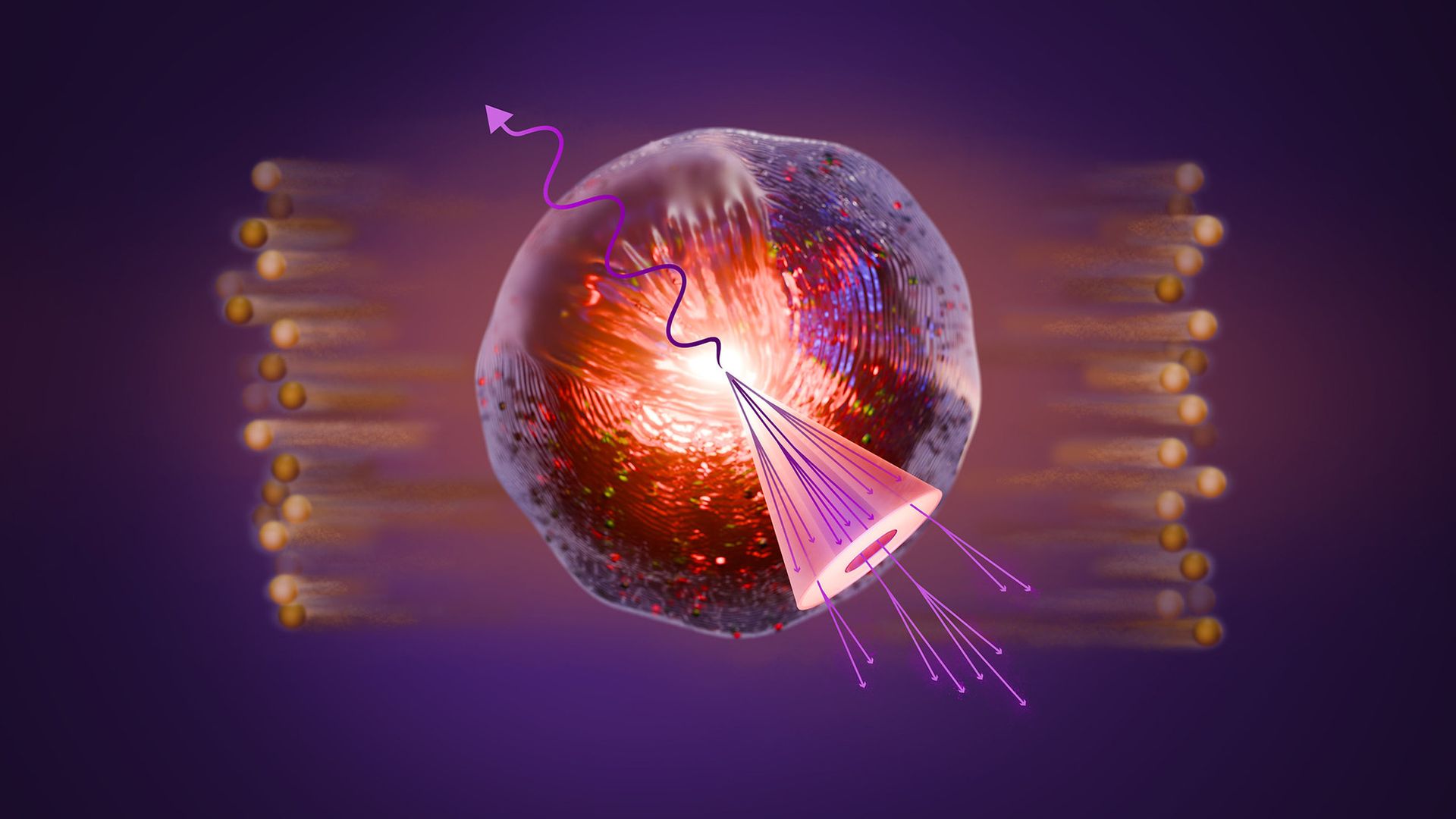
Researchers conducting particle collider experiments have discovered unexpected behavior in the quark-gluon plasma, the hot, dense state of matter that existed immediately after the Big Bang. The findings challenge current understanding of how this primordial particle soup transformed into the protons and neutrons that comprise ordinary matter in the universe today.
The experiment recreated conditions similar to those in the universe's first moments by colliding particles at extremely high energies. During these collisions, scientists observed phenomena they did not anticipate in the quark-gluon plasma, suggesting the transition from fundamental particles to composite particles like protons and neutrons may differ from previously accepted models.
Quark-gluon plasma consists of quarks and gluons existing in an unconfined state, a condition that only occurs at extraordinarily high temperatures and densities. As the early universe expanded and cooled, this plasma underwent a phase transition, allowing quarks to combine into hadrons such as protons and neutrons. These composite particles then formed the nuclei that eventually led to atoms and all visible matter.
The unexpected findings from the particle collider data indicate that the mechanisms governing this fundamental transformation may be more complex than current theoretical frameworks suggest. Understanding exactly how the quark-gluon plasma evolved into ordinary matter remains one of the key challenges in nuclear physics and cosmology.
Scientists continue analyzing the collider data to determine the precise nature of the unexpected behavior and what it reveals about the laws of physics operating in the universe's earliest moments. The results represent another step toward comprehending the Big Bang and the fundamental processes that shaped the cosmos.