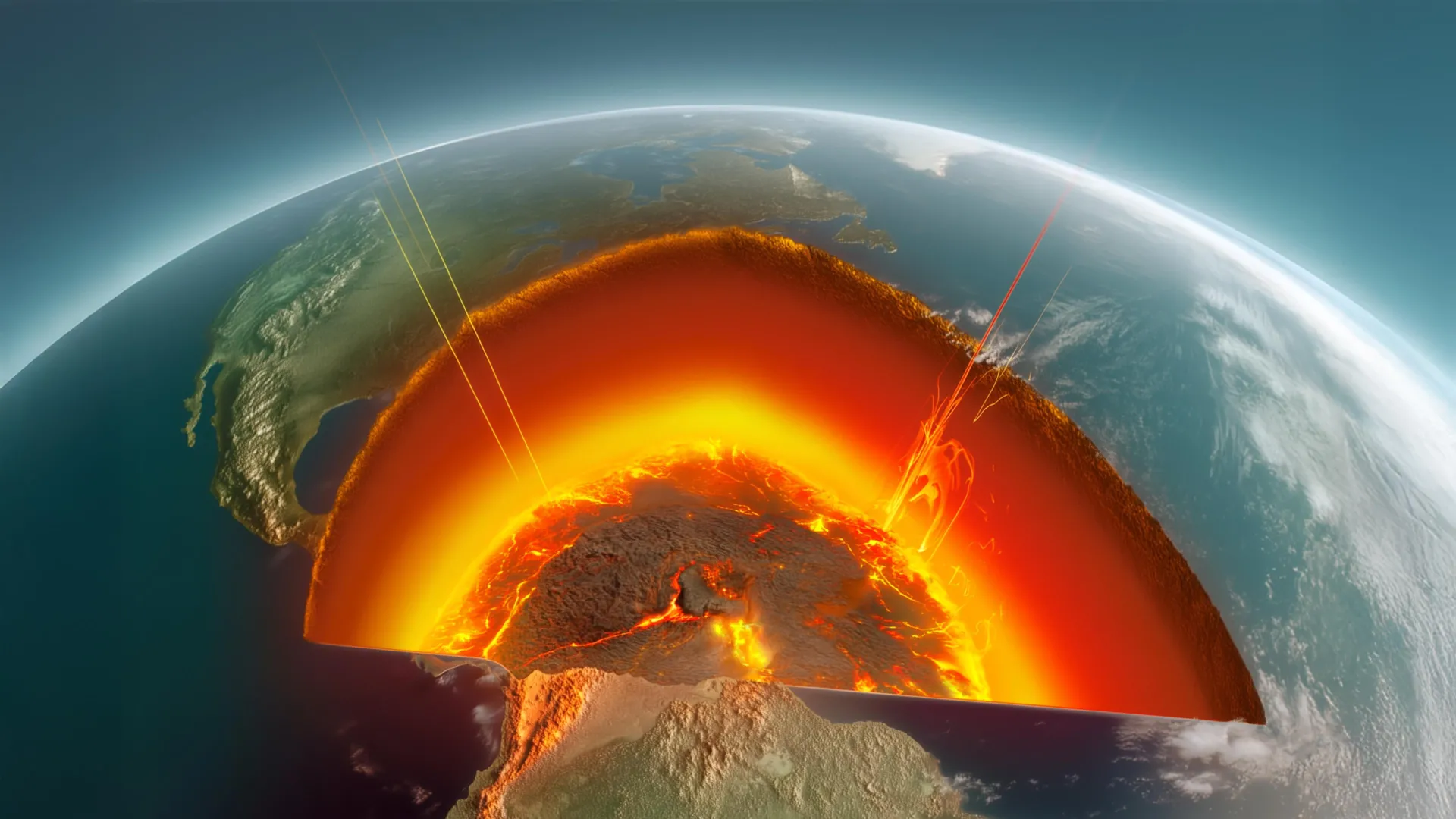
Scientists have discovered that molten rock deep inside Earth can store far more oxygen than previously believed, challenging assumptions about magma's composition. Researchers led by Dr. Yanhao Lin and Dr. Ho-kwang Mao of the Center for High Pressure Science and Technology Advanced Research (HPSTAR), working with Prof. Haiyang Niu of Northwestern Polytechnical University and Prof. Wim van Westrenen of Vrije Universiteit Amsterdam, published their findings in National Science Review.
The team conducted high-pressure experiments on synthetic mid-ocean ridge basalt, heating samples to 1200-1800°C under pressures up to 7 gigapascals (roughly 69,000 times atmospheric pressure). They added platinum oxide to create an oxygen-rich environment and measured how much additional oxygen the molten material could absorb. At normal atmospheric pressure, the glass contained almost no excess oxygen. At 7 gigapascals, excess oxygen accounted for more than 5% of the sample's weight. Using Raman spectroscopy, the researchers confirmed the oxygen had become part of the glass structure rather than trapped as gas bubbles.
Prof. Niu led computer simulations using deep neural network models that reproduced the laboratory pattern: magma's ability to hold excess oxygen increased with pressure. The calculations showed that oxygen atoms' electrical charges became more varied as more oxygen entered the melt, with some forming peroxide-like bonds where oxygen atoms bond to one another.
The researchers propose that oxygen released from magma moving upward through Earth's interior could be released as pressure decreases, potentially contributing to atmospheric changes. They note that major atmospheric oxygen increases occurred between approximately 2.5 billion and 2.0 billion years ago, overlapping with the formation of Earth's largest igneous provinces.