# Lava Planet 280 Light-Years Away Keeps Its Atmosphere Despite Scorching Heat
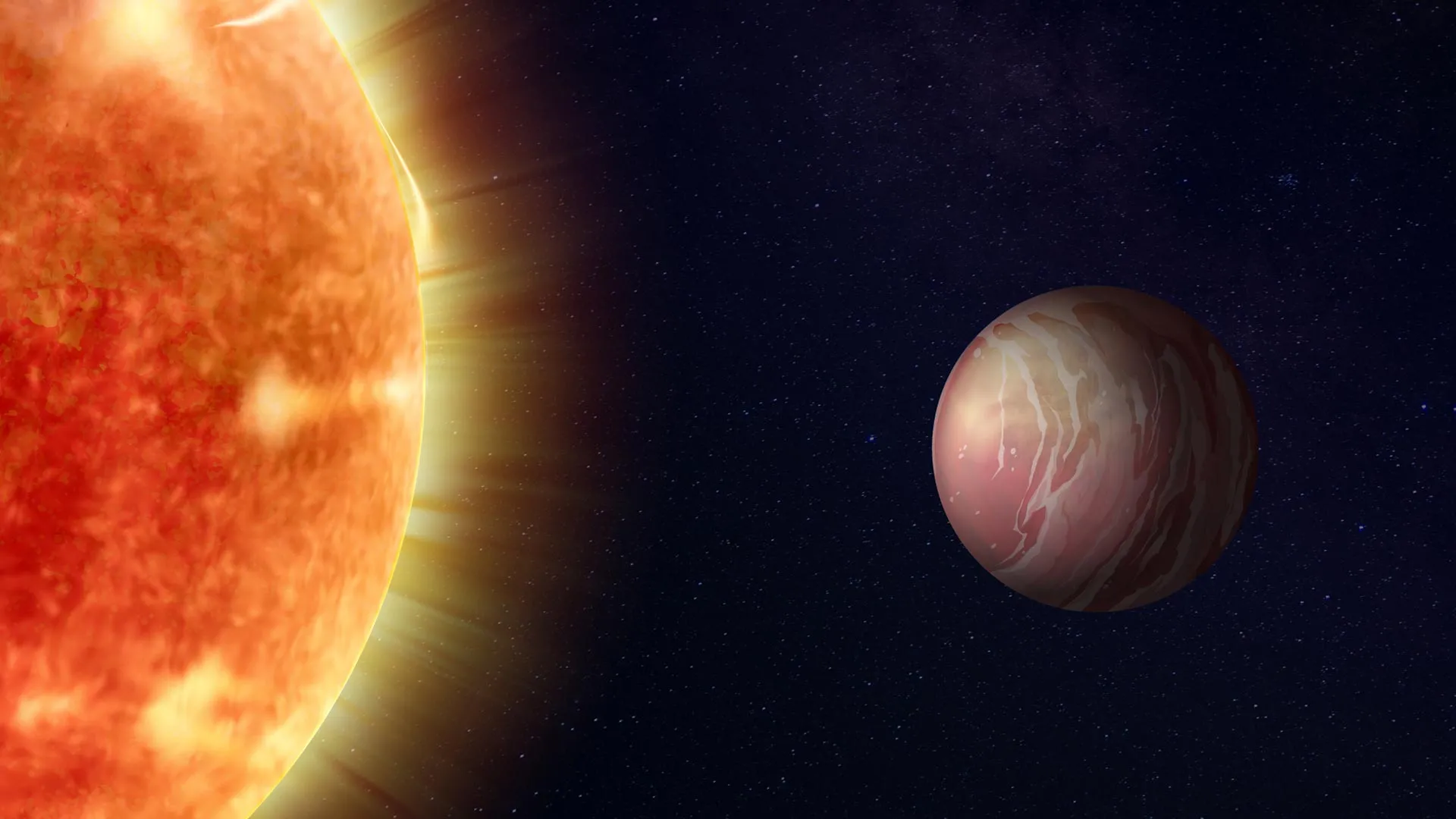
Astronomers using the James Webb Space Telescope have discovered something unexpected orbiting a star 280 light-years from Earth. The planet TOI-561 b, a scorching world of molten rock, should have lost its entire atmosphere billions of years ago. Instead, it retains a thick envelope of gases through mechanisms that challenge conventional understanding of planetary evolution.
TOI-561 b orbits incredibly close to its host star, completing a full revolution in just 2.5 days. The planet's surface temperature exceeds 2,700 Kelvin (roughly 2,400 degrees Celsius), hot enough to melt rock and create a global magma ocean. Under these extreme conditions, atmospheric gases typically escape into space over time, a process called atmospheric erosion. Yet this world has somehow preserved its atmosphere across billions of years.
The key to this puzzle lies in what researchers observed in the planet's light. TOI-561 b reflects approximately 75% of the starlight that strikes it, far higher than typical rocky planets. This exceptional reflectivity comes from mineral clouds in the upper atmosphere that scatter incoming radiation back toward space. These clouds function like a planetary sunscreen, reducing the energy absorbed and heating that would normally accelerate atmospheric loss.
The JWST observations, detailed in research from the Johns Hopkins University team, reveal silicate clouds composed of minerals similar to sand and glass. These particles remain suspended high in the atmosphere despite the intense heat below. The high albedo, a measure of reflectivity, creates a cooling effect that slows the escape of atmospheric gases into space.
Beyond reflection, the planet likely employs another mechanism to sustain its atmosphere. The global ocean of molten rock continuously releases gases through outgassing, a volcanic process that replenishes atmospheric material as lighter gases drift away. This ongoing resupply from the planet's interior compensates for losses and maintains atmospheric density over geological timescales.
TOI-561 b belongs to a class of exoplanets called ultra-short-period planets, objects that orbit their stars at distances closer than Mercury to our Sun. These worlds present extreme laboratories for studying planetary physics and atmospheric dynamics under conditions rarely found in our solar system. The discovery demonstrates that planetary systems remain capable of surprising us with unexpected survival strategies.
The findings have implications for understanding how planets retain atmospheres in hostile environments. Astronomers now recognize that reflective clouds and volcanic outgassing represent viable pathways for atmospheric preservation on hot, rocky worlds. This knowledge reshapes models of exoplanet evolution and stability.
Future observations of TOI-561 b and similar ultra-short-period planets will test predictions about atmospheric composition and cloud formation. The JWST's infrared sensitivity allows researchers to detect specific molecular signatures in distant atmospheres, capabilities that ground-based telescopes cannot match. As the space observatory continues surveying exoplanet atmospheres, additional examples of atmospheric resilience may emerge, revealing how varied planetary systems manage extreme conditions across the galaxy.