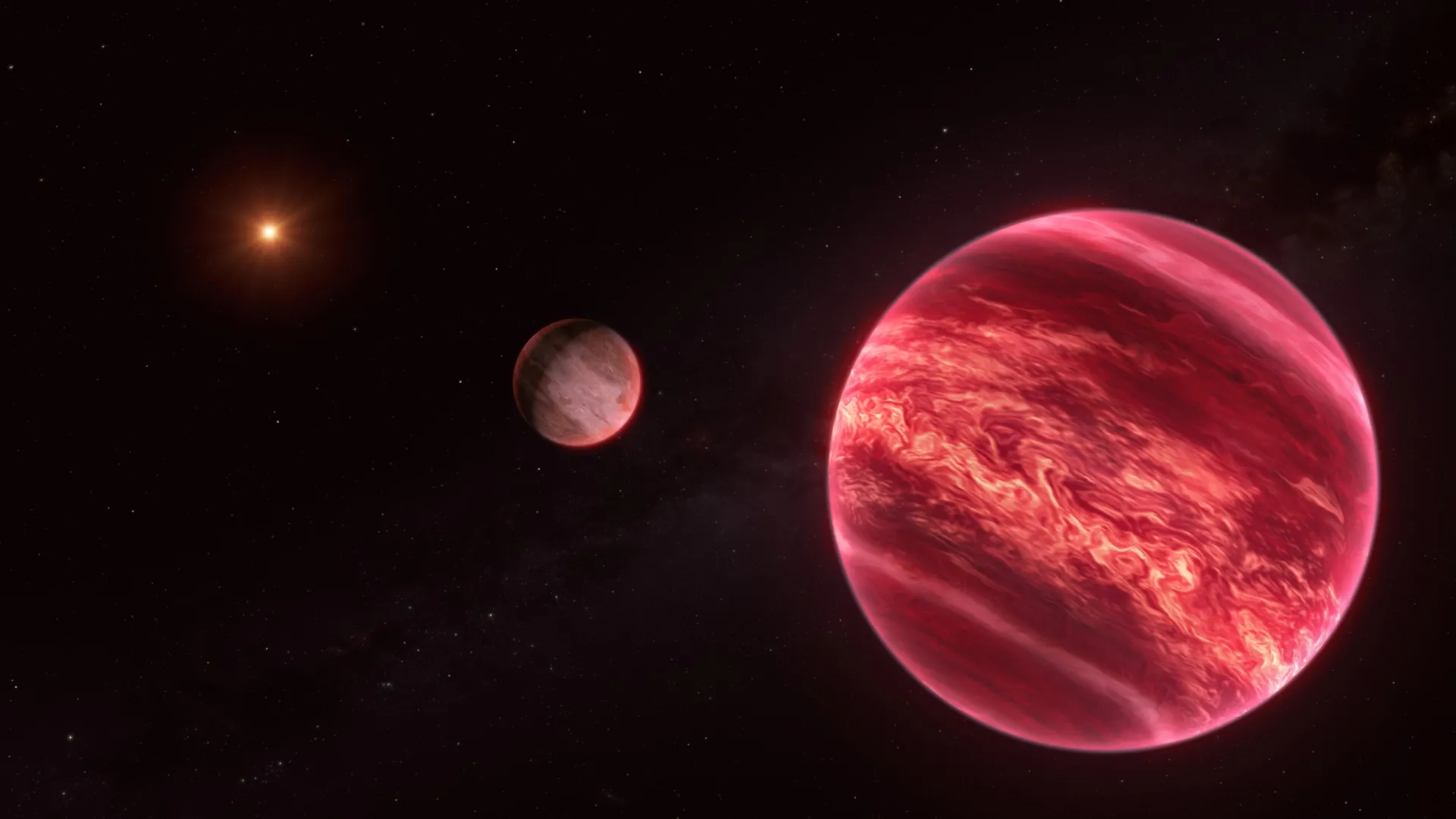
Astronomers have detected what could be the first moon orbiting outside our Solar System, according to new research published in early 2023. The candidate object is at least as massive as Jupiter and circles a brown dwarf, which itself orbits a star in a hierarchical system that defies conventional classifications.
The discovery emerged from careful analysis of gravitational effects and orbital dynamics. Researchers identified timing variations in how light reaches Earth from the star system, patterns consistent with a massive companion object tugging on the brown dwarf. The brown dwarf itself was previously known to orbit a star, but the detection of this potential satellite adds a new layer of complexity to the system.
This finding overturns assumptions about what exomoons should look like. Astronomers have long predicted that distant moons exist around exoplanets, but most theoretical models suggested they would resemble our own Moon or the Galilean moons of Jupiter. The newfound object dwarfs those comparisons entirely. Its mass approaches or exceeds Jupiter's, making it fundamentally unlike any moon in our Solar System.
The discovery raises thorny definitional questions. Traditional astronomy classifies moons as objects orbiting planets. But Jupiter-mass objects typically qualify as brown dwarfs or planets themselves. This system features a hierarchical structure where a potentially planet-sized object orbits a brown dwarf, which orbits a star. The intermediate body that hosts the massive object fits neither traditional moon nor planet categories neatly.
Brown dwarfs themselves occupy a gray zone in astronomy. They form like stars but lack sufficient mass to ignite hydrogen fusion in their cores. They retain properties of both planets and stars, occupying a unique category. When a brown dwarf hosts an object massive enough to be a brown dwarf itself, classification schemes collapse.
The research team used data from multiple telescopes and transit detection methods to establish their case. Precise measurements of the brown dwarf's position and velocity revealed periodic wobbles incompatible with a single object. A massive companion provided the best explanation for the observed perturbations.
Confirmation remains essential. Follow-up observations will test whether alternative explanations better fit the data. Direct imaging of the suspected moon presents formidable technical challenges given the enormous distance and the dim light reflected by such a distant object. Gravitational lens imaging and timing analysis offer more practical paths forward.
If confirmed, this discovery would transform exoplanet science. It would demonstrate that massive satellites can form in distant planetary systems, suggesting formation mechanisms different from those in our Solar System. The finding also suggests that binary systems of substellar objects may be far more common than previously thought.
The research pushes astronomers to reconsider how they define and classify objects beyond Earth. As more exotic systems come into view through improved telescopes, rigid categories may give way to more fluid descriptions accounting for the bewildering diversity of distant worlds.