# James Webb Reveals How Time Pressure Shapes Planet Formation
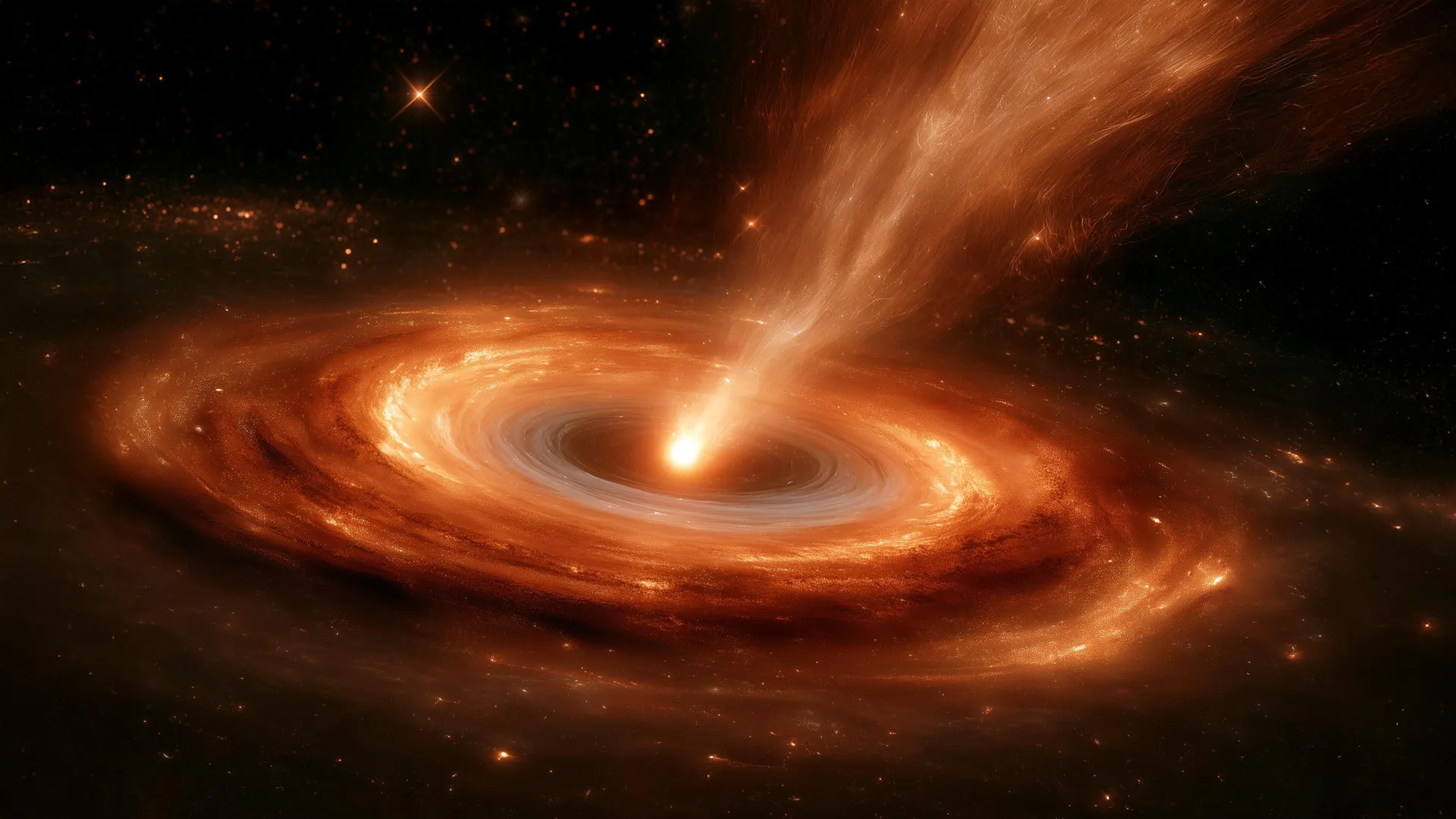
The James Webb Space Telescope has discovered why planetary systems operate on a strict clock. Young disks lose their planet-building material through three distinct mechanisms working in concert: powerful jets from the inner disk, molecular winds from the mid-disk region, and radiation-driven outflows from the disk's outer edges. This finding explains why giant planets must accumulate their massive atmospheres quickly or miss the window entirely.
Researchers studying young protoplanetary disks found that gas escape occurs through multiple pathways simultaneously, not a single dominant process as previously thought. The jets shoot material outward from regions closest to the forming star, where magnetic fields and gravitational forces concentrate. Molecular winds emerge from intermediate zones, carrying away gas molecules at significant velocities. Radiation from the star and surrounding environment then drives additional material away from the disk's periphery.
This multi-mechanism outflow creates intense competition for planets in formation. Gas giants like Jupiter require enormous quantities of hydrogen and helium to build their thick atmospheres. These elements exist only in the earliest disk phases, within the first few million years after a star forms. Once the gas dissipates through jets, winds, and radiation pressure, only rocky cores remain. Planets that don't accumulate sufficient gas during this window become smaller, terrestrial-type worlds.
The JWST observations reveal the timeline operates tighter than previous generations of telescopes suggested. Disk lifetimes vary from roughly three to ten million years depending on the system, but the actual window for giant planet formation compresses further. The combination of three removal mechanisms accelerates gas depletion compared to scenarios where only one or two processes dominated.
This research carries implications for understanding our own solar system's history. Jupiter likely formed within the first two million years of the solar system's existence, capturing its massive atmosphere before the disk thinned substantially. Saturn followed, though with a smaller atmosphere, fitting the pattern that later-forming planets captured less gas. Earth and other terrestrial planets formed after most hydrogen and helium had escaped, explaining why they lack thick primordial atmospheres.
The findings also reshape expectations for exoplanet demographics. The abundance of super-Earths and mini-Neptunes in discovered systems may reflect planets that formed just as their disks began dispersing. Many systems show no giant planets, possibly because their disks dissipated before core-accretion processes could complete. Future observations with JWST will track how disk structures change in systems of different ages, mapping the precise timeline of gas removal across hundreds of young systems.
Understanding these mechanisms helps astronomers interpret data from distant planetary systems and construct more accurate models of planetary formation. The race against time applies universally. Every forming planetary system fights a clock ticking down to atmospheric escape.