# Ancient Meteorites Reveal Powerful Early Magnetic Field Shaped Solar System Formation
A team of researchers examining ancient mineral grains trapped inside one of the oldest meteorites has uncovered evidence that Earth's solar system possessed an unexpectedly powerful magnetic field during its first 200,000 years of existence. This finding reshapes our understanding of how gravity and magnetism worked together to sculpt the primordial cloud of gas and dust into the sun and the disk of material that would eventually form planets.
The study analyzed grains of magnetite, an iron oxide mineral, preserved inside the Allende meteorite. This carbonaceous chondrite fell to Earth in 1969 in Chihuahua, Mexico, and contains some of the oldest solid materials known to exist, having formed approximately 4.5 billion years ago. Researchers used sophisticated techniques to measure the magnetic properties locked within these ancient grains, effectively reading a record of magnetic conditions from the solar system's infancy.
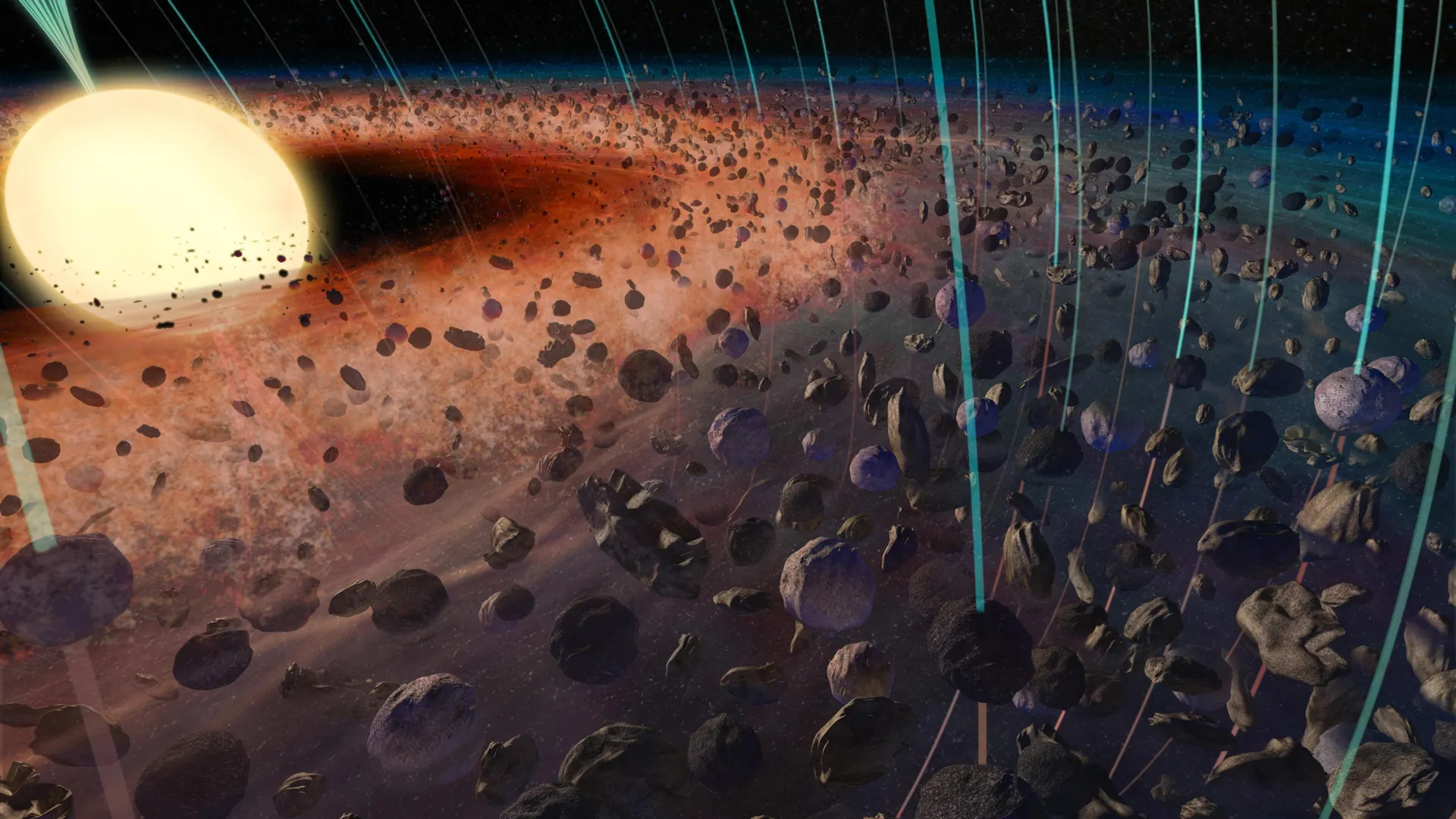
The magnetic field strength they discovered was roughly 200 times stronger than current scientific models predicted. This intensity rivals Earth's modern magnetic field and demonstrates that magnetism played a more active role in planetary formation than previously thought. During the solar nebula phase, this magnetic field would have generated significant forces capable of extracting angular momentum from the collapsing cloud of dust and gas, allowing material to spiral inward toward the forming sun rather than simply orbiting indefinitely at great distances.
The research team used a technique called paleomagnetic analysis, which measures the remanent magnetization preserved in mineral crystals. By heating samples in controlled magnetic environments and cooling them back down, scientists can determine the strength and direction of ancient magnetic fields. The precision required for this work rivals that needed to detect Earth's magnetic field in samples from the laboratory, underscoring the technical achievement involved.
This discovery carries implications for understanding not just our own solar system, but planetary formation processes across the universe. If magnetism played this substantial role during our sun's birth, similar magnetic dynamics likely influenced how other star systems assembled their planetary configurations. The finding also provides new context for explaining why our early solar system evolved the way it did, including why planets ended up at their particular orbital distances.
The Allende meteorite itself remains one of the most studied space rocks on Earth, having yielded numerous discoveries about early solar system chemistry and physics. Its preservation of these ancient magnetic signatures makes it an exceptional scientific resource. Researchers continue to extract new information from its grains, each analysis revealing fresh details about conditions in that distant era.
Understanding the interplay between magnetic and gravitational forces during planetary birth offers astronomers a more complete picture of how common planetary systems truly are and what physical mechanisms govern their development. This work suggests that any forming planetary system with a sufficiently strong magnetic field would benefit from an additional tool, beyond gravity alone, for organizing material into planets and moons.