NASA's Voyager 1 spacecraft will reach 16.09 billion miles from Earth this Wednesday, marking a new distance milestone for humanity's most distant spacecraft. The probe, launched in 1977, has traveled so far that light takes 24 hours to traverse the space between it and our planet.
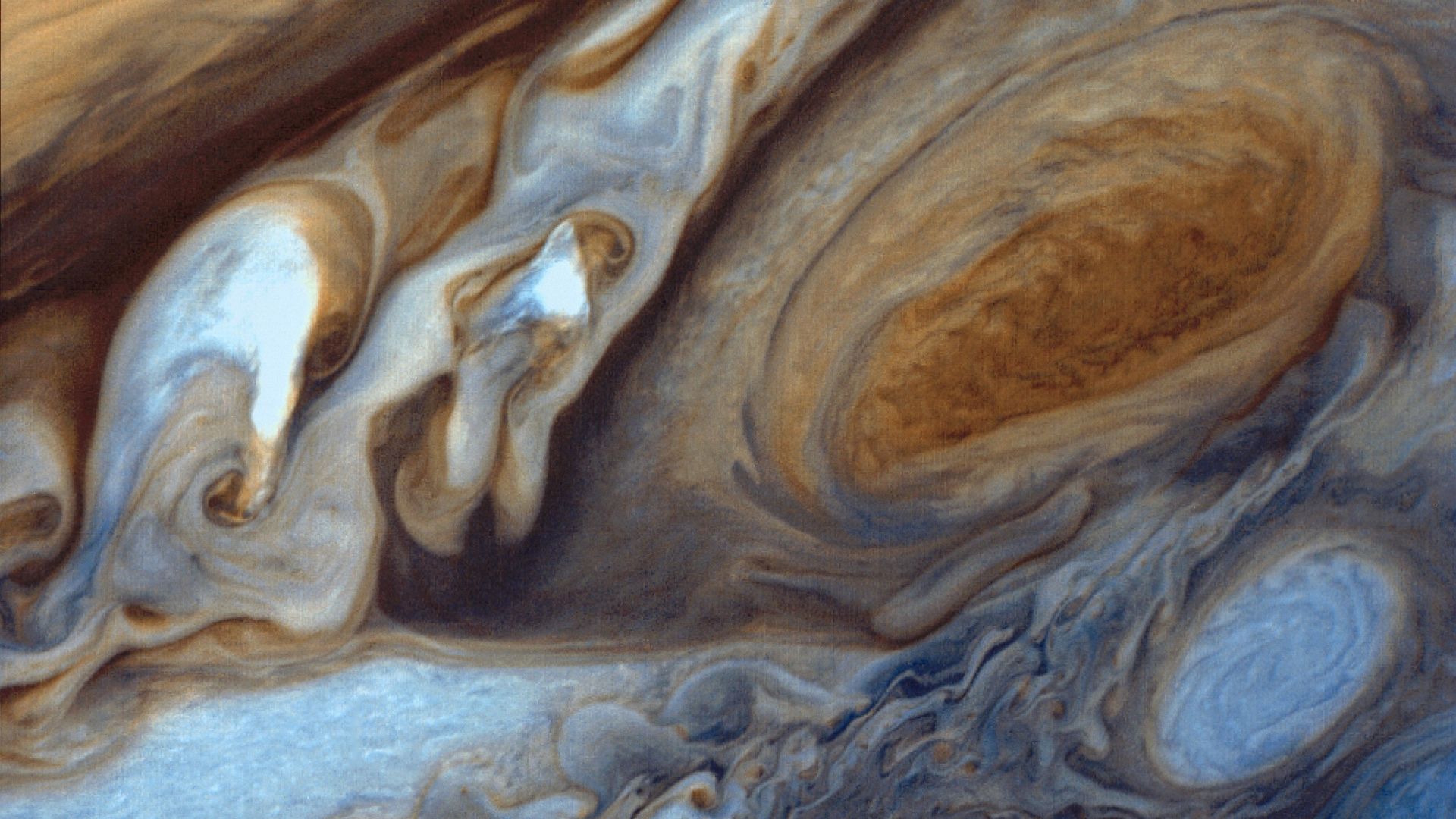
Before Voyager 1's camera was turned off in 1990, the probe gathered tens of thousands of images that transformed our understanding of the outer planets. From January to April 1979, Voyager 1 approached Jupiter and photographed it every 96 seconds. It reached a minimum distance of 174,000 miles from the gas giant in March 1979.
The time-lapse images revealed discrete bands of Jupiter's atmosphere spinning at various speeds in different directions, with clouds moving on conveyor belts and giant storms swirling. The spacecraft captured about 60 full Jupiter days, or roughly a month on Earth, providing the most comprehensive and high-resolution look at the planet at that time. This built significantly on data from NASA's Pioneer 10 and 11 probes, showing the planet's atmosphere to be much more dynamic than astronomers realized.
Just before its closest approach, Voyager 1 spotted a thin, faint ring system around Jupiter made primarily of dust. The rings appeared only when Jupiter was backlit by the sun. No telescope had ever seen this before, though ground-based observatories soon confirmed the rings' existence. Voyager 2 took even clearer pictures when it reached Jupiter in July 1979.
During its approach to Jupiter's moon Io, Voyager 1 witnessed the first-ever volcanic eruption on a world beyond Earth. A giant volcano called Loki Patera, measuring an estimated 125 miles wide, erupted during the spacecraft's observation. Scientists now suspect Jupiter's dusty rings are partially replenished by volcanic eruptions on Io.
Voyager 1 officially reached interstellar space in 2012. With its camera off, it now studies the radiation environment using magnetic field and plasma detectors, two of its 10 science instruments still receiving power. Scientists suspect the spacecraft will run out of power in the 2030s.