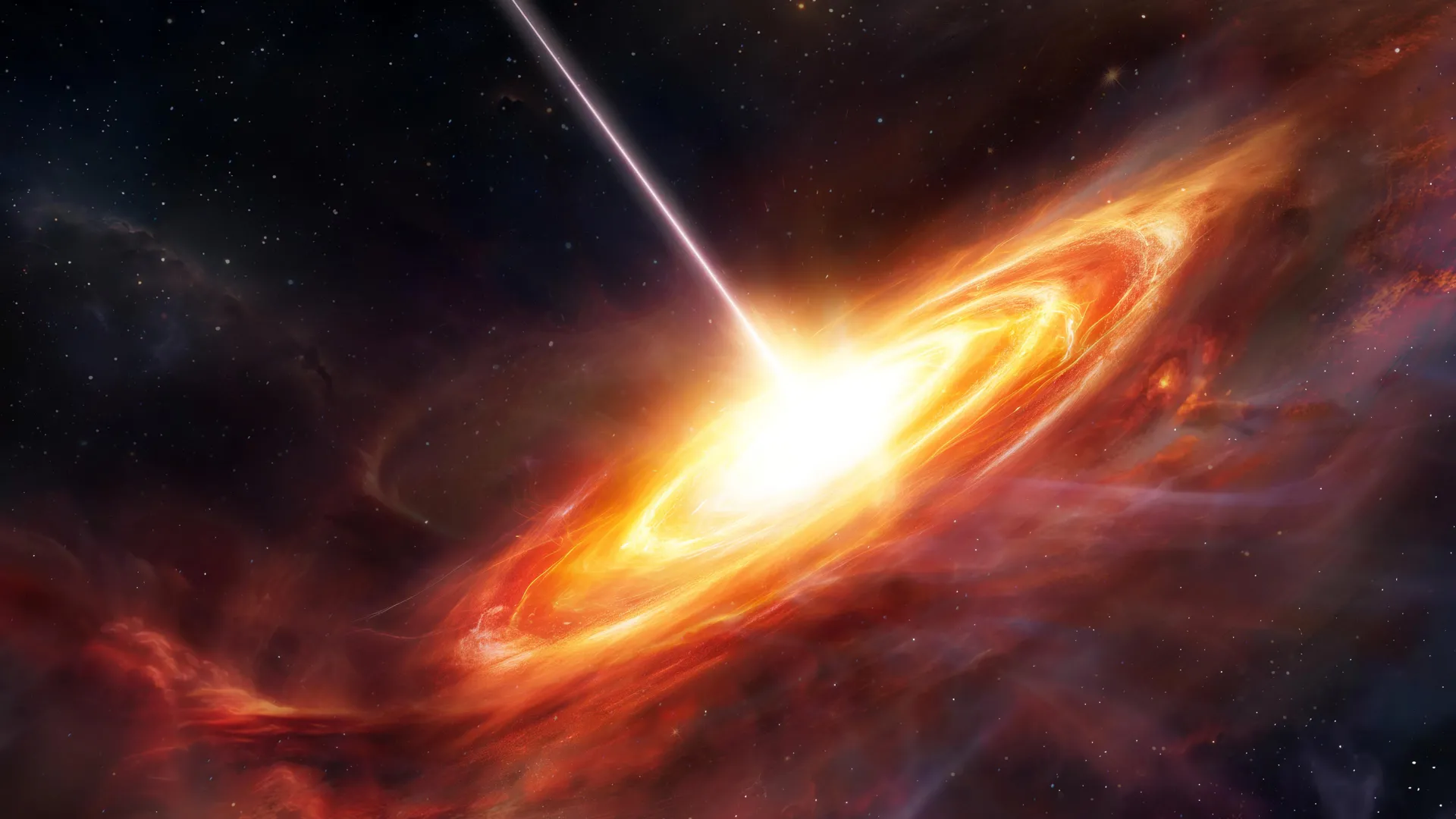
The European Space Agency's Euclid space telescope has identified 31 ancient quasars, with two breaking records as the earliest ever observed. The two record-breaking objects, EUCL J172902.75+641018.1 and EUCL J125308.55+705432.3, both have redshifts indicating they existed within the first 670 million years of cosmic history, when the Universe was about 5% of its present age. Each quasar shone with the brightness of a trillion Suns.
Quasars form when material spirals into supermassive black holes at galactic centers, releasing extraordinary energy. Finding ancient quasars is difficult because few galaxies had grown large enough to host them early on, and their light reaching Earth today is extremely faint.
Among the 31 newly discovered quasars, 12 have a redshift of 7 or higher, placing them within the Universe's first 770 million years. This discovery more than doubles the number of known quasars so ancient. Daming Yang of Leiden University, lead author of the discovery paper, states: "By finding and studying them, we can better understand how these enormous systems formed and grew so quickly - one of the greatest mysteries in astrophysics."
The pace of discovery is remarkable. Astronomers needed more than a decade to identify roughly the first 10 quasars with redshifts of 7 or higher. Euclid surpassed that number in just one year. The telescope's combination of abilities to survey vast sky regions while detecting faint infrared light from distant objects enabled this advance.
One of the newly discovered quasars sits inside a galaxy filled with gas and dust where stars form at high rates, offering insight into conditions during the Universe's infancy. These quasars also exist during the epoch of reionization, a transformative period when radiation heated and ionized surrounding gas, shaping the Universe we observe today.
All 31 quasars were identified using the Euclid Wide Survey, which will eventually examine more than one-third of the entire sky.