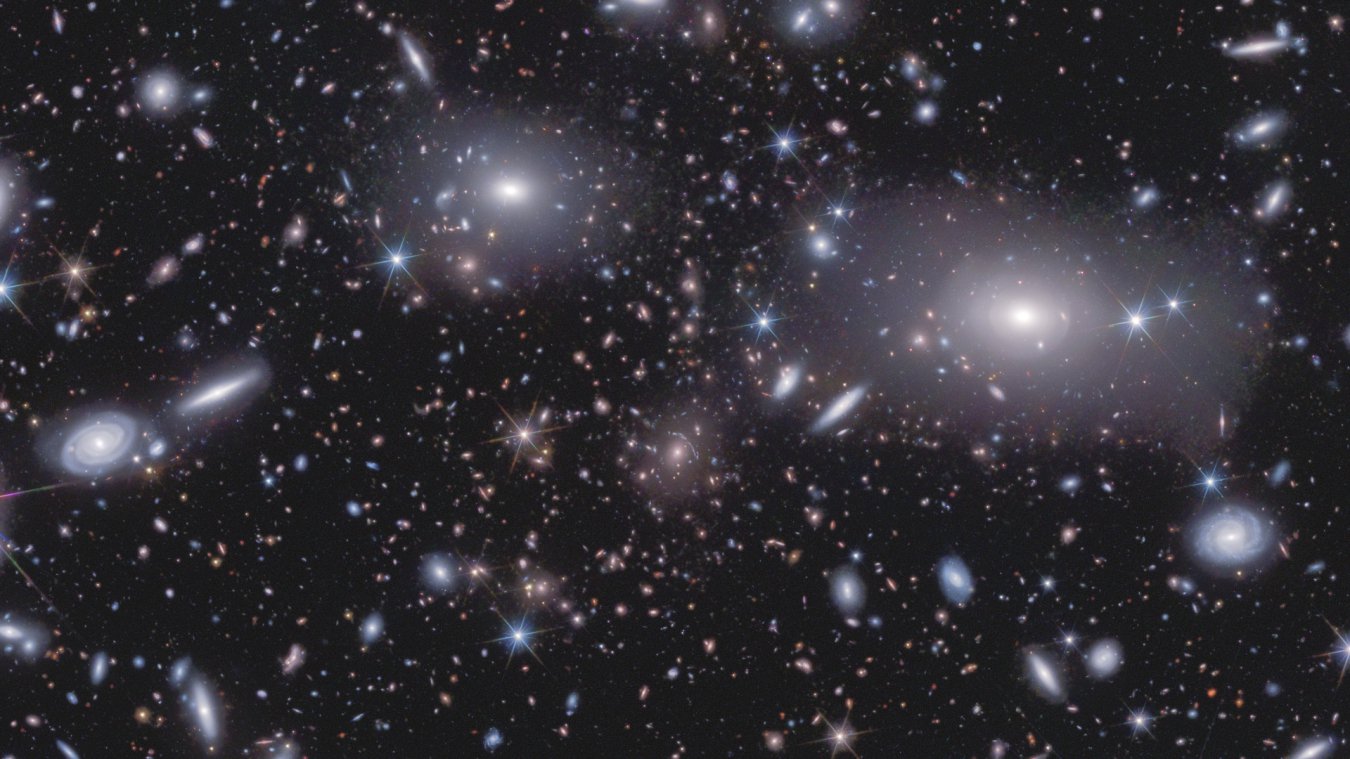
The European Space Agency released observations from the Euclid space telescope, a mission launched in 2023 to map one-third of the sky over six years. The latest data release, titled DR1-Foundation, contains images of 900 million galaxies covering an area equal to 9500 full moons.
A mosaic of 740 images collected in autumn 2024 and spring 2025 spans 367 square degrees of the northern sky at 500 gigapixels resolution. The images show nearby galaxies including Messier 81, located 12 million light years from Earth, along with the smaller galaxy NGC 3077 and parts of the M81 group. Patches of blue in the images are galactic cirrus in the foreground, part of our own galaxy.
Additional images reveal NGC 1291, a galaxy 33 million light years away where stars are actively forming, visible as blue dots. The data also includes Abell 3128, a cluster of hundreds of galaxies about 800 million light years distant, containing both spiral and elliptical galaxies. A gravitational lens appears at the center of the cluster, where light from a more distant galaxy has been warped by a massive foreground object.