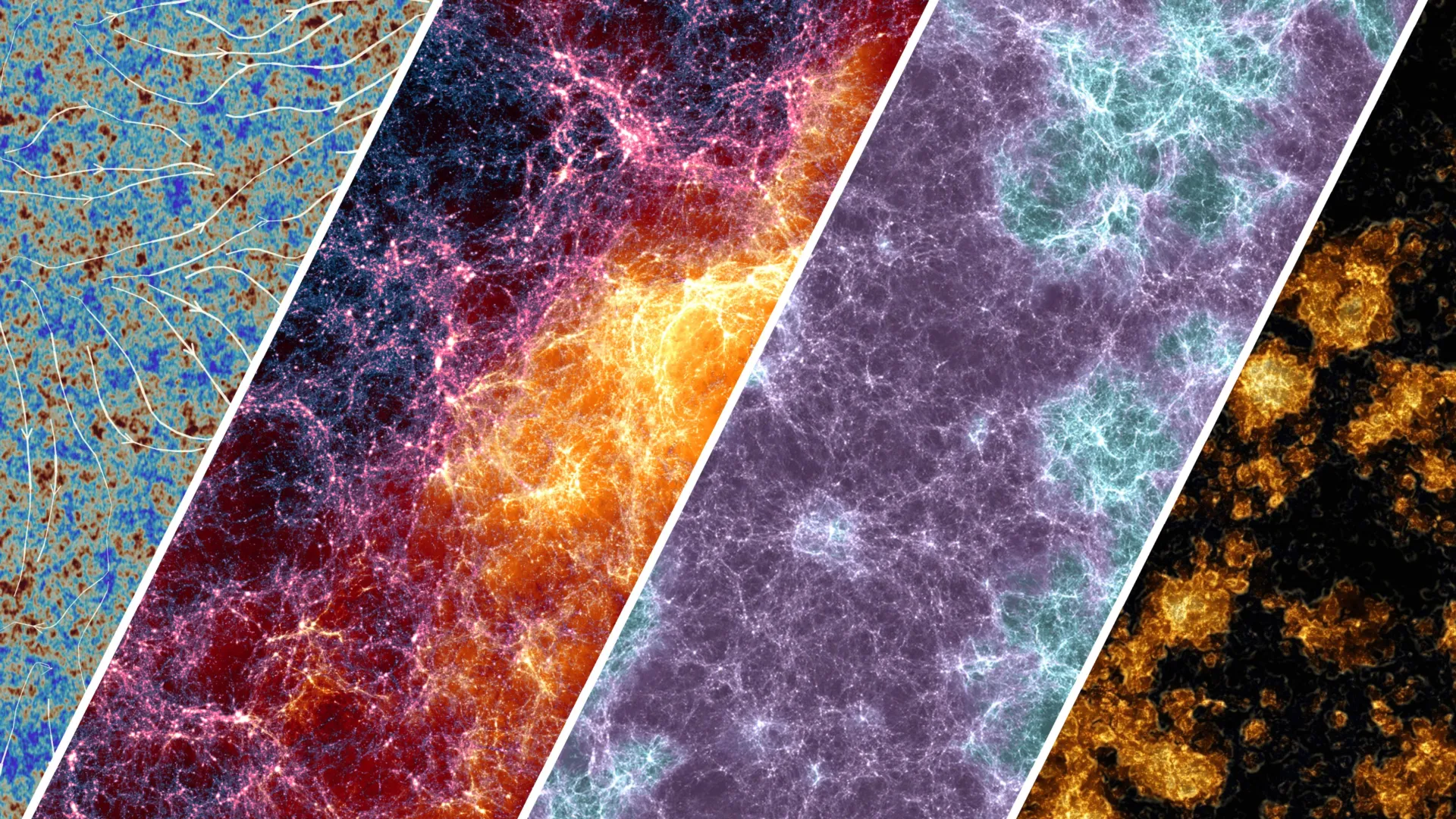
Researchers at MIT, Harvard University, and other institutions have developed a powerful computer simulation called Lumina that recreates the early universe across a region roughly 1.6 billion light-years wide. The simulation, published in the Monthly Notices of the Royal Astronomical Society, follows 2 billion years of cosmic history starting about 45 million years after the Big Bang.
Lumina tracks how the first stars and galaxies formed and how radiation gradually transformed the universe from a dark, neutral state into one transparent to light. The simulation contains approximately half a trillion individual elements, including dark matter particles and gas cells, providing roughly 30 times the resolution of an earlier simulation called IllustrisTNG while covering 100 times larger in volume than previous leading simulations.
One major achievement is recreating two key transformations in the early universe. Hydrogen re-ionization occurred as the first stars and galaxies produced ultraviolet radiation that stripped electrons from neutral hydrogen atoms, making the universe more transparent to ultraviolet light. Helium re-ionization required more intense radiation. The results show that early stars and galaxies drove hydrogen re-ionization, while actively feeding supermassive black holes supplied the radiation needed to ionize helium.
"Lumina does everything from small-scale star and galaxy formation to large-scale reionization of hydrogen and helium, in a volume that is 100 times larger than previous best simulations," says Mark Vogelsberger, a professor of physics at MIT and study author.
Xuejian Shen, an MIT co-author, noted that at peak scale, the calculation used "the equivalent of more than 100,000 CPU cores and around 15,000 GPUs" on Frontier, one of the world's most powerful supercomputers at Oak Ridge National Laboratory in Tennessee.
The researchers have released videos showing the simulation's processes, including visualizations of how hydrogen re-ionization spreads across the universe and detailed zoom sequences from the entire simulated region into individual galaxies. They are making Lumina available to other scientists for comparison with observations from existing and future telescopes.