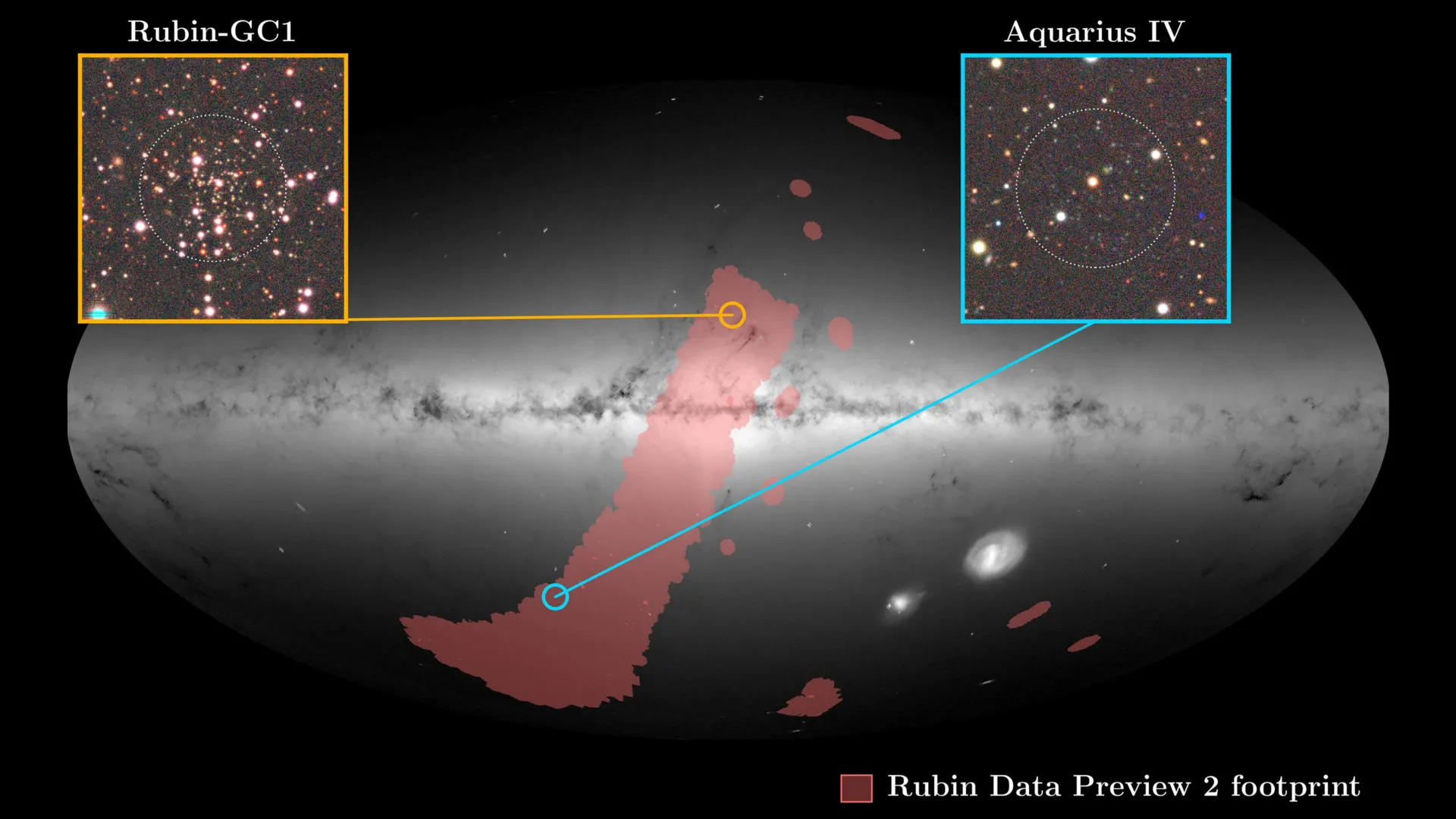
The Vera C. Rubin Observatory in Chile has discovered two previously unknown satellite galaxies orbiting the Milky Way using only preview data collected before its official launch in June 2025.
The first satellite, Aquarius IV, is a dwarf galaxy located approximately 355,000 light-years from Earth in the distant outskirts of the Milky Way. The second, Rubin-GC1, is a star cluster hidden on the opposite side of the galaxy within a region obscured by thick cosmic dust.
William Cerny, an astronomy student at Yale's Graduate School of Arts and Sciences, led the Aquarius IV study published in Research Notes of the AAS. Cerny and colleagues also contributed to the Rubin-GC1 study, accepted by The Astrophysical Journal Letters. Aashay Pai of the University of Chicago served as first author of the Rubin-GC1 paper.
These discoveries used observations covering only about 7% of the night sky. Astronomers have identified approximately 65 satellite galaxies around the Milky Way, but estimates suggest hundreds more remain undiscovered.
"If the observatory can find systems this faint and difficult with only its preview data, its full 10-year survey will undoubtedly provide us with many more Milky Way satellite discoveries," Cerny said.
The Vera C. Rubin Observatory, located on Cerro Pachón in the Chilean Andes and jointly funded by the National Science Foundation and the U.S. Department of Energy's Office of Science, features an 8.4-meter telescope and a 3.2-gigapixel digital camera. It began its 10-year Legacy Survey of Space and Time in June 2025.
Marla Geha, a professor of astronomy and physics at Yale, noted that finding faint satellites could help scientists study dark matter and reconstruct the Milky Way's formation history. The research involved collaboration from institutions including the University of Chicago, University of Virginia, University of Washington, Dartmouth College, NSF NOIRLab, Duke University, and others.