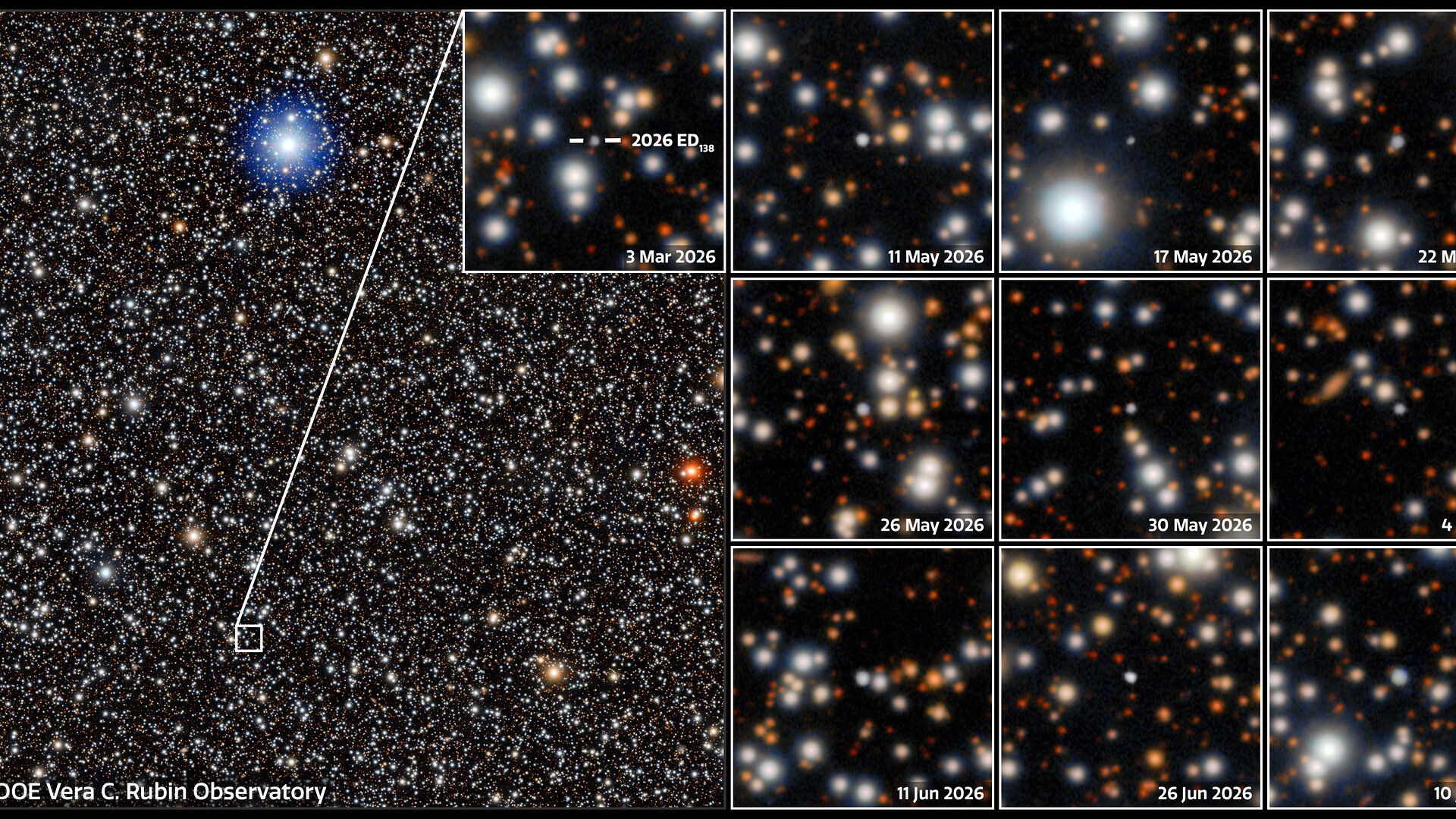
The Vera C. Rubin Observatory has detected a potential new dwarf planet in the outer solar system, designated 2026 ED138, orbiting about 46 times Earth's distance from the sun. If confirmed, it would become the sixth officially recognized dwarf planet, joining Pluto, Ceres, Eris, Haumea, and Makemake.
The object ranks among the largest and brightest bodies discovered beyond Neptune. Estimates place its diameter between 370 to 930 miles, larger than Ceres (595 miles) but smaller than Pluto (1,477 miles). Matthew Holman, an astrophysicist at the Smithsonian Astrophysical Observatory, developed code that helped identify the object while processing data from Rubin's mission, which began in July. "My first reaction was one of excited disbelief," Holman said. "Objects like this are very rare, so I immediately started checking whether I or the code had done something wrong."
The object remained hidden because its orbit tilts 25 degrees from the solar system plane, positioning it behind the bright stars of the inner Milky Way where many telescopes cannot see. Rubin's southern sky surveys, conducted every few nights with the largest digital camera ever built, proved capable of detecting the moving object among millions of stars. Holman worked with colleague Kevin Napier to develop algorithms comparing billions of observations to identify detections of the same moving object. The team confirmed the discovery by examining past Rubin data and archival images from the Dark Energy Camera at Cerro Tololo Inter-American Observatory in Chile, mapping ED138's orbit over 10 years.
The Kuiper Belt, which extends from roughly 30 to 50 times Earth's distance from the sun beyond Neptune, contains thousands of known small icy bodies. Dwarf planets are large enough to be rounded by their own gravity but too small to clear their orbits like planets do. Future observations will determine ED138's diameter and density more precisely to confirm whether it meets dwarf planet criteria.