# A Suitcase-Sized Lunar Observatory Aims to Detect the Universe's Earliest Whispers
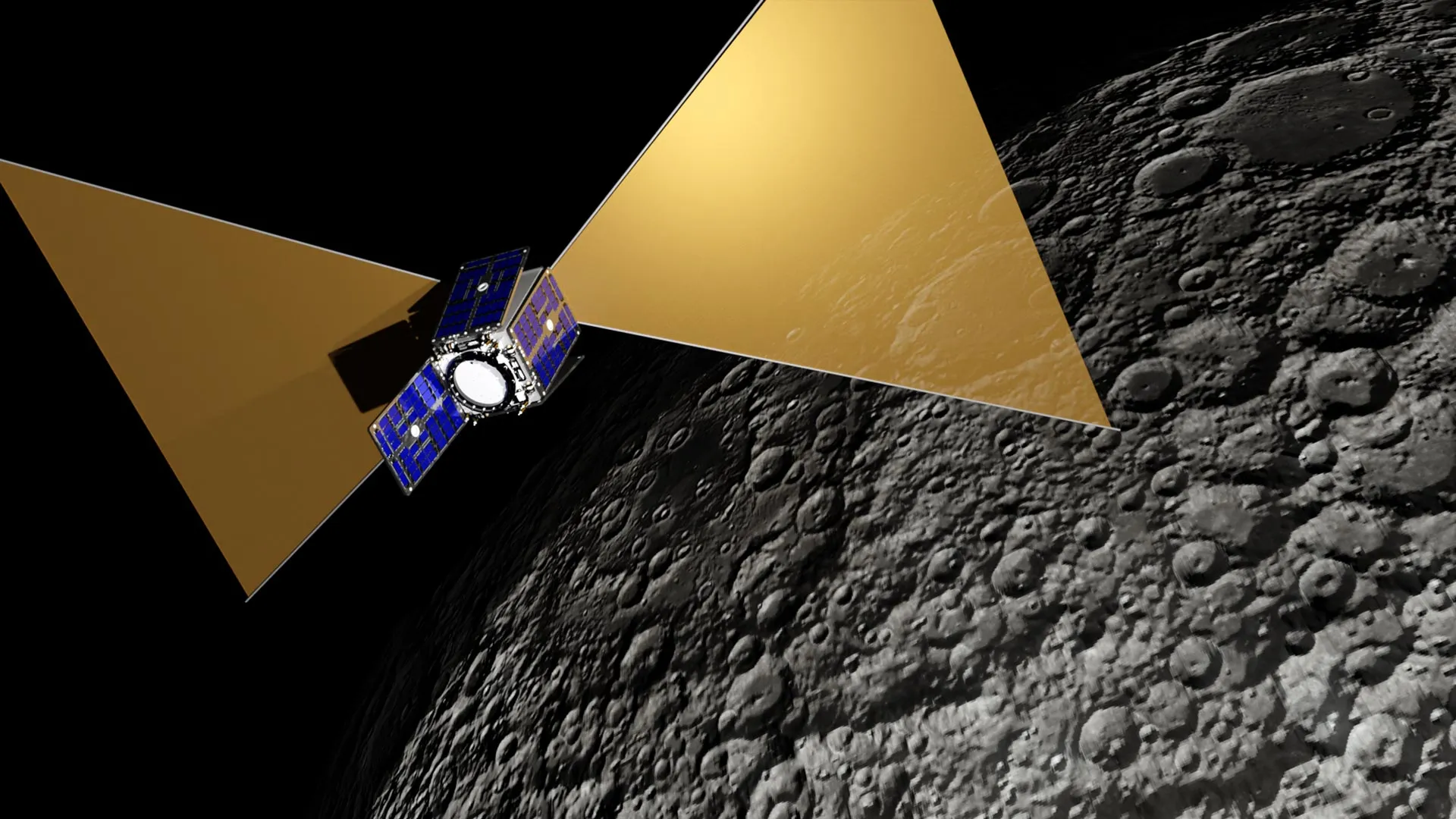
CosmoCube, a compact spacecraft no larger than a suitcase, represents an audacious attempt to eavesdrop on the universe during its infancy. The satellite will position itself on the far side of the Moon to detect radio signals from the cosmic dark ages, the period before the first stars ignited billions of years ago.
The mission addresses one of astronomy's fundamental questions: how did the universe transition from a featureless expanse of hydrogen gas to a cosmos filled with galaxies? This era, roughly 50 to 100 million years after the Big Bang, remains almost entirely unobserved by current telescopes.
CosmoCube's design exploits the Moon's geography. Earth continuously broadcasts radio waves from satellites, power lines, and communications networks. These signals create a cacophony that drowns out faint cosmic emissions. By operating from the lunar far side, CosmoCube places the entire Moon between itself and Earth, creating a radio shadow. The Moon acts as a natural shield, blocking Earth's electromagnetic chatter and allowing the spacecraft to detect the universe's quietest voices.
The target signal carries specific scientific weight. Researchers seek radiation emitted by neutral hydrogen during the cosmic dark ages. This hydrogen absorbed light from the first stars and galaxies as they formed, leaving an imprint on the radiation pattern. By detecting this fingerprint, astronomers can determine when the first stars appeared, how rapidly they populated the universe, and how gravitational collapse shaped galaxy formation.
Dark matter plays a crucial role in this narrative. Invisible matter comprising roughly 85 percent of the universe's mass, dark matter's gravitational influence guided the assembly of the first galaxies. The signals CosmoCube detects will encode information about dark matter's distribution during the universe's earliest epochs.
The suitcase dimensions matter. Traditional radio telescopes require massive equipment and extensive infrastructure. CosmoCube's compact form allows deployment aboard lunar landers or orbital vehicles already planned for lunar missions. This piggyback approach reduces costs and accelerates the timeline for observations.
Several research teams have pursued far-side lunar radio astronomy concepts, but CosmoCube represents a streamlined approach optimized for rapid development. The spacecraft will operate in frequency ranges where Earth's radio background proves particularly problematic from ground-based sites.
Technical challenges remain substantial. Lunar operations demand extreme reliability. The far side experiences two-week darkness cycles. CosmoCube must survive extreme temperature swings and generate power during long lunar nights. Thermal regulation and power systems occupy much of the suitcase volume, leaving limited space for scientific instruments.
Data transmission poses another hurdle. CosmoCube cannot directly contact Earth from the far side. The mission requires relay satellites already in lunar orbit or ground stations stationed on the lunar nearside to receive and forward observations. China's Queqiao relay satellite currently provides this infrastructure for far-side missions.
If successful, CosmoCube opens a new observational window into cosmic history. Current space telescopes like the James Webb Space Telescope peer backward in time, observing ancient galaxies. But those galaxies had already formed. CosmoCube targets the dark ages before galaxies existed, revealing the universe during a phase that remains almost entirely mysterious. This data would fundamentally reshape understanding of how the cosmos assembled itself from near-perfect uniformity into the structured universe observed today.