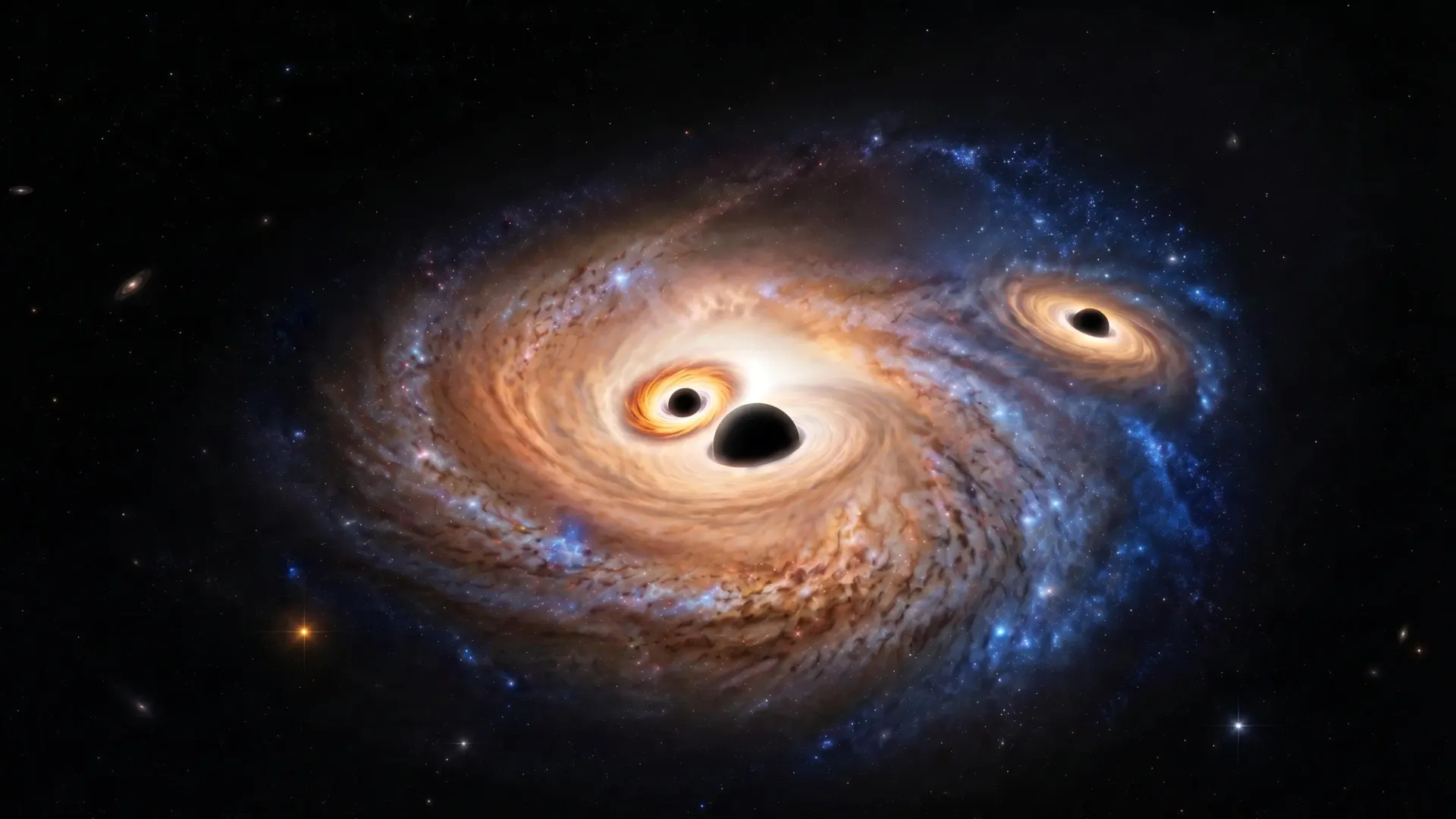
Astronomers have detected three actively feeding supermassive black holes within a single galaxy located 12.5 billion light-years away, offering a rare glimpse into the early universe when galaxy mergers were common. The discovery challenges current models of black hole growth and suggests that massive black hole assemblies formed faster than existing theory allows.
The galaxy, observed as it existed roughly 1.3 billion years after the Big Bang, contains black holes of staggering scale. One weighs approximately 80 million solar masses. A second black hole is accreting matter at rates that exceed predictions from standard formation models, growing faster than conventional physics suggests possible. The third black hole sits farther from the pair, which itself orbits at a separation of just 620 light-years.
Researchers identified the system using data from space-based observatories detecting X-ray and ultraviolet radiation emitted as matter spirals into each black hole. The close proximity of two black holes means they will eventually collide and merge over cosmic timescales, producing gravitational waves when they finally coalesce. This merger process likely triggered the unusual growth rates observed in the second black hole.
The research team did not name a lead institution or specific researchers in available reporting, though the discovery was likely made through collaborative efforts among multiple observatories. The system represents one of the most compact collections of actively accreting supermassive black holes known at such extreme distances.
The finding carries implications for understanding how supermassive black holes reached billions of solar masses in the early universe, a longstanding puzzle in astrophysics. Standard formation pathways suggest these objects should grow through gradual accretion over billions of years, yet observations consistently reveal them at unexpectedly large sizes when the universe was young. Multiple black hole systems undergoing mergers provide pathways for faster growth through gravitational interactions and enhanced feeding rates during galaxy collisions.
Galaxy mergers were dramatically more common in the early universe than today. When galaxies collide, their central black holes are drawn together through dynamical friction with surrounding gas and stars. This process drives black holes into tight orbits and fuels frenzied accretion as gravitational interactions dislodge material into their event horizons. The newly discovered triple system captures this violent epoch in action.
Detection of such systems remains challenging. Black holes separated by hundreds or thousands of light-years require angular resolution beyond most telescopes' capabilities. Distinguishing individual black holes from a single active galactic nucleus requires careful spectral analysis to identify distinct emission signatures. The extreme distance adds observational difficulty, as radiation becomes faint after traveling across cosmic expansion.
Future observations with advanced telescopes, including the James Webb Space Telescope and next-generation ground-based facilities, should reveal whether multiple black hole systems were more prevalent than current surveys suggest. Understanding the prevalence of these systems refines models of black hole formation and constrains theories of galaxy assembly during the universe's first billion years. The discovery confirms that the early universe operated under fundamentally different rules than the relatively quiet cosmos we observe today.