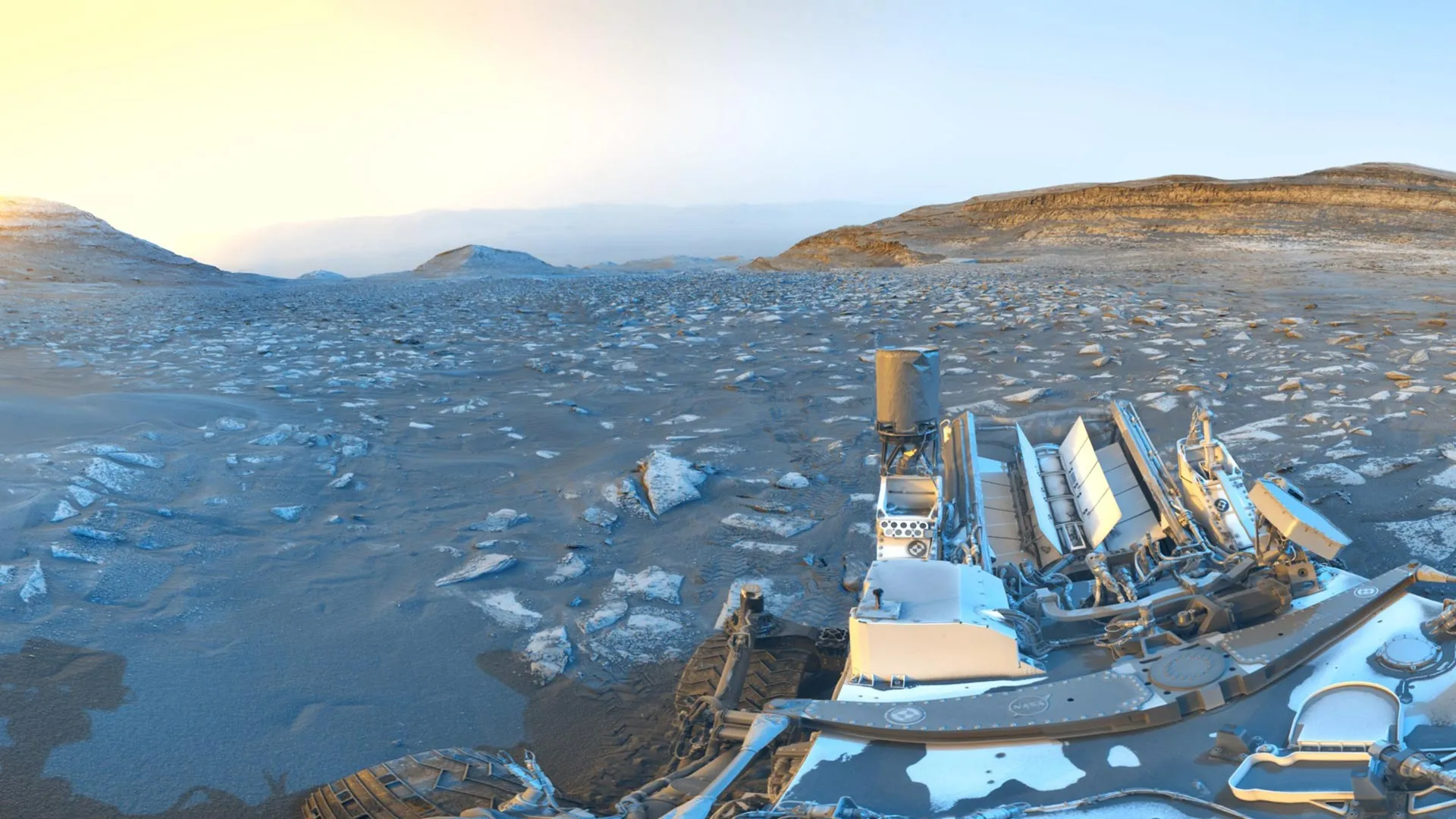
NASA's Curiosity rover has completed 5,000 Martian sols, or days, on the surface of Mars, a milestone the rover celebrated by capturing striking panoramic images of its surroundings near Mount Sharp in Gale Crater.
The rover, which landed on Mars in August 2012, has far exceeded its original two-year mission timeline. Engineers at NASA's Jet Propulsion Laboratory designed Curiosity to operate for 687 Earth days, but the six-wheeled vehicle continues functioning after more than a decade of exploration. The 5,000-sol mark equals approximately 5,135 Earth days, underscoring the rover's remarkable durability on the harsh Martian surface.
The panoramic image captured on sol 5,000 blends morning and afternoon photographs into a single panorama, creating what NASA described as a "postcard" view of the landscape. The composite shows Curiosity itself in the frame, along with its wheel tracks carved into the rusty Martian regolith, stretching behind the rover as evidence of its long journey across Gale Crater's floor. Mount Sharp, formally known as Aeolis Mons, dominates the panorama in the distance. This 3.4-mile-high mountain sits at the center of Gale Crater and represents the primary scientific target for Curiosity's extended mission.
The rover's longevity reflects successful engineering and careful operational planning by the JPL team. Curiosity relies on a plutonium-238 radioisotope thermoelectric generator for power, which decays gradually over time. Despite the declining power output, mission controllers have managed the rover's energy consumption to keep it functional through instrument prioritization and strategic use of hibernation periods during Martian dust storm season.
Curiosity's scientific instruments have made landmark discoveries throughout its mission. The rover confirmed the presence of organic molecules in Martian rocks, detected seasonal methane fluctuations in the atmosphere, and measured radiation levels critical for understanding human exploration risks. The rover has also characterize Mount Sharp's geology layer by layer, revealing a record of Mars' climate history preserved in sedimentary rock.
The wheels that carried Curiosity across 5,000 sols bear visible damage from sharp rocks and rough terrain. NASA engineers designed wheels for Curiosity's successor, the Perseverance rover, with thicker aluminum to address the wear issues observed on Curiosity. Perseverance landed in Jezero Crater in February 2021 and has also exceeded expectations for operational longevity.
Curiosity continues exploring Mount Sharp's upper slopes, analyzing rock samples and searching for clues about Mars' past habitability. The rover's data directly informs planning for future human missions to Mars, providing baseline measurements of the Martian environment and atmospheric conditions. Mission planners estimate that Curiosity could continue operations for several more years, weather permitting, as the power system continues its slow decline.
This 5,000-sol milestone represents not just an engineering achievement but a testament to Mars rover resilience and the scientific return on a mission that has repeatedly defied expectations about robotic durability in space exploration.