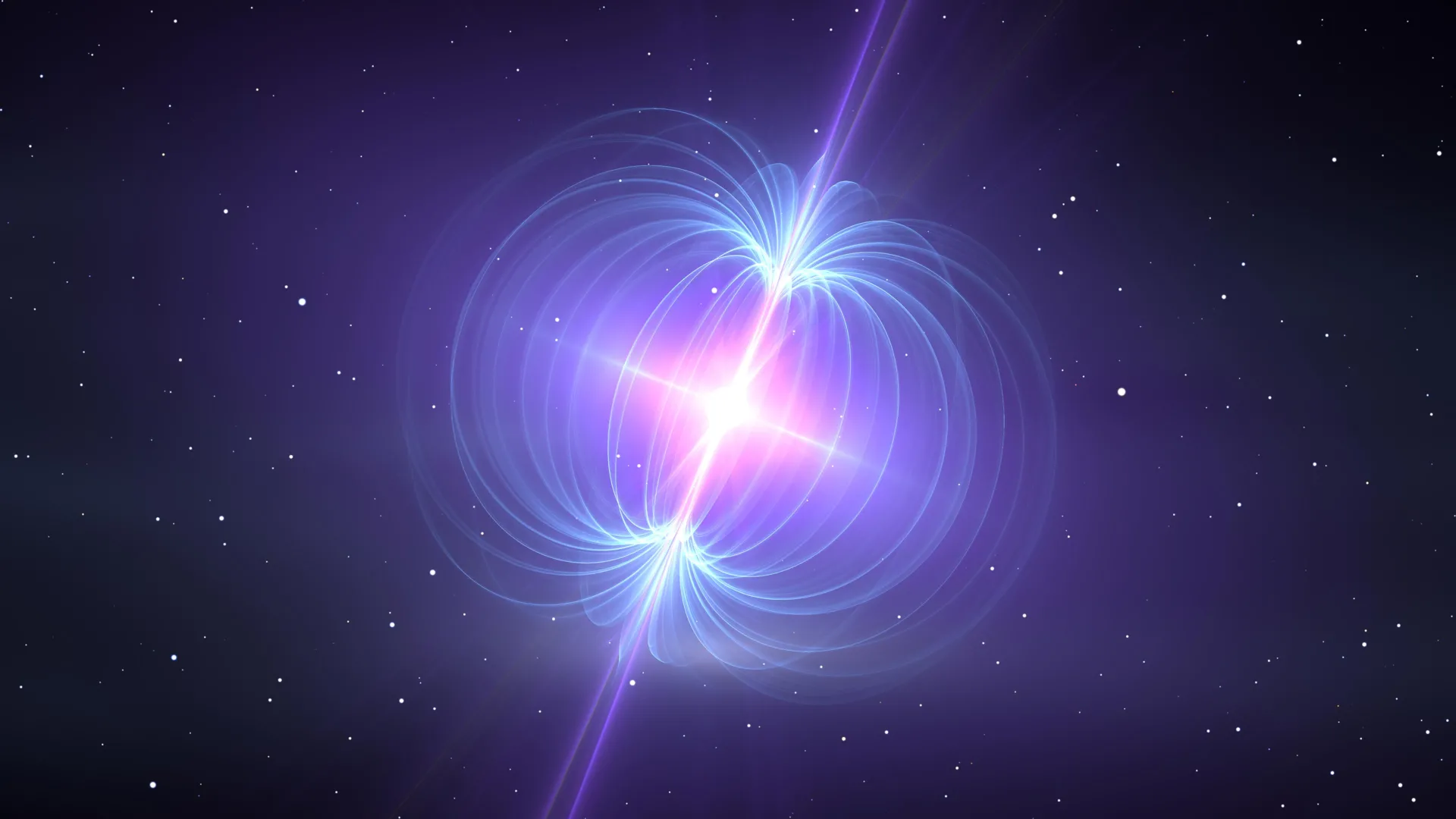
A team of international astronomers has identified strong observational evidence linking long-duration X-ray flashes to neutron star collisions that birth magnetars, the most magnetic objects known in the universe. The breakthrough centers on an unprecedented X-ray event that sustained visible emission for nearly 10 minutes, substantially longer than typical flashes in this category.
Magnetars form when two neutron stars merge. These events produce gravitational waves and create matter under conditions so extreme that the resulting object's magnetic field reaches strengths billions of times greater than Earth's. Until now, astronomers lacked a reliable method to identify neutron star mergers through X-ray observations alone, making this discovery potentially transformative for multi-messenger astronomy.
The record-breaking X-ray flash detected by the research team lasted approximately 10 minutes, far exceeding the typical duration of comparable events. Standard X-ray flashes from neutron star mergers usually fade within seconds to minutes. This extended luminosity allowed astronomers to gather detailed spectroscopic data showing chemical signatures consistent with magnetar formation rather than other cosmic phenomena like black hole creation or hypernova explosions.
The extended duration likely reflects the rapid spin and powerful magnetic field of the newly formed magnetar. As material from the merger spirals inward, it generates intense X-ray radiation through friction and shock heating. The magnetar's extreme magnetic field channels and confines this radiation, extending the visible emission period. This mechanism differs fundamentally from short gamma-ray bursts, which produce their energy through different physical processes and dissipate much faster.
The work holds practical implications for future neutron star merger detection. Current gravitational wave observatories like LIGO and Virgo detect merger signals through spacetime distortions alone. Adding X-ray observations allows astronomers to pinpoint merger locations more precisely, determine the composition of the resulting object, and measure properties of matter at nuclear density. These simultaneous detections enable tests of fundamental physics under conditions unreplicable in laboratories.
The researchers used data from space-based X-ray telescopes including Swift and Chandra observations, combined with follow-up spectroscopy from ground-based facilities. This multi-wavelength approach proved essential. X-ray data alone provided the initial detection; follow-up infrared and radio observations from other instruments confirmed the merger origin and ruled out alternative explanations.
The study establishes a new observational signature for identifying magnetar birth events. Future gravitational wave alerts can trigger immediate X-ray telescope observations. When long-duration X-ray flashes appear within the gravitational wave localization regions, astronomers gain confidence they have identified a genuine neutron star merger producing a magnetar rather than misidentifying unrelated phenomena.
Limitations remain. The extreme rarity of observable neutron star mergers means statistical confirmation will require years of data accumulation. Magnetars themselves remain incompletely understood, with theoretical models still debating the precise mechanisms powering their radiation. Climate and observing conditions also affect detection rates for ground-based confirmatory observations.
The discovery opens new avenues for studying the universe's most extreme environments. Each merger event provides a natural laboratory for nuclear physics, relativistic effects, and magnetic field behavior at scales impossible to achieve artificially. As detector sensitivity improves and observatories coordinate more effectively, the rate of identified merger events should accelerate substantially.