# Dead Star's Impossible Shock Wave Challenges Stellar Physics
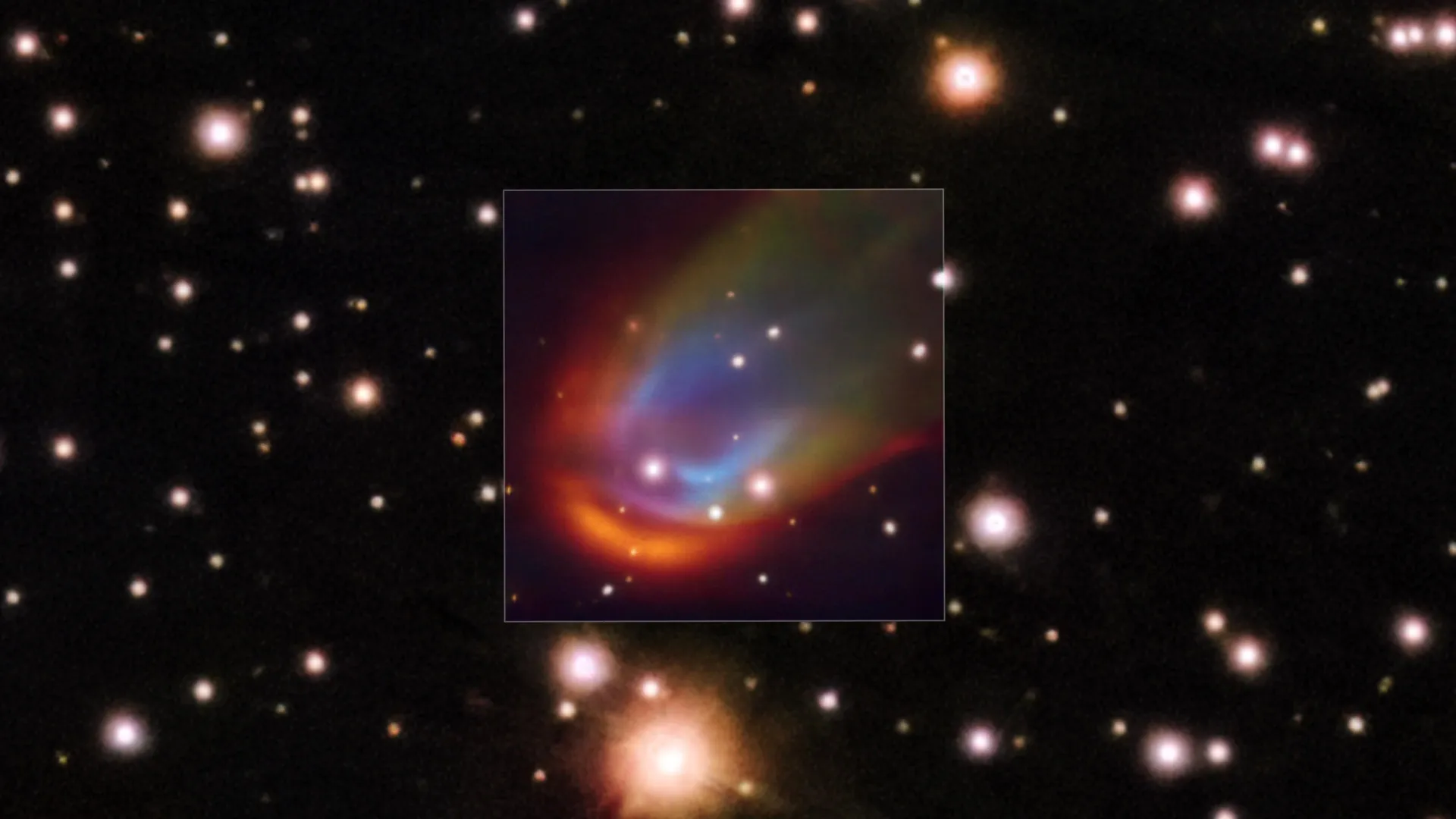
Astronomers have discovered a white dwarf producing a shock wave that violates current theoretical expectations. The stellar remnant lacks an accretion disk, the standard mechanism that powers high-energy phenomena around dead stars, yet continues generating a powerful wave structure that has persisted for at least 1,000 years.
The observation contradicts established models of how white dwarfs function. These dense stellar cores, typically Earth-sized objects with masses equal to our Sun, normally remain quiet after their host stars die. When they do produce energetic outbursts, accretion disks of infalling material provide the necessary fuel. This white dwarf breaks that pattern entirely.
Researchers identified the shock wave through X-ray and optical observations, but the mechanism driving it remains unclear. The star's strong magnetic field accounts for part of the energy output, channeling charged particles and generating radiation. However, the field's strength alone cannot fully explain the sustained shock production observed over centuries or millennia.
"We found something never seen before," researchers stated, emphasizing the novelty of this discovery. The persistence of the shock wave despite the absence of an accretion disk suggests an unknown energy source operating within or around the white dwarf. Astronomers have termed this an unexplained "mystery engine," acknowledging that conventional physics cannot yet account for the phenomenon.
White dwarfs provide laboratories for extreme physics. At densities exceeding one million times Earth's, they probe fundamental principles of matter under conditions impossible to replicate on Earth. Most dead stars fade gradually into darkness, gradually cooling over billions of years. Active systems with accretion disks offer chances to study magnetic reconnection, particle acceleration, and relativistic processes. This object combines inactivity with activity, creating a puzzle.
Several hypotheses might explain the anomaly. Retained rotational energy from the star's death could power the magnetic field's acceleration mechanisms. Internal thermonuclear reactions on the white dwarf's surface might supplement external processes. Alternatively, the white dwarf could interact with a companion star or material in unexpected ways, producing effects that current models fail to predict.
The shock wave itself represents extreme physics. Shock waves compress gas to temperatures millions of degrees, accelerating particles to relativistic speeds. In this case, the wave structure persists with no obvious fuel source, suggesting either a process continuously renewing the disturbance or a system in slow decay that will eventually fade over tens of thousands of years.
Future observations will test competing explanations. Advanced X-ray telescopes can map the shock's structure and energy output with finer detail. Optical and ultraviolet observations will reveal the white dwarf's surface activity and interactions with surrounding gas. Radio observations might detect particle acceleration signatures. Spectroscopy will identify the chemical composition and temperature distribution around the star.
This discovery highlights gaps in stellar physics understanding. White dwarfs represent the fate of most stars, including our Sun billions of years hence. Comprehending all possible behaviors of these remnants improves forecasts of stellar evolution. The mystery engine, whatever its nature, forces revision of models treating white dwarfs as passive, cooling objects. Solving this puzzle could reveal new physics operating in the most extreme stellar environments.