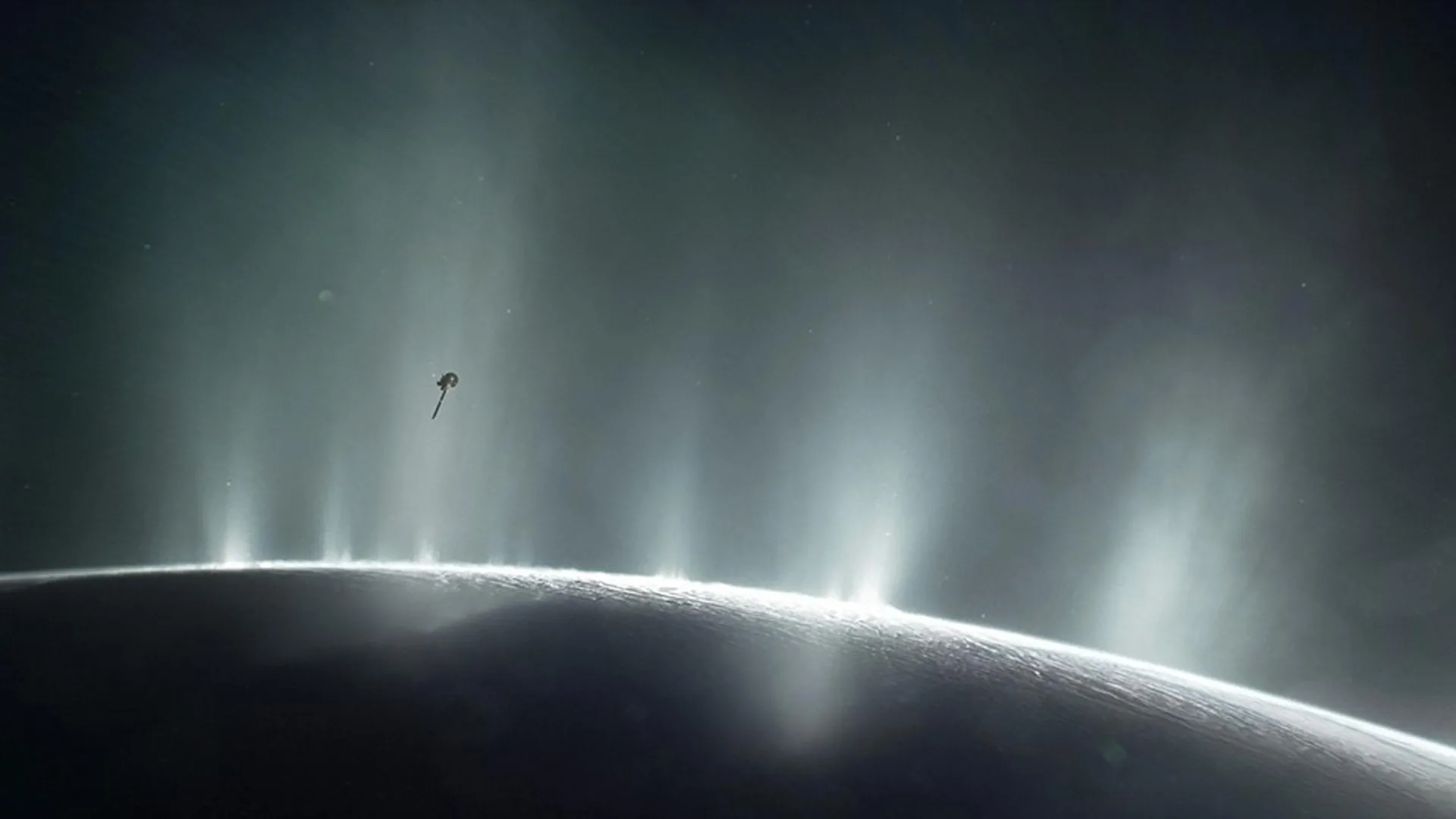
NASA's Cassini spacecraft detected something puzzling when it flew through plumes of ice and water vapor erupting from Saturn's moon Enceladus. The chemical composition of ice grains in those plumes differed strangely from what scientists expected based on the moon's subsurface ocean. New research now explains why.
A team of researchers has proposed that Enceladus naturally separates and concentrates chemicals as water droplets freeze during their journey through space. The freezing process occurs gradually as droplets rise through the moon's icy crust and into the vacuum above its surface. As water crystallizes, dissolved salts and organic compounds become increasingly concentrated in the remaining liquid, much like salt concentrating in brine as ice forms in Earth's polar regions.
The mechanism works like this: droplets ejected from hydrothermal vents deep in Enceladus's subsurface ocean travel upward through cracks and pores in the ice shell. As they rise toward lower pressure and colder temperatures, water begins freezing around the edges of each droplet. This partial freezing leaves the still-liquid core enriched with whatever chemicals were dissolved in the original water. Eventually, the remaining liquid freezes explosively when it reaches the vacuum, shattering into fine ice grains with a composition dramatically different from what bulk ocean water would contain.
This "freeze concentration" process explains Cassini's observations from 2015. The spacecraft detected unexpected abundances of certain organic compounds and salts in Enceladus's ice plumes compared to measurements of the ocean itself. Previous explanations struggled to account for how these compounds became so enriched at the surface.
The finding holds enormous implications for future exploration. If this concentration process works naturally, it means spacecraft exploring Enceladus need only analyze ice grains to gain a disproportionately clear chemical fingerprint of the moon's ocean. Future missions like the proposed Enceladus Life Finder mission would not need to somehow drill through miles of ice to reach the hidden ocean directly. Flying a spacecraft through the plumes and collecting ice samples could reveal organic compounds and biosignatures far more efficiently than in-situ ocean sampling.
Enceladus ranks among the most promising locations in our solar system to search for microbial life. Its subsurface ocean contains liquid water, chemical energy from hydrothermal activity, and all the basic building blocks organic chemistry requires. Cassini's earlier detection of hydrogen gas in the plumes suggested active chemical reactions in the ocean floor capable of supporting simple life.
The freeze-concentration mechanism also raises questions about whether similar processes occur on other icy moons. Europa around Jupiter and Triton around Neptune both harbor suspected subsurface oceans and emit vapor plumes. Understanding how chemistry changes during freezing and ejection could shape how scientists design instruments for future missions to these distant worlds.
The research builds on existing knowledge about phase transitions and solution chemistry while offering testable predictions. Future spacecraft can verify whether the concentration pattern matches what this model predicts, refining our understanding of how Enceladus and similar ocean worlds transport their chemical signatures into space.