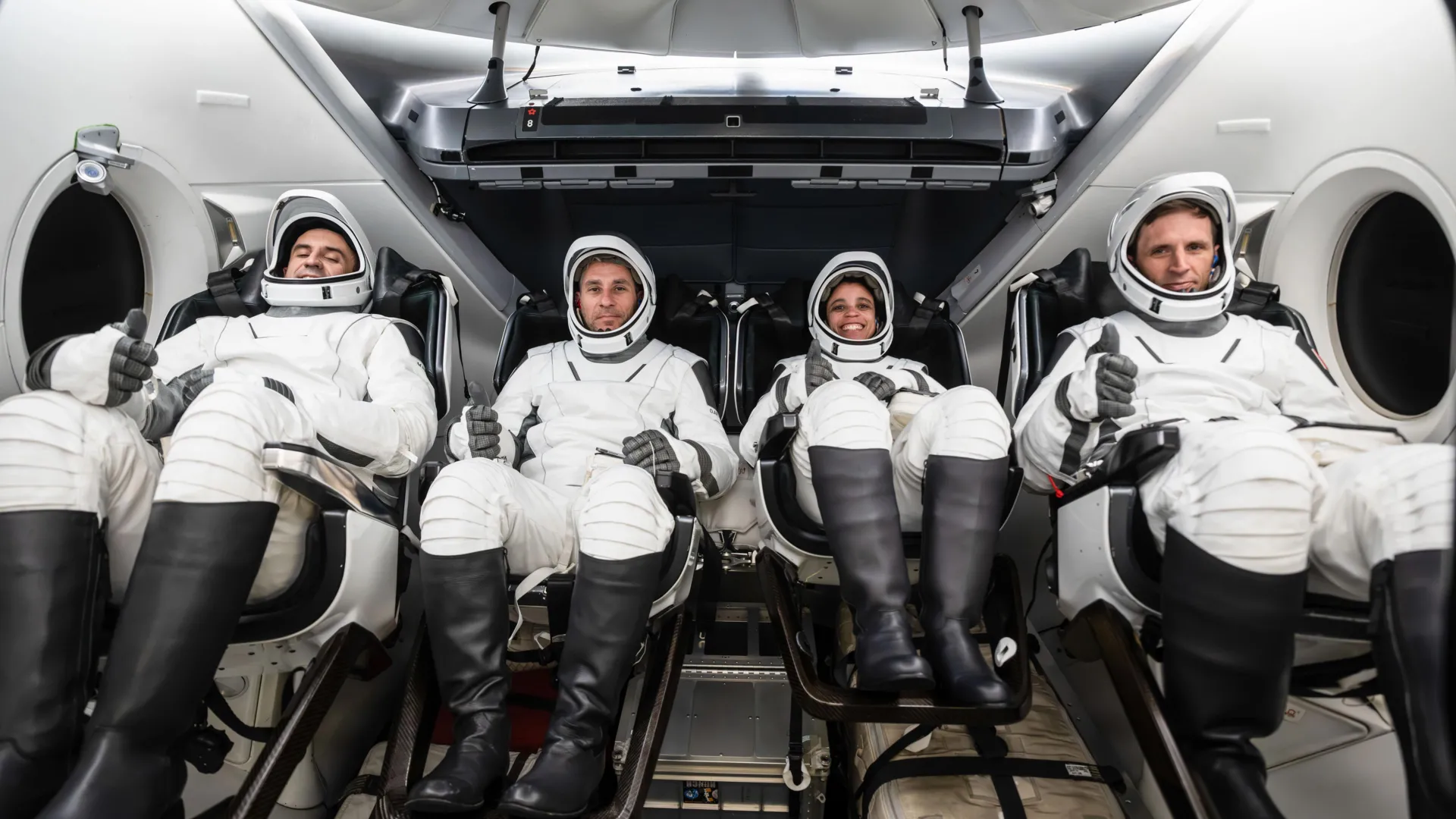
NASA and SpaceX are preparing to launch four astronauts toward the International Space Station on October 1 aboard a SpaceX Dragon capsule, targeting a docking time of less than nine hours after liftoff from Florida. This Crew-13 mission represents the latest crewed flight under NASA's Commercial Crew Program, a partnership that has shifted human spaceflight operations to private industry.
The four crew members will join Expedition 75 at the orbiting laboratory once the spacecraft docks. The accelerated timeline reflects improvements in launch procedures and spacecraft operations refined through previous commercial crew missions. Earlier Dragon flights to the ISS typically required roughly 19 to 24 hours to reach the station, so the proposed nine-hour trajectory demonstrates significant operational efficiency gains.
The faster approach trajectory depends on several factors. SpaceX has optimized the Dragon capsule's rendezvous procedures and approach angles to the ISS. NASA and SpaceX teams have also coordinated orbital mechanics more precisely, calculating optimal launch windows that minimize transit time without compromising crew safety or spacecraft systems performance. This shorter journey reduces time crew members spend in the relatively confined Dragon capsule during ascent and coast phases.
Before the October 1 target date, NASA and SpaceX will complete a final battery of launch-readiness reviews. These comprehensive checks examine vehicle systems, weather forecasting, emergency procedures, medical clearances for the crew, and contingency plans. The readiness reviews typically occur within days or weeks before launch and serve as final verification that all systems meet human spaceflight safety standards.
Crew-13 continues NASA's rotation of astronauts to the ISS under the Commercial Crew Program, which began operational missions in 2020 with Demo-2, a test flight carrying astronauts Robert Behnken and Douglas Hurley. Since then, NASA has certified the SpaceX Dragon and Boeing's Starliner (recently completed its first crewed flight in September 2024) to transport crews to and from the orbiting station. The program represents a fundamental shift in how NASA conducts human spaceflight, moving from sole reliance on government-operated Space Shuttle missions to partnerships with private companies operating commercial vehicles.
The faster rendezvous approach also has practical benefits for station operations. Crew rotations occur more smoothly when new arrivals dock quickly, reducing overlap periods with departing crews and streamlining handover procedures. The ISS typically hosts three crew members permanently, with rotations occurring every six months as resupply missions and crew exchanges maintain continuous human presence.
SpaceX's Dragon crew vehicle has proven reliable through multiple missions. The capsule launches atop a Falcon 9 rocket and uses autonomous systems for the rendezvous and docking phases. Dragon includes life support systems, communications equipment, and abort capabilities designed to protect crew during all mission phases. The spacecraft returns to Earth via ocean splashdown in the Gulf of Mexico, where recovery teams retrieve the capsule and crew.
Successful completion of Crew-13 with this accelerated timeline would validate further optimization of crewed Dragon missions and contribute data supporting continued operations under the Commercial Crew Program. NASA maintains contracts with both SpaceX and Boeing to maintain reliable crew transport capabilities and reduce dependence on any single commercial provider.