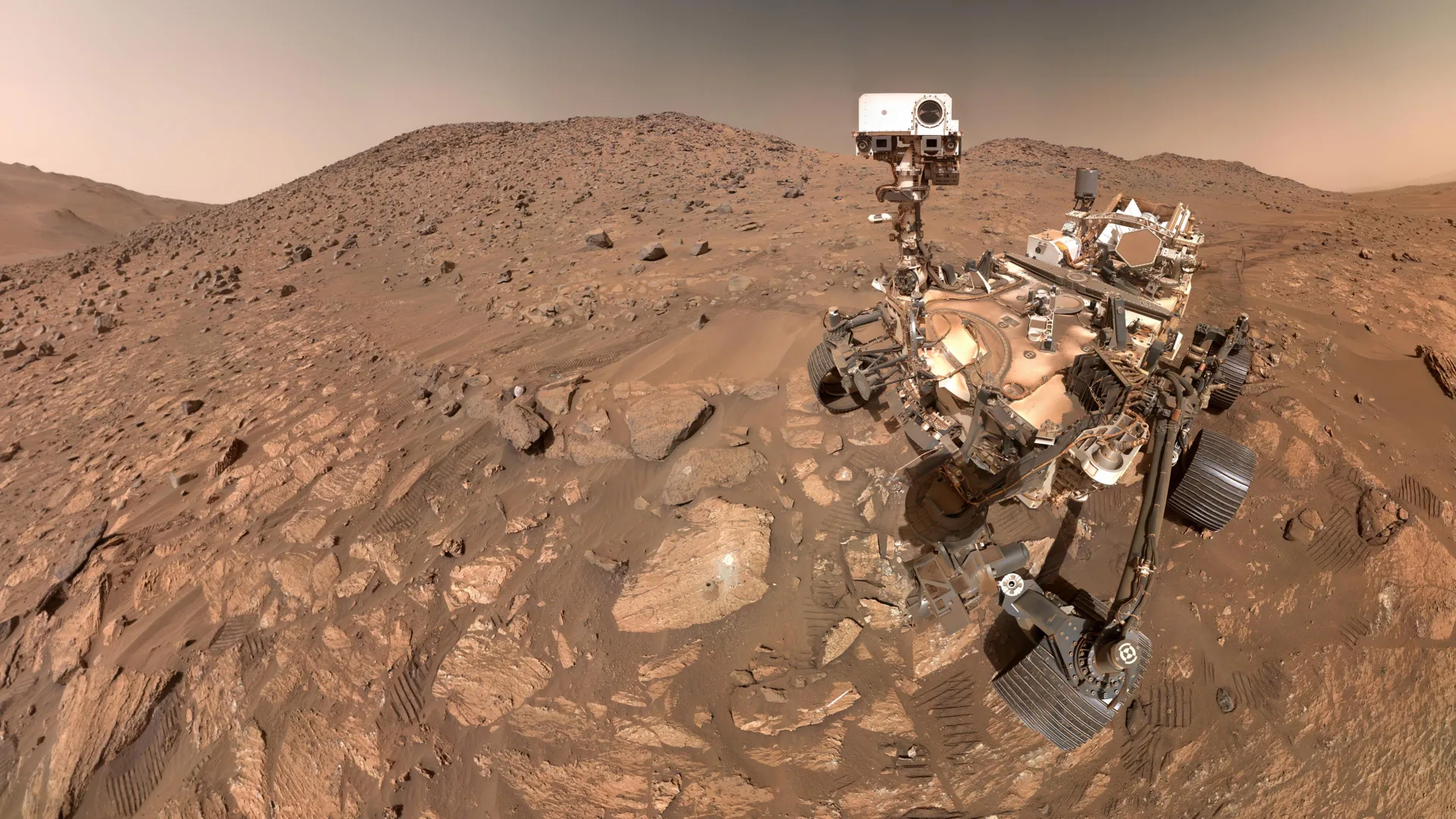
NASA's Perseverance rover has confirmed the presence of organic carbon in two ancient Martian rocks from the Bright Angel formation within Jezero crater, according to research published in Science Advances. The discovery builds on a September 2025 announcement of a potential biosignature in the same rocks.
The study, co-led by Ashley Murphy, a postdoctoral researcher at the Planetary Science Institute, and Kyle Uckert, Deputy Principal Investigator of the SHERLOC instrument, used Raman spectroscopy to identify macromolecular carbon (MMC), a form of carbon made of large, interconnected networks of carbon atoms. This material can form through biological activity or through chemical processes without life, so its presence alone cannot prove Mars was once inhabited.
The organic carbon was found just a few microns below the exposed surface, making it the shallowest detection of macromolecular carbon ever reported on Mars. This location is particularly striking because Mars' surface experiences radiation, sunlight, and chemically reactive substances that typically destroy organic molecules. Murphy noted that the material may have survived "either resistant to degradation and/or has been sufficiently shielded by other minerals, such as clays, or iron-rich Martian soil."
The carbon was detected alongside carbonate and sulfate minerals that formed as water altered the rocks. This distribution suggests organic material entered or formed within the rocks during at least two separate periods of Mars' geological history. The detection at a location more than 2,000 miles from Gale Crater, where Curiosity previously found organic compounds, indicates that organic carbon may have been widely distributed across ancient Martian lakes and rivers. Murphy stated that "billions of years ago, organics may have been more than just locally present and may have been more widely available in ancient lakes and rivers on Mars."
Determining whether the rocks contain fossilized microorganisms remains beyond the capabilities of current rovers. The next step would involve examining Martian samples in Earth laboratories with more sophisticated equipment to determine whether biological or nonliving processes produced the organic carbon.