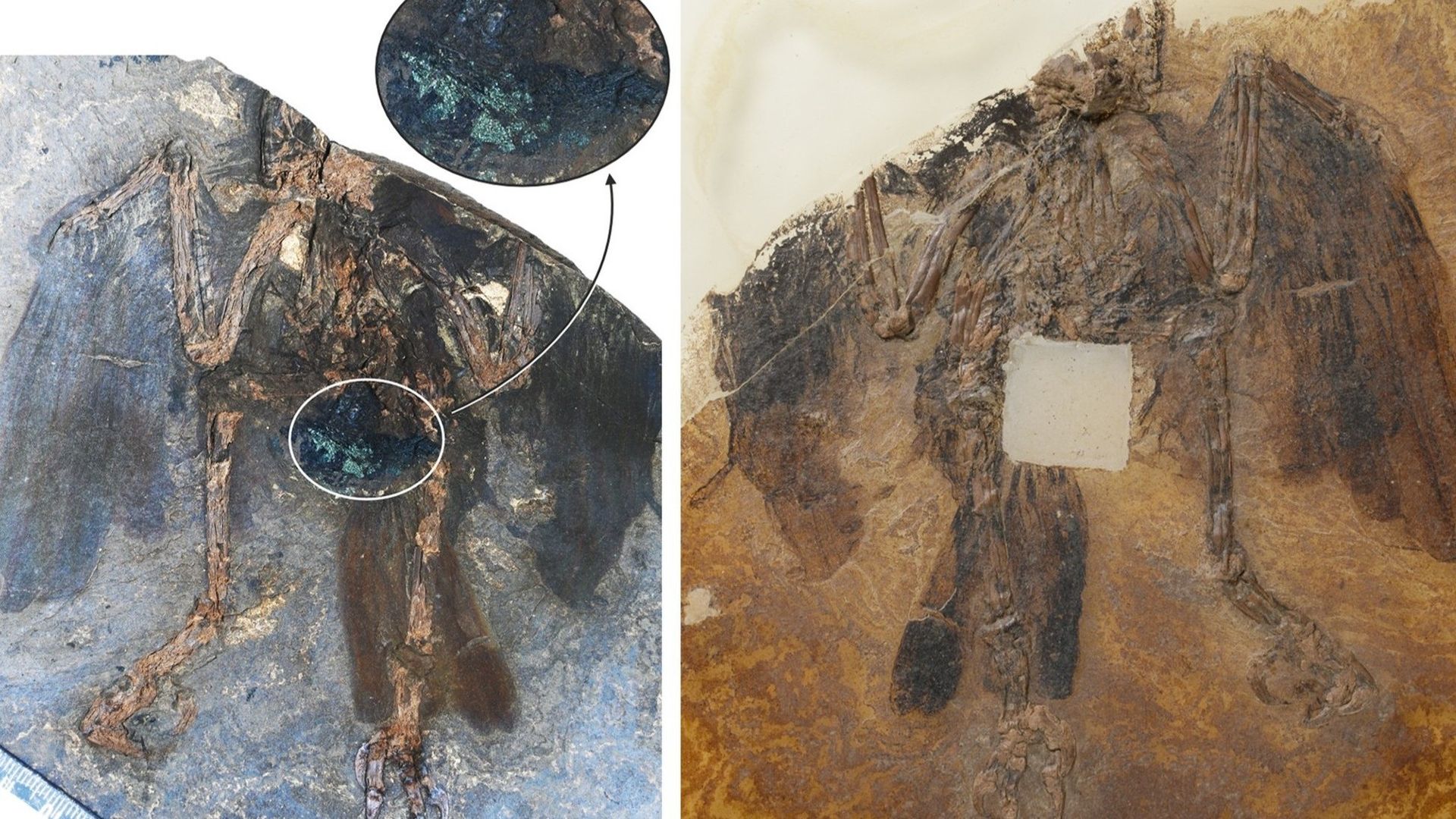
A nearly complete fossil of a young owl from 47 million years ago found in Germany provides new evidence that owls were once active during the day, researchers report.
The specimen, a newly described species named Masillastrix blattophaga, was unearthed in 2025 at the Messel Pit in Germany. Though the skull is missing, the rest of the fossil preserves remarkable detail, including the owl's last meal: a greenish-blue, iridescent cockroach found in its stomach.
Gerald Mayr, a paleontologist and head of ornithology at the Senckenberg Research Institute and the Natural History Museum Frankfurt, led the study published Nov. 2 in Current Biology. The iridescent coloration of the cockroach suggests the owl hunted during daylight, since iridescence is associated with a diurnal lifestyle. The owl measured less than 5 inches long.
Additional evidence points to daytime activity. The bird's feather appearance and the shape of its upper wing bones, or humeri, hint at a diurnal lifestyle. Modern nocturnal owls have slim humeri and fly nearly silently. The Messel owl's stocky humeri suggest it flew when silent movement conferred no advantage because sufficient light allowed detection of predators.
"There exists a consensus that owls must have evolved from a diurnal ancestor," Mayr said in an email. Early owl fossils show head-rotation structures similar to those of diurnal raptors and bony ridges above eye sockets that could have provided sun shading.
The fossil suggests owls became nocturnal sometime between 47 million and 35 million years ago. The earliest known nocturnal owl species date to approximately 35 million years ago during the Late Eocene, Mayr noted. The oldest known owl fossil, Ogygoptynx wetmorei, dates to around 60 million years ago.
The timing deepens questions about why owls shifted to nocturnal activity. Previous theories proposed owls avoided competition with diurnal birds of prey or exploited nocturnal mammals. However, both groups expanded around 20 million to 25 million years ago, well after owls became nocturnal, leaving the evolutionary driver unclear.
"By narrowing down the time frame when owls became nocturnal, our study may eventually contribute to solving this mystery," Mayr said.