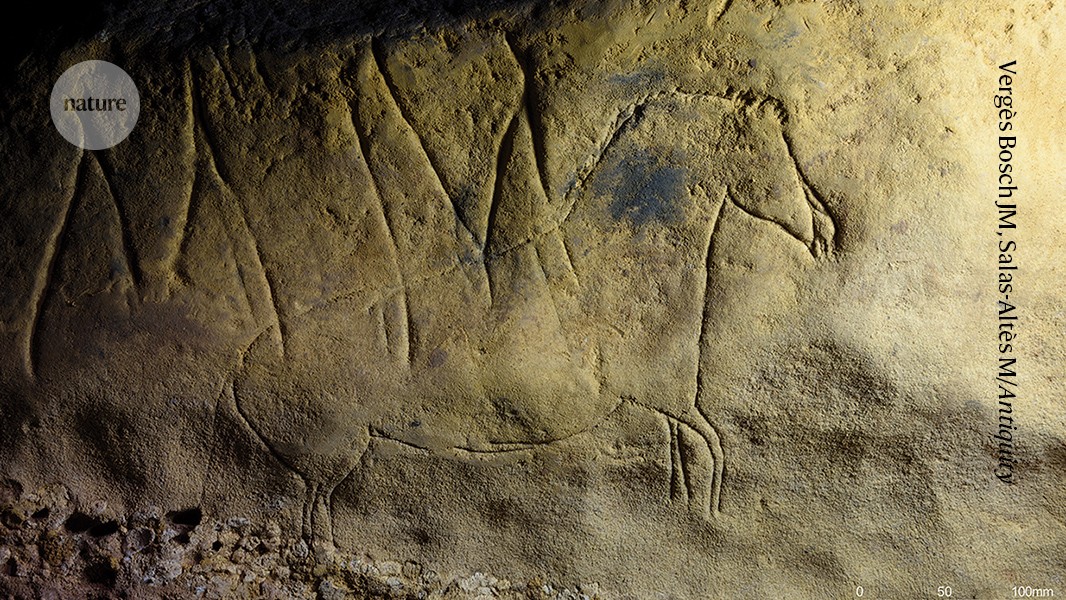
Archaeologists discovered hundreds of rock-art engravings dating back approximately 26,000 years at the Cova de la Font Major cave system in Catalonia, northeastern Spain. The findings were published in Antiquity on November 5.
Josep Maria Vergès Bosch, an archaeologist at the Catalan Institute of Human Paleoecology and Social Evolution (IPHES-CERCA) in Tarragona, spotted the prehistoric engravings during a planned excavation in 2019, mixed among more-modern graffiti.
Vergès and archaeologist Míriam Salas-Altès studied 280 Palaeolithic art motifs, including 55 animal depictions. "The sheer quantity of art discovered at the Cova de la Font Major is exceptional," Salas-Altès said.
The cave system contains more than 3.5 kilometres of underground passageways and has been open to the public for roughly seven decades. It became a museum in the 1990s.
The engravings remained undetected for millennia because they required specific lighting to see. "When you shine a light straight on the engravings, they are really difficult to see, you have to play with light from different directions to see the depressions," Salas-Altès said.
The etchings depict animals including horses, bears, and aurochs, along with swirling lines. Some artists incorporated natural lines or fissures in the cave walls into their designs. One engraving used a natural fissure to represent the ground beneath a horse.
The discovery challenges earlier assessments that Catalonia had almost no Palaeolithic art.