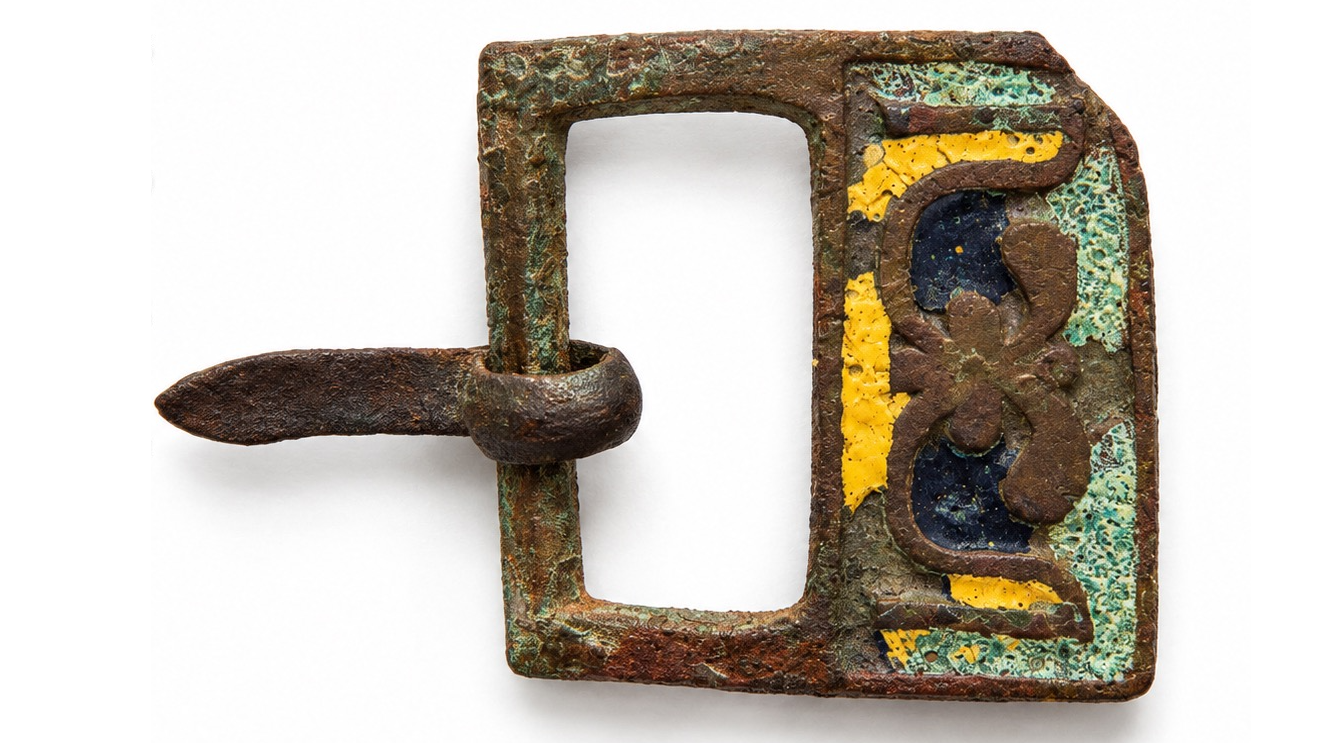
Local residents unearthed a colorful belt buckle in the Tsetsyn Forest in southeastern Ukraine and gave it to Antonii Moisei, a professor at Bukovinian State Medical University. The roughly square metal buckle measures about 0.8 inches on each side and features teal, blue, and yellow enamel decorations. Moisei dated the buckle to the second to third centuries A.D., when this part of Ukraine was in the ancient Roman province of Dacia.
Moisei theorizes the belt may have belonged to a Sarmatian warrior, a member of tribes that lived outside Roman borders in what are now central Ukraine, southern Russia, and the Balkans. Some Sarmatians fought against Rome while others served as mercenaries for the empire.
Moisei collected additional artifacts associated with the belt, including a decorative belt fitting and three small round metal objects. He reconstructed what the complete belt might have looked like. The metal fragments follow a Roman provincial craft tradition and may have been obtained through trade or captured as war trophies, according to Moisei's statement.
The discovery provides new evidence of Roman military contact on the empire's outskirts. Moisei continues studying the artifacts to determine whether they are definitively Sarmatian.