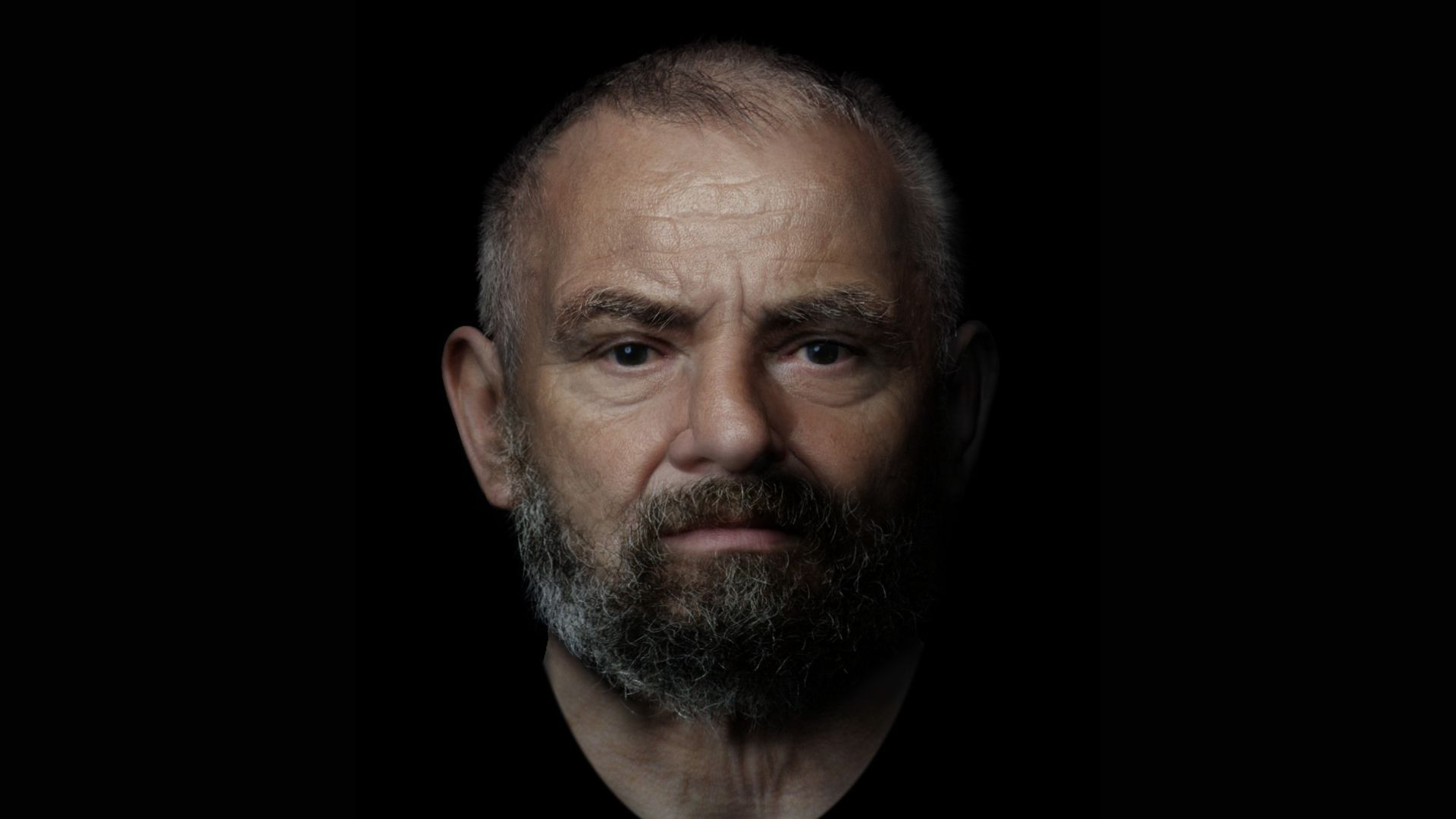
Researchers virtually reconstructed the face of a man decapitated nearly 2,000 years ago and buried near a Roman military fort at Inveresk in Scotland. A chemical analysis of his remains suggests he grew up in southern Britain, yet he appears to have worked for the Roman army when he died between A.D. 142 and 165.
The man was probably about 50 years old at death. His skeleton shows his right arm had severely limited movement, ruling out sword use, so he likely held a non-combat role such as clerk or used his left hand for weapons. His nose had been broken and healed, and his right elbow showed extensive bone growth, possibly from arthritis or a previous injury.
Researchers at National Museums Scotland and forensic anthropologist Christopher Rynn created the facial reconstruction based on the skull. The man was buried with dignity despite decapitation, John H. Reid, an archaeologist at the Trimontium Trust, told Live Science. This differs from executed criminals of the era, who were often decapitated.
Four of six Roman-era burials found at Inveresk show similar decapitation. Reid noted that beheading bodies may have been an obscure burial rite for some southern Britons, as other headless bodies from the same period have been found in that region. He said the isotopic analysis could alternatively suggest recruitment from the Netherlands coast, which shares the same chemical signature.
Non-Romans served the Roman army as servants, artisans, auxiliary soldiers, or in citizen-based legions, Reid explained. By the time the Antonine Wall was built around A.D. 140, few Roman army members in Scotland came from Italy.