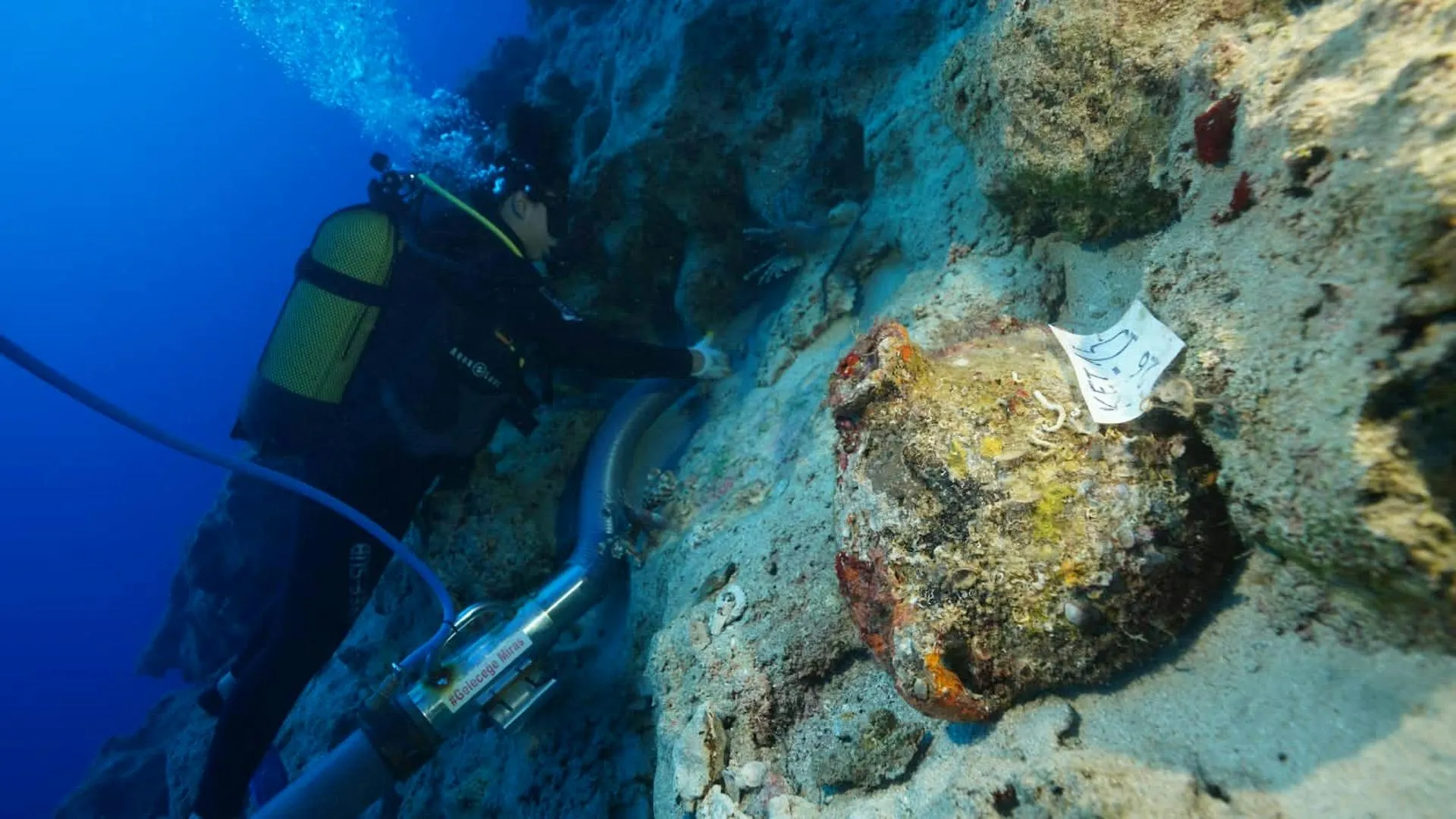
Archaeologists have identified what appears to be the world's oldest documented shipwreck off the Turkish coast, pushing back the known history of Mediterranean maritime commerce by centuries.
The vessel, located underwater, dates to approximately 4,500 years ago, placing it during the era when Egyptian pyramid builders were transforming the Nile Valley. Though the wooden hull has not survived the millennia, ceramic cargo recovered from the site provides the primary evidence for dating and understanding the ship's final voyage.
The pottery collection tells a story of ancient trade routes connecting distant Mediterranean societies. Researchers interpret the vessel's cargo of oil, wine, or tree resin as evidence of an established commercial network that linked civilizations across the sea. This discovery challenges previous assumptions about when sophisticated maritime trade emerged in the Mediterranean world.
Archaeologists believe the ship met its end when it crashed against rocks during a storm. The impact and subsequent submersion preserved the cargo in ways that have allowed researchers to piece together details of the vessel's origin, destination, and economic purpose. The pottery itself carries markers that help establish the shipwreck's age and geographic connections.
The location off Turkey's coast positions this find at the crossroads of ancient maritime routes. The Eastern Mediterranean hosted trade networks connecting Egypt, the Levant, Anatolia, and the Aegean world. A shipwreck at this nexus offers direct archaeological evidence of long-distance commerce during the Early Bronze Age, a period when scholars previously debated the extent of seafaring capabilities.
What makes this discovery particularly noteworthy is the absence of the wooden hull. Most ancient shipwreck studies depend on analyzing surviving wooden structures to understand construction techniques and maritime technology. Here, archaeologists must rely almost exclusively on the pottery assemblage. This limitation actually tests the precision of archaeological dating methods, since ceramic styles and chemical analysis of clay sources can pinpoint time periods and geographic origins with considerable accuracy.
The pottery cargo represents a valuable dataset for understanding Bronze Age trade networks. Each vessel's shape, decoration, and clay composition reveals information about where it was made and who produced it. When pottery from multiple origins appears together in a single wreck, it documents actual ancient trade goods rather than speculation based on scattered finds.
This shipwreck adds to a growing body of evidence showing that ancient Mediterranean societies were far more interconnected than previously recognized. Earlier discoveries of shipwrecks from subsequent centuries have already demonstrated extensive trade in metals, lumber, and luxury goods. The new find extends this network backwards in time, suggesting that maritime commerce was established even before the height of the Egyptian Old Kingdom.
Future research will likely focus on detailed analysis of the pottery assemblage and seafloor mapping to recover additional artifacts. The site may also preserve organic remains such as seeds or wood fragments that could provide precise radiocarbon dating. Each artifact recovered helps fill gaps in knowledge about Bronze Age technology, trade practices, and the daily lives of ancient seafarers.