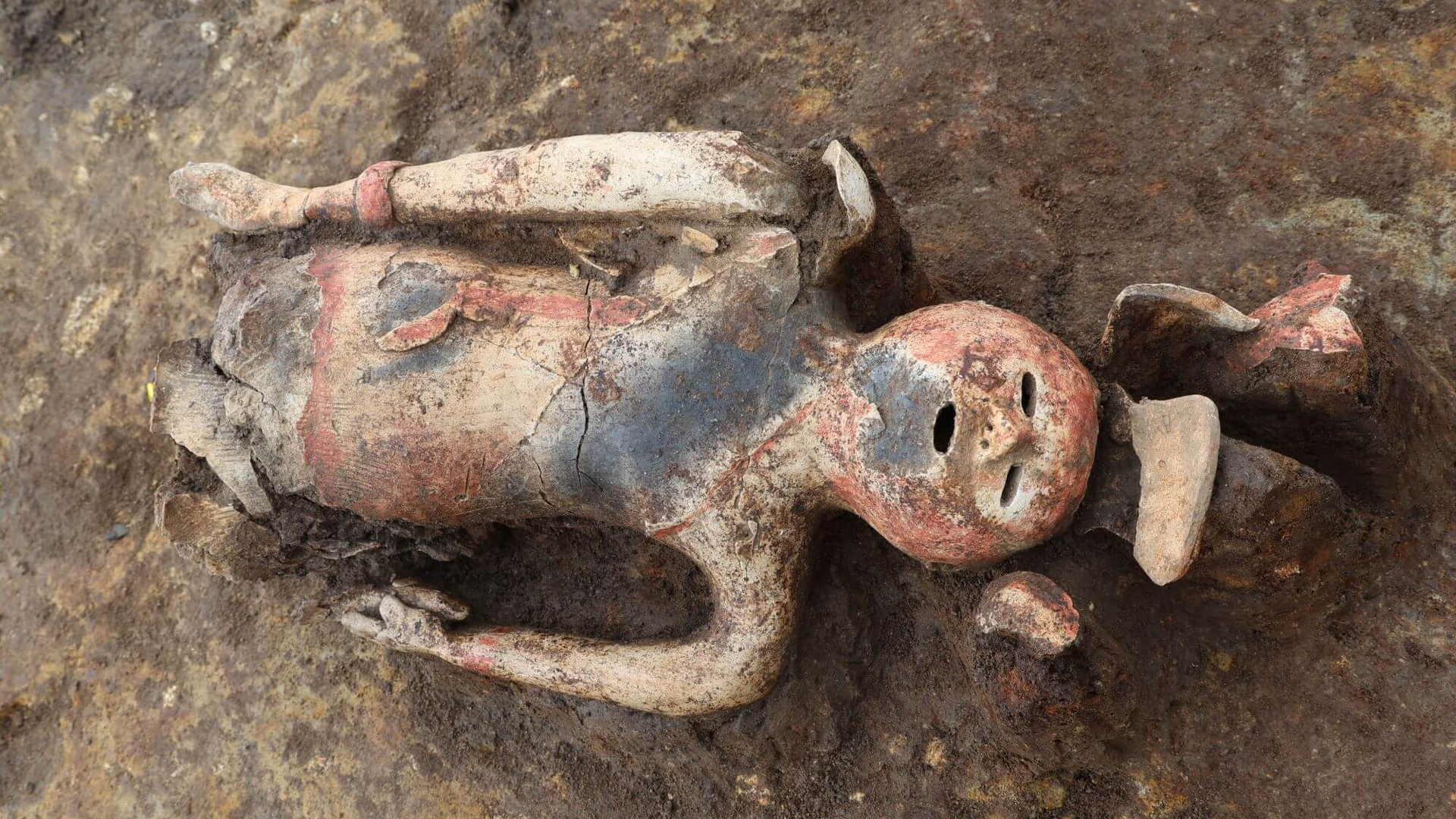
Archaeologists unearthed a clay figurine at the Nishikaminomiya burial site northwest of Tokyo that represents a female shaman from the fifth century. The artifact, called a haniwa, stands about 16 inches tall, though only the head and torso survive from what was originally a larger sculpture.
The figurine depicts a miko, or shrine maiden, a priestess in the Shinto religion who performed funeral rituals and offered spiritual guidance during the Kofun period, which lasted from about 300 to 710 A.D. The haniwa wears a traditional Japanese topknot hairstyle called a shimada, clay bracelets on both wrists with red pigment, and holds a rod-shaped ritual implement in her left hand. A red sash is painted on her torso.
Archaeologists discovered the haniwa in a moat surrounding an enormous burial mound measuring about 145 feet in diameter at the site. A boat-shaped sarcophagus was found in the mound itself. The figurine likely was originally placed near the sarcophagus and slipped down into the moat over time, according to the Gunma prefectural government statement.
During the Kofun period, haniwa sculptures were used as offerings to the dead and were often thought to contain the souls of the deceased. The figurine's detailed features, including carefully molded fingers and a prominent nose, show that "considerable care was taken in making the figure, even in features that would not be visible from a distance," representatives of the Gunma prefectural government said.
Archaeologists have worked at Nishikaminomiya since 2020 and discovered the haniwa during recent excavations. The figurine is on display at the Gunma Prefectural Archaeological Research Center's Excavation Information Museum in Shibukawa.