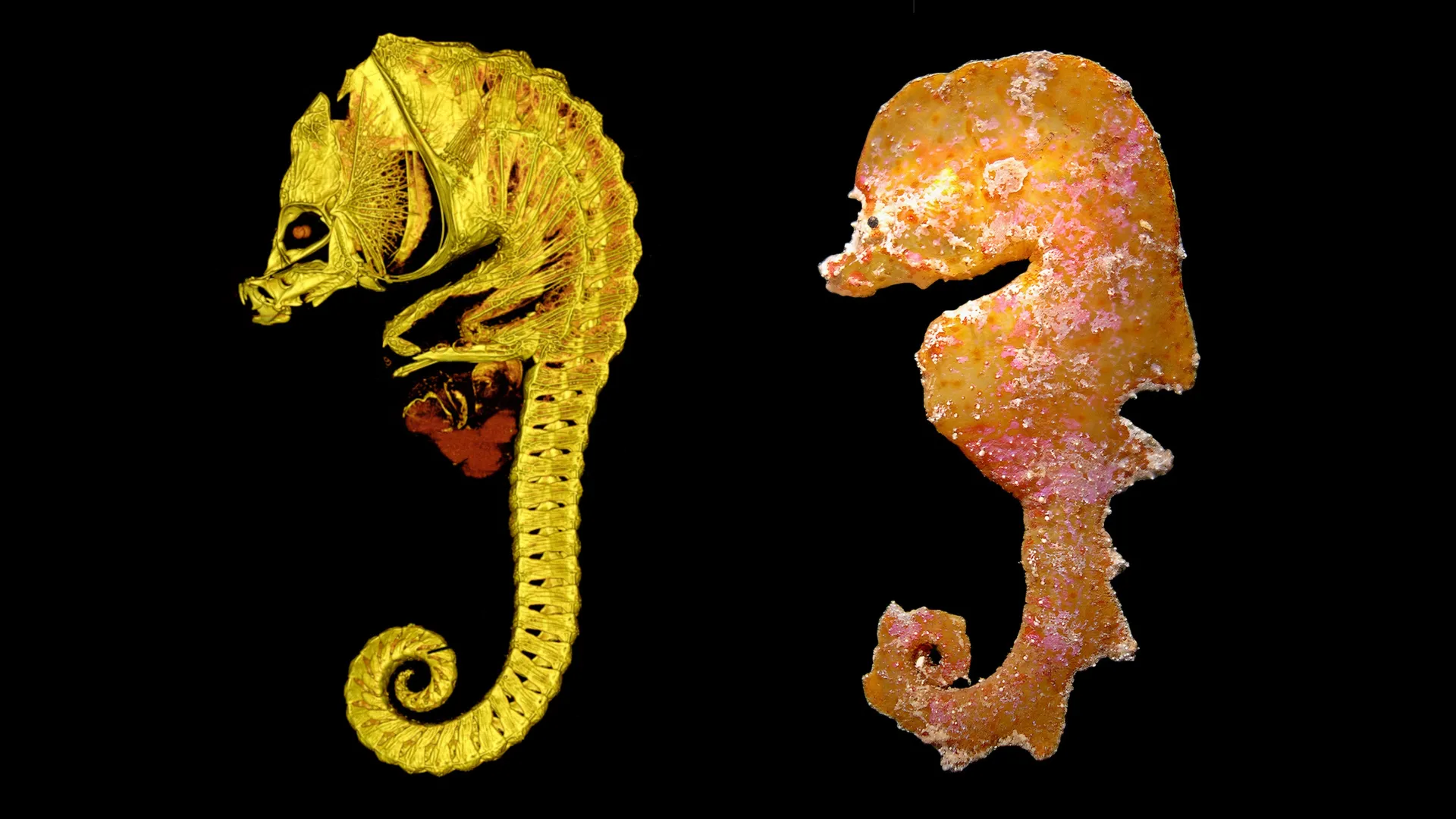
Researchers have identified a new genus of deep-sea fish that resembles seahorses but belongs to a separate branch of the family tree. The three species, named Australyichthys aegis (helmethead sea muppet), A. minotaur (bullneck sea muppet), and A. paradoxus (paradoxical sea muppet), were described in a study published in the Journal of Lost Species by Graham Short and David Harasti.
The fish measure no longer than a thumb and live on deep reefs off southern Australia between 50 and 125 meters down. All known specimens were caught accidentally in trawl nets or dredges over approximately 65 years, with only seven individuals found across more than 2,500 kilometers of coastline. No specimens have been collected in nearly two decades.
Researchers used micro-CT scanning to examine the skeletons without damaging the preserved specimens. The scans revealed that Australyichthys lacks the internal architecture of true seahorses, including the rigid cage of fused bony plates and the bony crown called a coronet. Instead, the fish possess a different arrangement of bones supporting the belly.
Genetic sequencing of A. aegis, the only specimen preserved in ethanol rather than formalin, confirmed the skeletal findings. The DNA placed the fish outside the seahorse genus on the branch of their closest relatives.
The researchers describe this as convergent evolution, where separate lineages evolve similar appearances. The seahorse body shape, with its bent head, gripping tail, and brood pouch, has evolved at least twice within the fish family Syngnathidae.
No one has observed these fish alive. The researchers note that targeted surveys in the Great Southern Reef, where the fish live, represent a priority for future study.