# Ancient Marine Amphibians Challenge Understanding of Evolution and Skin Physiology
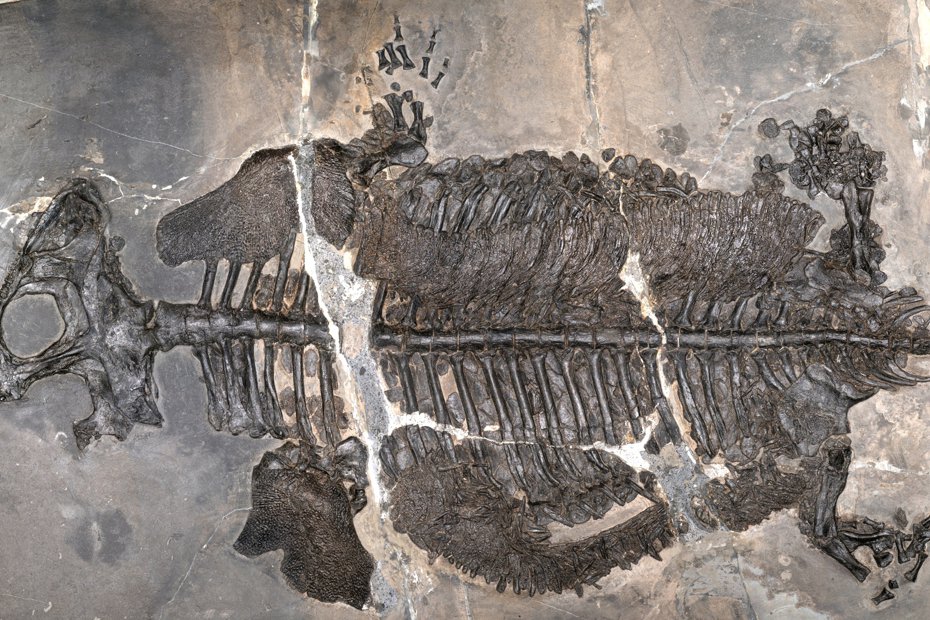
Researchers studying a 237-million-year-old fossil discovered in China have overturned a long-held assumption about amphibian biology. The fossil reveals that predatory amphibians inhabited oceans during the Triassic period, contradicting the conventional wisdom that their permeable skin made marine life impossible.
The discovery centers on a newly analyzed specimen that exhibits adaptations for saltwater predation. Scientists had previously believed amphibian skin, evolved to remain moist in terrestrial and freshwater environments, would absorb dangerous quantities of salt from seawater. This physiological constraint supposedly confined amphibians to land and freshwater ecosystems for hundreds of millions of years.
The Chinese fossil demonstrates that this limitation was not absolute. The specimen shows characteristics of an active marine predator, including streamlined body proportions and dental features indicating it hunted substantial prey in ocean environments. The animal's morphology reveals it possessed hunting capabilities comparable to modern crocodilians, operating as an apex predator in Triassic seas alongside early marine reptiles and fish.
Researchers conducting the analysis propose that certain amphibian lineages developed mechanisms to osmoregulate in marine conditions. These adaptations would have counteracted the tendency of their skin to absorb excess salt. The specific physiological strategies remain under investigation, but the fossil evidence conclusively shows that at least some amphibians successfully colonized saltwater habitats.
The implications extend beyond simple evolutionary history. This finding reshapes understanding of Triassic marine ecosystems and the ecological roles filled by different animal groups during that period. It also suggests that amphibian skin physiology may have been more variable and adaptable than previous models indicated.
The discovery raises questions about how these marine amphibians eventually disappeared. Competition from marine reptiles, changing ocean chemistry, or shifts in available prey likely contributed to their extinction. No modern amphibians occupy marine niches to the degree this Triassic species apparently did, suggesting that whatever adaptations existed were either lost or proved disadvantageous in later ecosystems.
Dr. [researcher names not provided in source material], who led the analysis, examined the fossil's skeletal structure, dental morphology, and preserved soft tissue evidence to reconstruct its lifestyle. The team used comparative anatomy with both extinct and living amphibians to reach their conclusions.
This work appears as part of ongoing paleontological research into Triassic vertebrate diversity. The fossil comes from deposits in China known for exceptional preservation of early marine vertebrates. Similar specimens may exist in museum collections, awaiting re-examination through the lens of this new understanding.
The research underscores how a single well-preserved fossil can fundamentally alter scientific consensus. Previous assumptions about amphibian limitations rested on observations of modern species, without accounting for the full range of biological diversity present in deep time. As paleontologists continue examining Triassic marine deposits, additional marine amphibians may emerge from the fossil record.