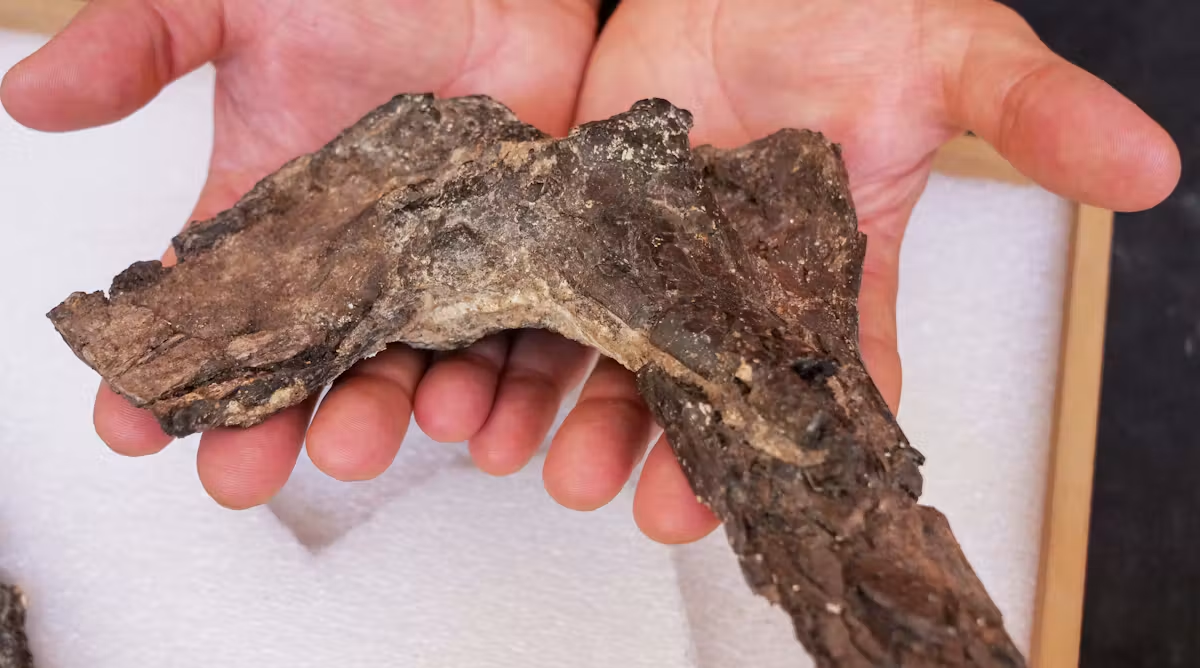
A 115-million-year-old dinosaur bone from Brazil contains tiny structures resembling red blood cells along with molecular traces of blood, according to research published today in the Proceedings of the National Academy of Sciences. This marks the first direct molecular evidence of blood compounds preserved within structures that look like red blood cells in a dinosaur fossil.
The fossil belongs to a small dinosaur called Aratasaurus museunacionali, found in the Romualdo Formation in northeast Brazil. The specimen consists of an exceptionally well-preserved partial hind limb currently housed at a paleontology museum in northeast Brazil. The formation is known for its exquisitely preserved fish, turtles, crocodile relatives and pterosaurs, with unique geochemical conditions that preserve fossils with fine anatomical detail.
Researchers found the structures exclusively within vascular canals inside the bone, where red blood cells are found in living vertebrates. The surrounding sediment contained no such structures, making external contamination unlikely. The team evaluated and ruled out alternative explanations before concluding the structures are most likely authentic fossilized red blood cell remains.
Analysis revealed two chemical fingerprints of blood with the structure of heme molecules, a key component of hemoglobin that carries oxygen. The fossil bone contained a distinct chemical signature dominated by heme molecules, while the surrounding sediment mostly contained compounds from plant and bacterial sources. Additional techniques confirmed the presence of heme molecules and elements including iron, carbon and nitrogen.
The dinosaur was rapidly buried in a low-oxygen environment that slowed decay. Minerals such as hausmannite may have acted like antioxidants, stabilizing organic molecules and slowing their breakdown. Researchers discovered that fossilized red blood cells appear slightly larger and more rounded than cells found in modern birds and crocodilians, possibly due to deformation during fossilization or genuine differences in dinosaur cell shape.
The discovery demonstrates that blood-derived molecules can survive over 110 million years under appropriate conditions. Researchers note that many fossils in museums worldwide may preserve molecular and chemical information not yet analyzed using modern techniques.