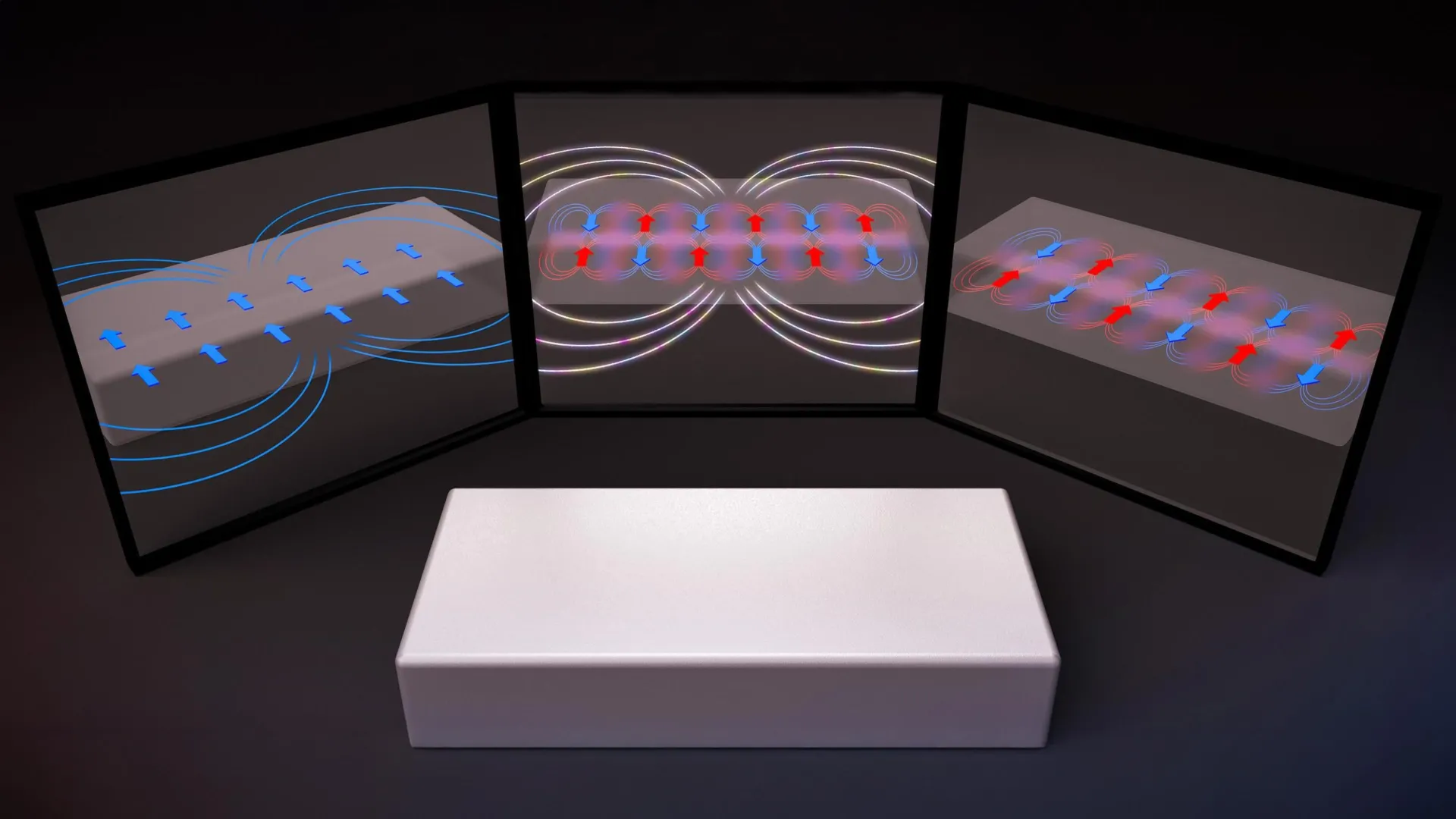
Scientists at SLAC National Accelerator Laboratory have confirmed the existence of a third type of magnetism, called altermagnetism, in a study published in Science.
For nearly 90 years, physicists recognized only two categories of magnetic materials: ferromagnets, where electron spins align in the same direction and produce a detectable magnetic field, and antiferromagnets, identified in 1933, where neighboring spins point in opposite directions and cancel out. Daniel Jost, an associate scientist at SLAC and Stanford Institute for Materials and Energy Sciences, led the research team.
Recent experiments revealed materials that did not fit neatly into either category. They displayed alternating spins like antiferromagnets but could support spin currents, a property associated with ferromagnets. Researchers introduced the term "altermagnets" in 2022 for this proposed third magnetic class.
The key difference in altermagnets is that while electron spins alternate up and down like in antiferromagnets, the crystal structures surrounding the oppositely aligned spins are rotated relative to one another. This rotation breaks a symmetry present in conventional antiferromagnets and allows electrons to behave differently.
The missing evidence for altermagnetism involved chirality, a property sometimes described as handedness. An object is chiral when its mirror image cannot be perfectly aligned with the original. Altermagnets possess a chiral signature that conventional antiferromagnets do not.
The team tested manganese telluride, a material long classified as an antiferromagnet. At the European Synchrotron Radiation Facility in France, they used circularly polarized X-rays with electric fields rotating in left-handed or right-handed directions. Manganese telluride scattered the two X-ray polarizations differently, revealing the expected chiral response of altermagnetism. Researchers performed the experiment in 2024 and repeated it in early 2025, reproducing the results.
"This chiral signature gave us the solid experimental ground to say altermagnetism stands in a class of its own," Jost said.
Rachel Nickel, a postdoctoral scientist at ESRF and co-author of the study, noted that "Altermagnetism was only proposed a few years ago, and the rapid progress in confirming these models is incredible."
The discovery could advance spintronics, which uses electron spin for more capable electronic devices. Potential applications include advanced memory systems, quantum devices, and more energy-efficient data centers.