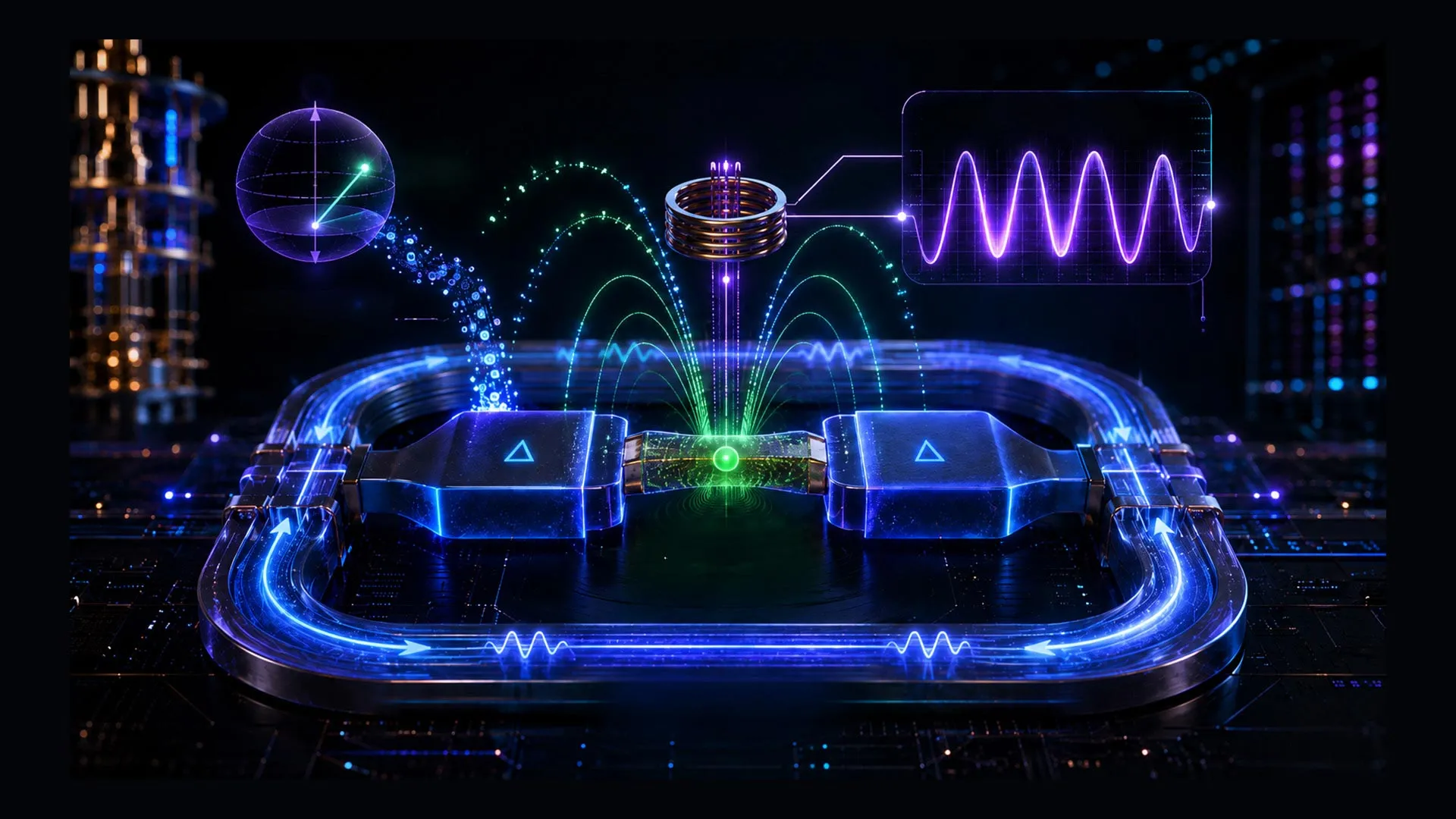
Researchers have proposed a method to read quantum information from Andreev qubits without directly measuring them or destroying their quantum states. The technique, published in Physical Review B Letters, focuses on monitoring an oscillating electrical supercurrent that the qubit generates naturally.
José Carlos Egues at the São Carlos Institute of Physics at the University of São Paulo in Brazil and Yugui Yao at the Beijing Institute of Technology in China led the research, supported by FAPESP.
The core problem the work addresses is well-known: measuring a qubit typically collapses its quantum state, destroying the superposition it holds. Current solutions use auxiliary qubits called ancillas to transfer information indirectly, but this requires extra equipment and complexity.
The Andreev qubit operates differently. It consists of a quantum dot made from an indium arsenide nanowire connected to superconducting materials on both sides. When this qubit exists in a superposition, it produces a supercurrent, an electrical current that flows without resistance. The supercurrent develops oscillations that encode information about the qubit's state.
The steady component of the supercurrent and the size of its oscillations reveal how much each basic state (0 and 1) contributes to the superposition. The timing of the oscillations reveals the phase relationship between the states. "By measuring how the current varies over time, it's possible to reconstruct the initial state of the qubit," Egues explains.
Remarkably, these oscillations occur without an externally applied voltage. They arise from the qubit's own quantum evolution.
If experimentally confirmed, the approach could eliminate the need for auxiliary qubits in certain measurement techniques.