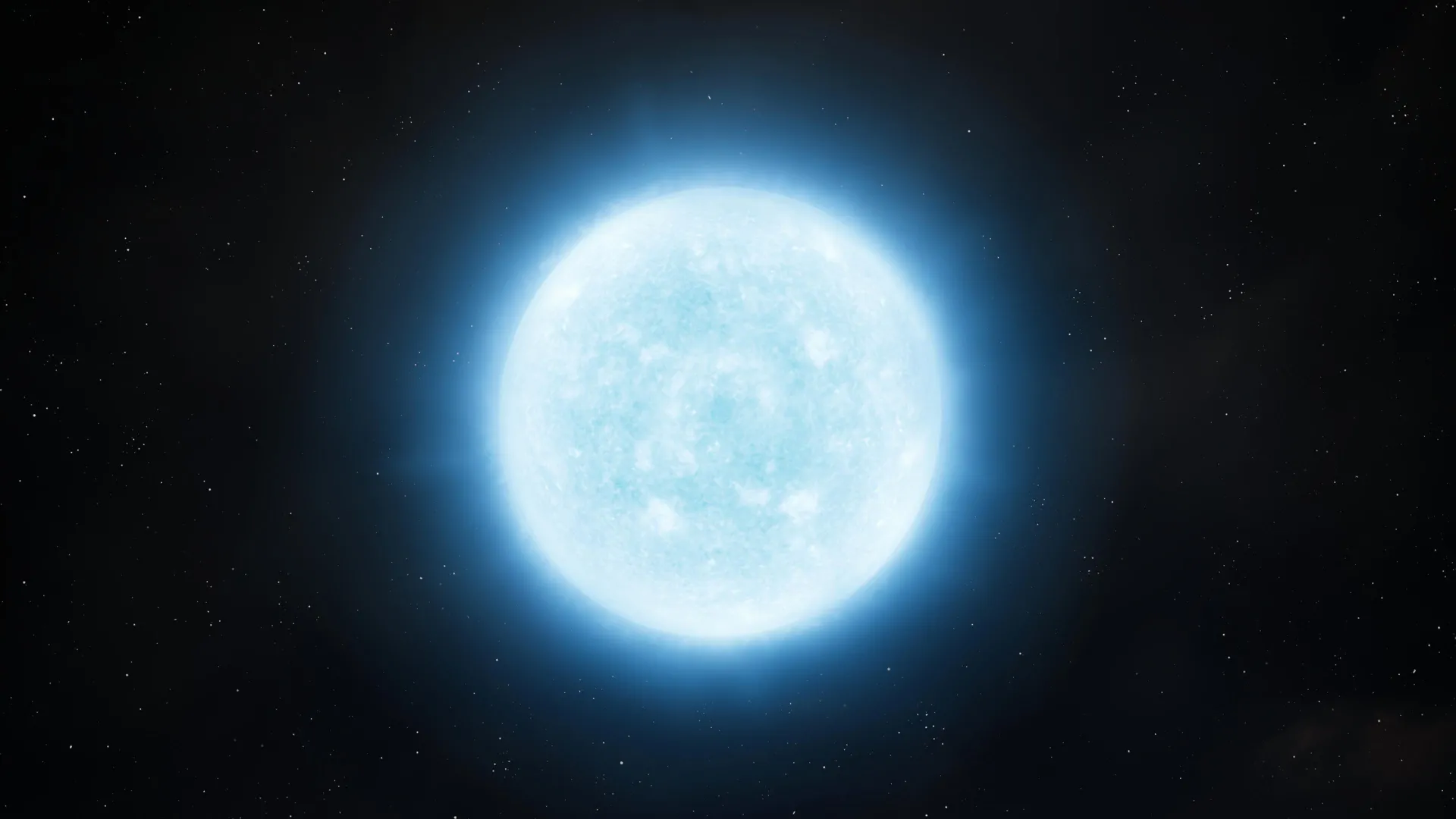
Researchers at the Indian Institute of Science used computer simulations to show that white dwarfs with strong internal magnetic fields could exceed the Chandrasekhar limit, a famous mass boundary long thought to cap these stellar remnants at about 1.4 times the Sun's mass.
In one simulation, a magnetized carbon-oxygen white dwarf reached approximately 2.4 solar masses, substantially exceeding the conventional limit. The team, led by Banibrata Mukhopadhyay, modified a stellar evolution program called STARS to account for magnetic fields and white dwarf cooling. They simulated how magnetized stars develop from the main sequence through to white dwarfs and into binary systems where matter accumulates from a companion star.
As material builds up on the white dwarf, compression strengthens its internal magnetic field. This magnetic support then provides additional pressure to counteract gravity, allowing the star to hold more mass than conventional physics predicts.
Zenia Zuraiq, first author of the study published in The Astrophysical Journal Letters, notes the key question was whether a star could "actually evolve into one" of these super-Chandrasekhar white dwarfs, not just whether they were theoretically possible.
Astronomers have observed Type Ia supernovae that shine brighter than expected, suggesting some white dwarfs might reach masses as high as 2.8 solar masses before exploding. These supernovae serve as cosmic distance markers. If white dwarfs can have substantially different masses due to magnetic fields, this could affect how bright their explosions become, potentially helping explain unusually luminous supernovae and refining measurements of cosmic expansion.
The findings remain based on simulations rather than direct observations of such massive white dwarfs.