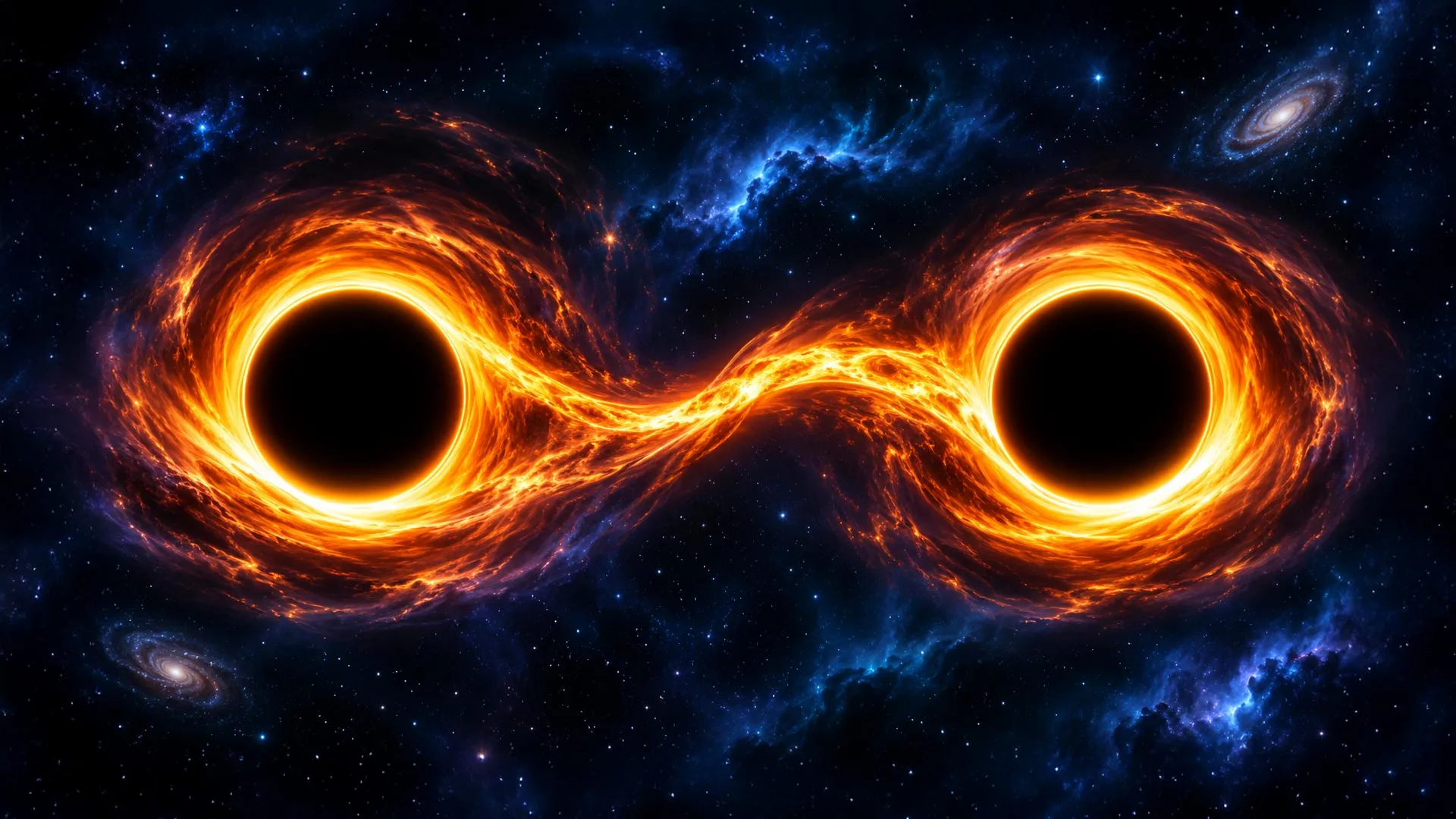
A new theoretical study published in Physical Review D proposes that black holes might split into two under extreme conditions, contradicting the conventional understanding that they only merge.
Francesco Sannino, a professor of physics at University of Naples Federico II and the Quantum Field Theory Center at University of Southern Denmark, led the research with collaborators Giacomo Cacciapaglia from the French National Centre for Scientific Research (CNRS) in Paris, and Manuel Del Piano and Vania Vellucci from the Quantum Field Theory Center at University of Southern Denmark.
Black holes normally remain intact because splitting into two smaller black holes would reduce total entropy, making the process thermodynamically unfavorable. However, the researchers found that extremely rapid rotation could create a narrow exception to this rule.
A sufficiently fast spinning black hole might overcome the usual thermodynamic restriction, but another problem arises. The two resulting black holes would need to separate far enough apart to avoid immediately merging again. "When we include this requirement, the window largely closes again, except possibly for black holes rotating close to their maximum possible rate," Sannino says.
The researchers also examined scenarios involving extra spatial dimensions beyond the three humans experience. Some theoretical models describe black hole-like objects that become unstable and fragment. In certain cases, splitting could become thermodynamically favorable, particularly when one resulting black hole is much smaller than the other.
Sannino notes that small primordial black holes may be more prone to splitting than larger astrophysical black holes. Gamma-ray telescopes such as Fermi-LAT could potentially detect signals from tiny fragments forming during mergers, offering an indirect way to investigate the idea. However, calculating the actual probability of splitting requires understanding how gravity behaves beyond Einstein's theory, which remains an open question.