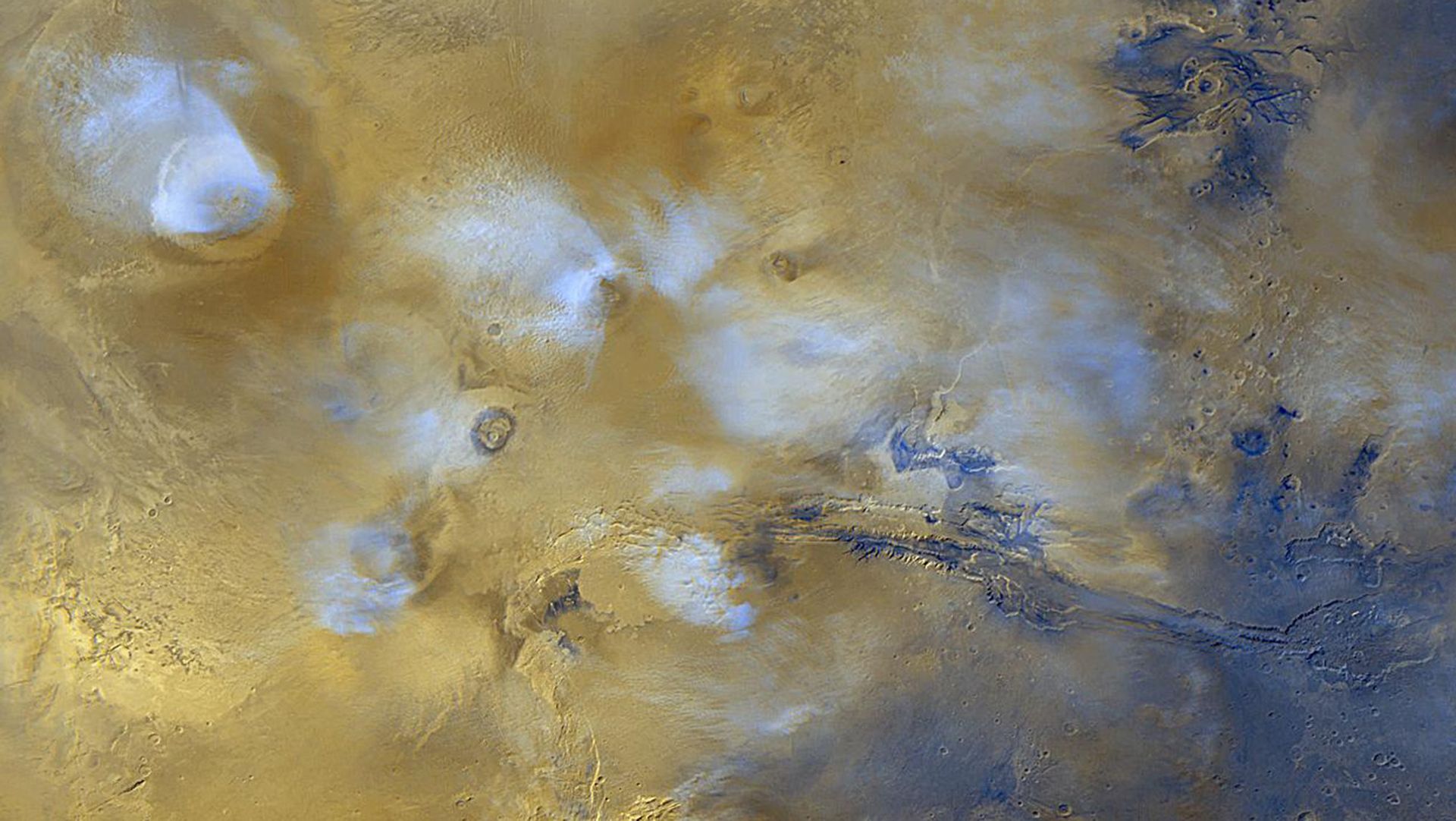
Europe's ExoMars Trace Gas Orbiter detected hydrogen chloride gas leaking from rifts in Alba Mons, the largest volcano on Mars by surface area. The spacecraft spotted this gas seeping through cracks, which scientists interpret as emissions from hot magma beneath Mars' surface.
The findings appear in Science Advances on November 4. Alexander Trokhimovskiy, first author at Russia's Space Research Institute, said the study offers "a complementary and potentially independent line of evidence" of Martian magma through atmospheric observations.
The TGO first detected the hydrogen chloride in 2021, but researchers initially hesitated to link it to volcanism because the gas appeared seasonal and sulfur dioxide, another volcanic gas, was absent. Kevin Olson, a visiting researcher at the University of Oxford, noted that further analysis revealed the gas appeared in unexpected times and places over two Mars years of targeted measurements. "This inconsistency is more suggestive of a puff of gas entering the atmosphere than of regular atmospheric chemistry," Olson said. The team observed the gas appear locally and nowhere else over four Mars years.
Daniel Mège, a professor of planetary geology at the Polish Academy of Sciences and co-author, identified the fissures where the gas may emerge. He noted that Earth's first life-forms arose at hydrothermal vents, which have similar conditions to the potential vents on Mars. However, Mège cautioned that stable conditions would need to persist for millions of years at a local scale for life to form. "If these requirements are met at local scale, at the scale of the seepage structures, then living organisms might wait for us to discover them," he wrote, though he added that "maintaining stable conditions over such a long period at a very local scale is not obvious."
The findings complement earlier seismic evidence of magma detected by NASA's InSight lander.