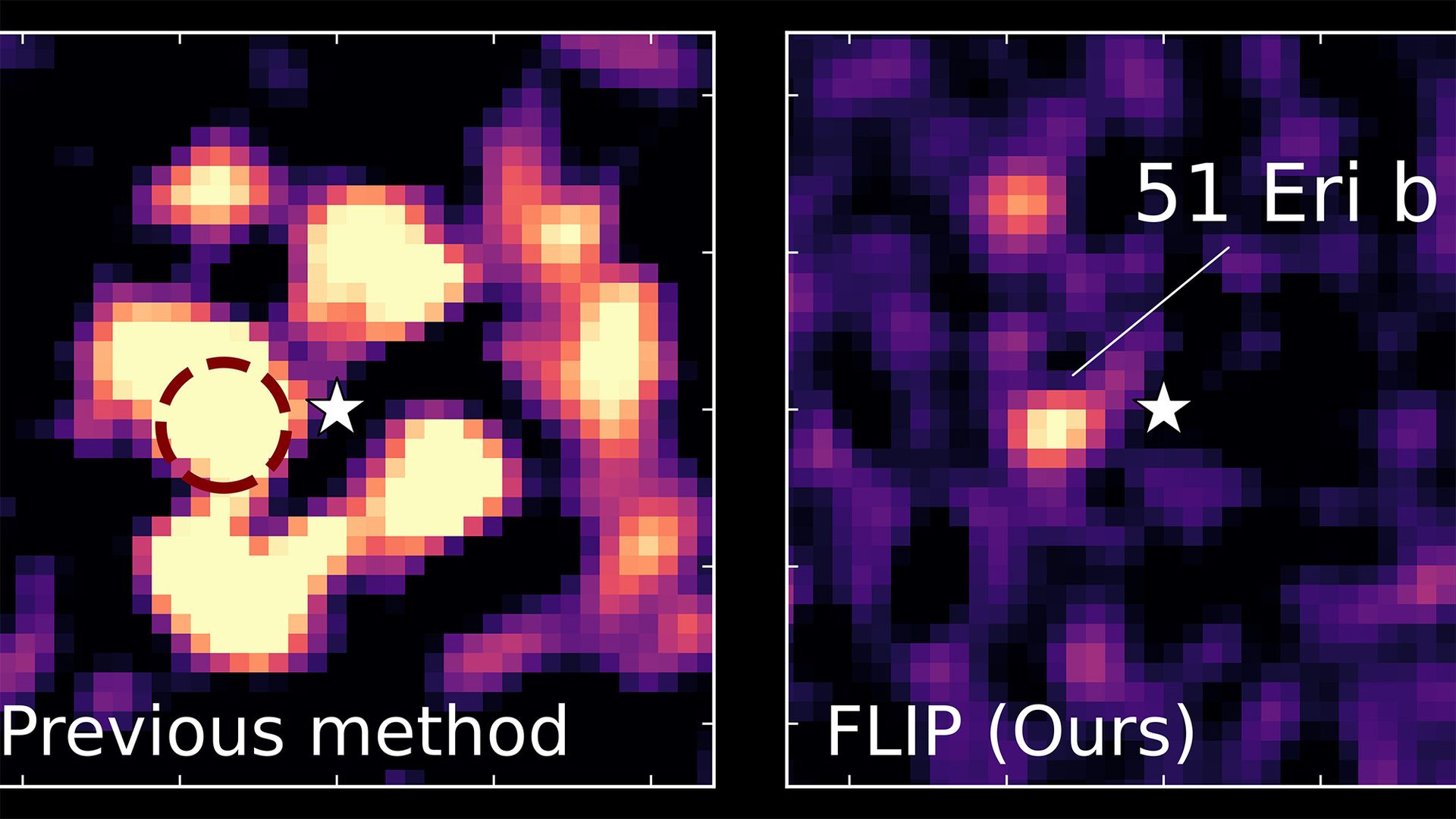
Astronomers developed a new technique to spot exoplanets hidden in the glare of distant stars using data from the James Webb Space Telescope. The method, called Physics-based Learning for Imaging Planets (FLIP), combines computational physics models with machine learning to remove stellar interference from JWST observations.
Rodrigo Ferrer-Chavez at Northwestern University led the research, published Nov. 4 in Nature. "Planets are a million times fainter than their stars," Ferrer-Chavez said. "So, to image exoplanets, we need to remove that glare."
The team created a "digital twin" of JWST that simulates how light travels through the telescope's detectors while accounting for the instrument's slight vibrations and movements. Co-author Jason Wang, also at Northwestern, clarified that FLIP is not an AI model. "Because we already know the physics, we don't need AI to understand what's happening," Wang said.
The researchers tested FLIP on data from three stars, including 51 Eridani, located 97 light-years from Earth. A giant exoplanet orbiting this star, called 51 Eridani b, had been detected by ground-based telescopes but was obscured in previous JWST images. FLIP revealed the planet in the JWST dataset.
Ferrer-Chavez noted that most discovered exoplanets differ from planets in our solar system, partly because larger, more reflective worlds are easier to detect. "It's not that [solar-system-like planets] don't exist," he said. "It's that we can't see them." The researchers expect FLIP to help astronomers identify additional faint exoplanets.