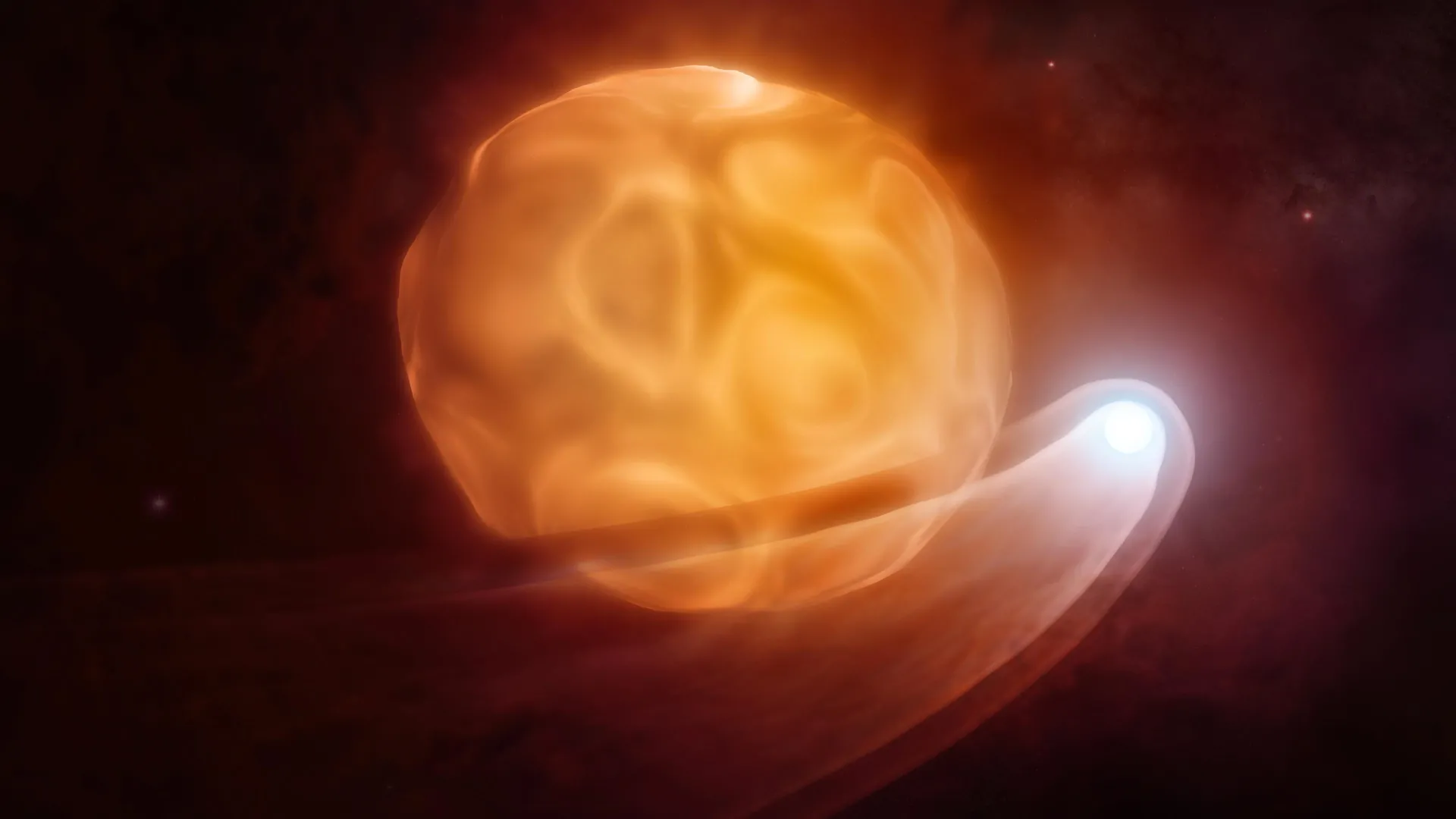
Astronomers have detected evidence that a companion star named Siwarha is traveling through the atmosphere of Betelgeuse, one of the brightest stars visible from Earth. The discovery emerged from radio observations conducted between 2021 and 2026 using the Karl G. Jansky Very Large Array and the Atacama Large Millimeter/submillimeter Array.
The research team, led by Dr. Lynn D. Matthews at MIT Haystack Observatory and including scientists from the Center for Astrophysics at Harvard & Smithsonian, the University of Manchester, and the European Southern Observatory, analyzed seven radio frequencies to map Betelgeuse's outer atmosphere.
Siwarha orbits extremely close to Betelgeuse, at a distance of only about twice the red supergiant's radius. As it moves through Betelgeuse's extended atmosphere, Siwarha likely disturbs the surrounding gas much like a fast boat cutting through water, creating detectable changes in the star's shape.
The team found that Betelgeuse's atmosphere appears stretched into an oval shape at certain times, and these shape changes correlate with the expected position of Siwarha in its orbit. When the companion reaches its greatest apparent separation from Betelgeuse, the atmosphere becomes more elongated. When Siwarha passes directly in front of or behind Betelgeuse from Earth's perspective, the atmosphere appears rounder.
"This companion is orbiting so close to the star that it actually passes through its extended atmosphere," Matthews said. The researchers calculated that Siwarha is tens to hundreds of times too faint to detect directly in their radio observations.
The observations also revealed that Betelgeuse's atmosphere has largely returned to normal temperatures following the Great Dimming of 2019 and 2020. The team confirmed the existence of an unusually cool atmospheric layer, called the MOLsphere, with temperatures around 2,200 Kelvin, more than 1,000 degrees below the star's visible surface.
Astronomers say additional observations are necessary to confirm the connection between Siwarha's orbit and the atmospheric distortions.