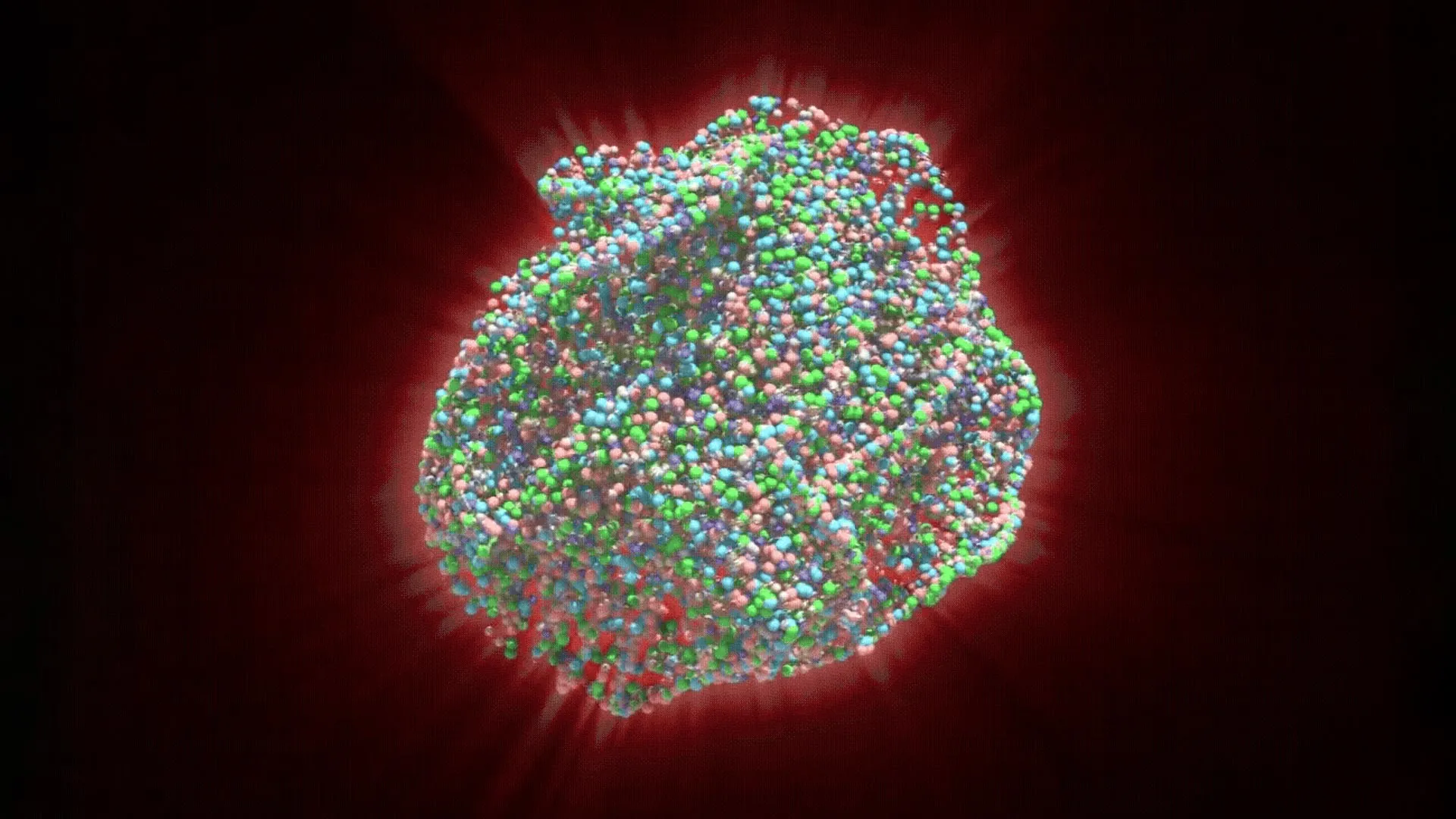
All four major research collaborations at the Large Hadron Collider have detected quark-gluon plasma (QGP) forming in collisions between oxygen and neon nuclei, challenging decades of assumptions about the enormous forces required to create this primordial matter.
QGP is an extreme state of matter that existed throughout the universe in the first millionths of a second after the Big Bang. At temperatures exceeding 100,000 times those at the Sun's center, protons and neutrons break apart into quarks and gluons. Scientists believed for decades that recreating these conditions required collisions of very heavy atomic nuclei, particularly lead, which is more than 200 times heavier than protons.
The ALICE, ATLAS, CMS, and LHCb collaborations reported multiple independent signatures of QGP in the lighter oxygen and neon collisions. The ATLAS collaboration detected parton energy loss by studying pairs of particle jets from oxygen-oxygen and neon-neon collisions, finding that energetic particles lost energy while traveling through the hot, dense material. The effect was more pronounced in head-on central collisions that create larger plasma volumes.
The CMS collaboration found that charged-particle production was suppressed in oxygen-oxygen and neon-neon collisions compared with proton-proton collisions, consistent with energy loss in quark-gluon plasma. LHCb observed more pronounced suppression in heavier neon collisions than lighter oxygen collisions, the pattern expected if larger collisions produce greater plasma volumes.
ALICE provided what the report describes as "unambiguous evidence" of parton energy loss by comparing neutral pion production in oxygen-oxygen and proton-oxygen collisions. The CMS and LHCb collaborations also detected varying suppression patterns in particles called upsilon mesons, another distinctive QGP signature.
ALICE identified anisotropic flow in oxygen collisions, where baryons showed stronger directional preferences than mesons, a pattern explained by QGP formation. Researchers continue analyzing data from collisions involving lighter nuclei to further understand how QGP forms and behaves.