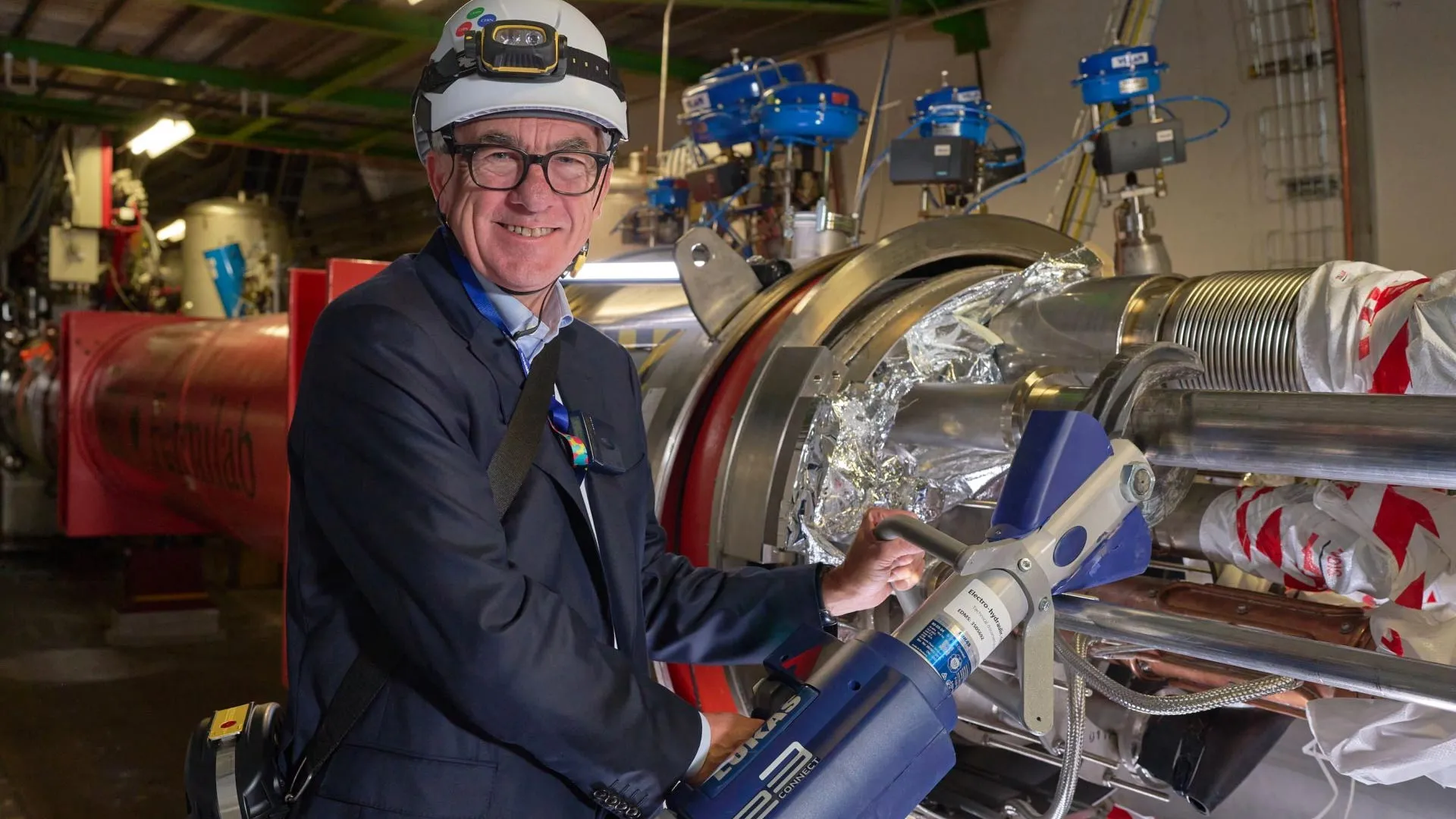
CERN has begun a major overhaul of the Large Hadron Collider, systematically disconnecting and replacing some of the facility's most critical components. The organization is installing new superconducting magnets as part of its High-Luminosity upgrade project, a multiyear effort to dramatically increase the collider's collision output.
The replacement magnets represent a substantial engineering leap forward. They will generate magnetic fields approximately 40 percent stronger than the current system, enabling the LHC to compress particle beams into tighter configurations before they collide. This technical advancement directly translates into a crucial operational goal: producing far more collision events for analysis by ATLAS and CMS, the two largest particle physics experiments at CERN.
The High-Luminosity upgrade addresses a fundamental limitation of the current LHC. While the facility has operated successfully since 2008, discovering the Higgs boson in 2012 and making numerous contributions to particle physics, the number of collisions it generates per unit time remains constrained by the focusing power of its magnet system. By tightening the beam geometry through stronger magnetic fields, researchers can pack more collision events into the same time window without increasing the total energy or significantly raising operational demands.
The physics payoff extends beyond mere data volume. More collisions provide statistically richer datasets, allowing physicists to identify rare processes and subtle deviations from the Standard Model that would remain hidden in smaller samples. This expanded dataset becomes particularly valuable for investigating physics beyond the Standard Model, searching for new particle candidates, and refining measurements of established particle properties with unprecedented precision.
The High-Luminosity project represents one of the largest physics infrastructure investments globally. The magnet replacement and associated upgrades require careful coordination across CERN's international collaboration of 2,500 physicists and engineers from 190 institutions across 40 countries. The work involves not only magnet replacement but also upgrades to detector systems, power systems, and cryogenic infrastructure needed to support the enhanced magnetic fields.
The timeline for this upgrade extends over several years. CERN expects the LHC to reach High-Luminosity operating conditions sometime in the mid-2020s, following commissioning and testing phases. During this period, the collider will operate at reduced capacity or enter planned shutdown periods, reducing scientific output temporarily but setting the stage for dramatically expanded research capabilities.
The project costs run into billions of euros, with significant contributions from funding agencies worldwide. This investment reflects the global physics community's confidence that the High-Luminosity LHC will yield discoveries and refined measurements that cannot be obtained elsewhere. No other facility on Earth can replicate the LHC's collision energies or the complexity of its detector systems.
The disconnection and magnet replacement work underway now marks the transition from the LHC's current era into its next phase. Success depends on flawless engineering execution and careful management of the extremely complex cryogenic and electrical systems involved. The stronger magnets promise to open new windows into fundamental physics, justifying the substantial disruption and investment required to install them.