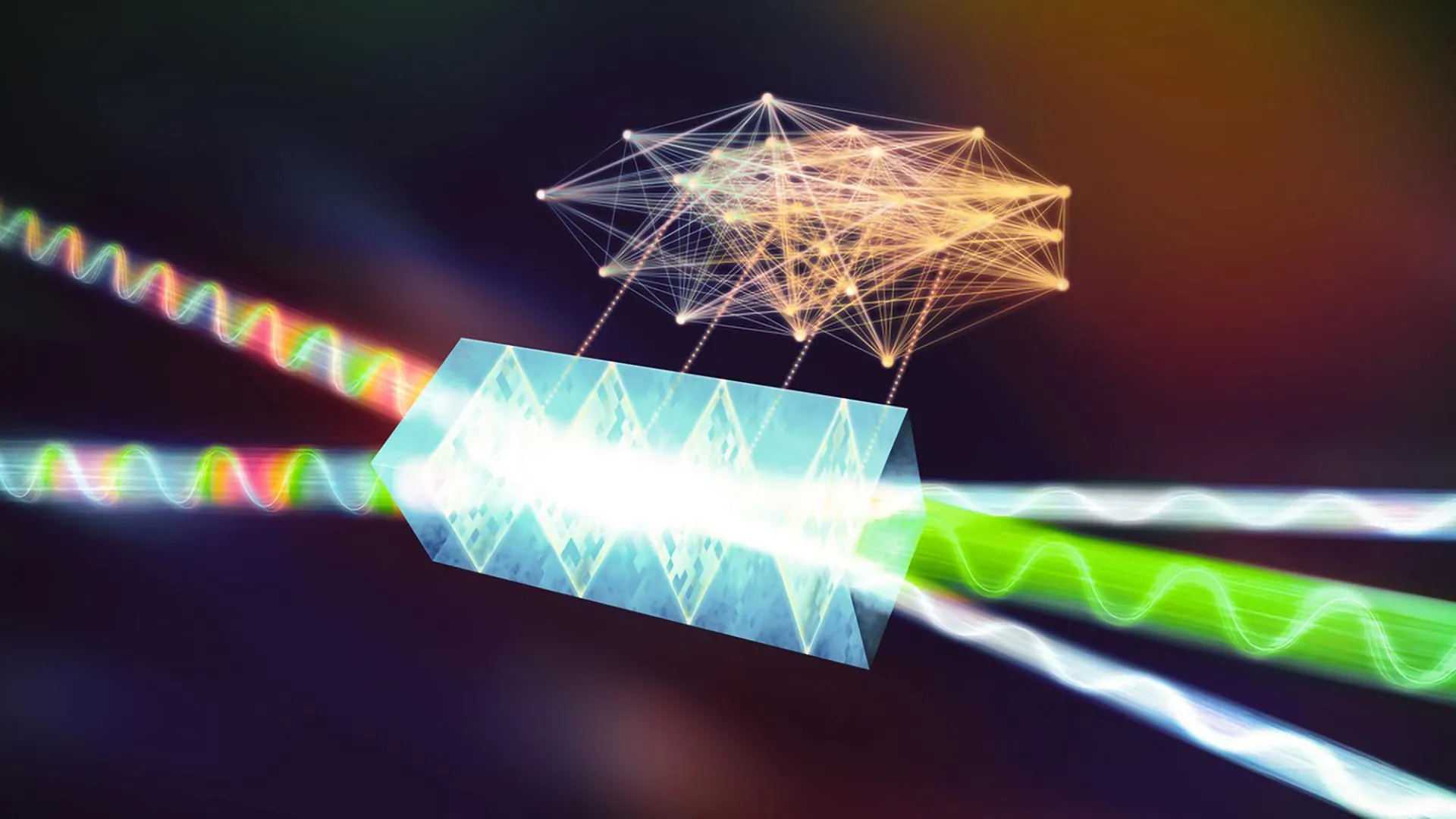
Scientists at Stanford University, UCLA, and SLAC National Accelerator Laboratory developed an artificial intelligence model that accelerates simulations of laser behavior by approximately 250 times. The work appears in the journal Advanced Photonics.
The research addresses a computational bottleneck in simulating second-order nonlinear optics, or chi-2 processes. These interactions occur when light waves exchange energy inside specially designed crystals, allowing scientists to change light frequency and control laser pulse shape. Traditionally, scientists solve these interactions using the split-step Fourier method, which accounts for roughly 95 percent of total processing time in complete laser simulations.
The team built their AI model using LSTM (long short-term memory), a type of recurrent neural network. Rather than repeatedly converting calculations between time and frequency domains like conventional methods, the neural network works entirely with compressed frequency characteristics of light. This eliminates repetitive computation that slows traditional approaches.
The researchers tested the model using noncollinear sum frequency generation, a process where three interconnected light fields evolve together inside a crystal. The simulations covered diverse laser pulse shapes, including pulses with pronounced gaps in frequency spectra and strong optical phase variations.
When processing multiple simulations using graphics processing units, average calculation time dropped to a few milliseconds per simulation. The AI model accurately predicted how laser pulses change over time and across frequencies while capturing the interconnected behavior of interacting light waves.
The researchers envision connecting AI models directly to operating laser systems using a modular design where individual physical processes are represented by separate trained neural networks. This could enable digital twins, virtual models that mirror real laser equipment behavior, supporting real-time monitoring and adaptive control at scientific facilities.