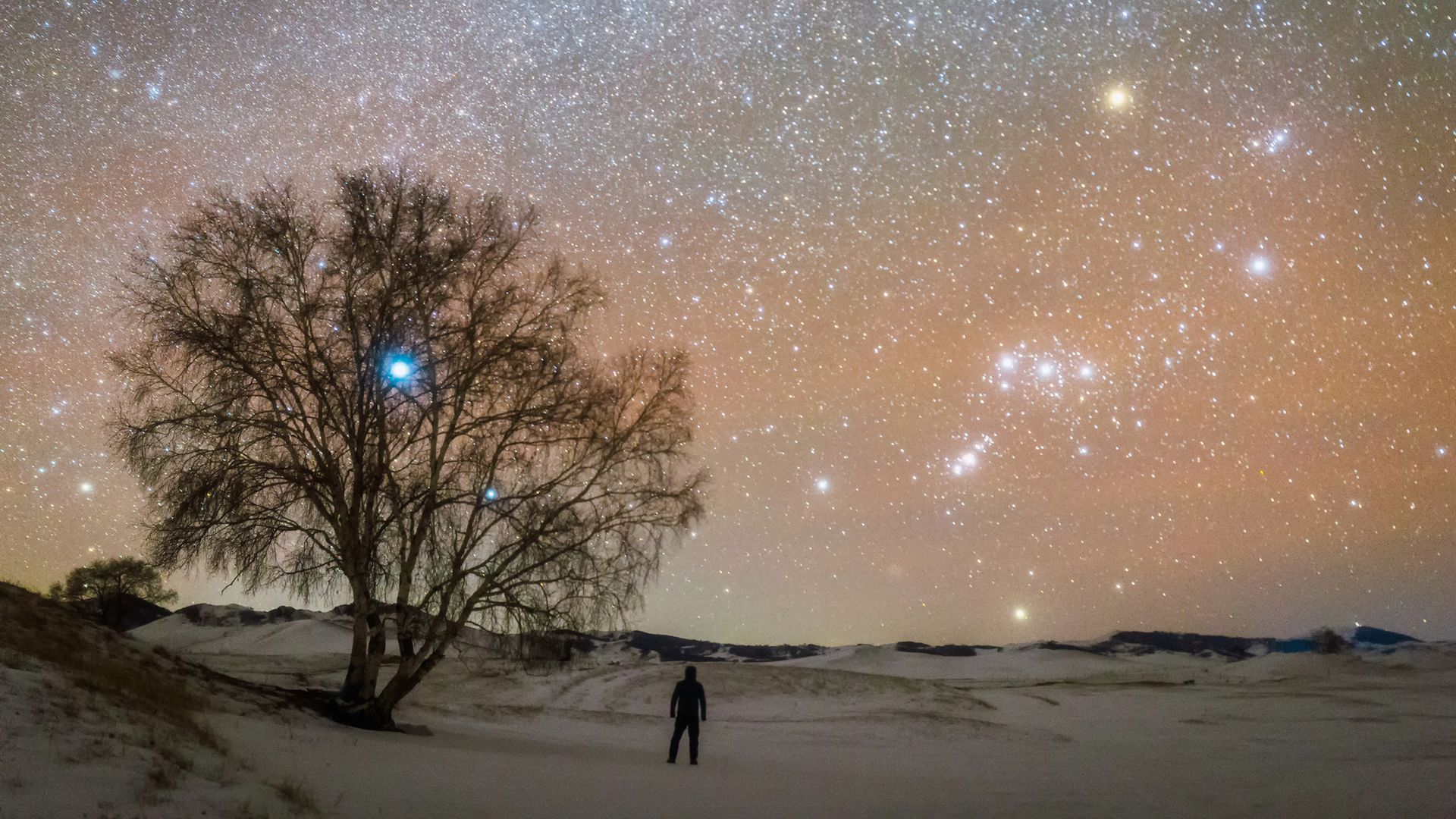
Winter 2026-2027 offers multiple stargazing opportunities for observers with any equipment level, from naked-eye viewing to telescopes.
Three supermoons will occur this winter. The Christmas Eve supermoon peaks December 24, 2026, at 01:28 UTC and will appear up to 14% larger and 30% brighter than a normal full moon. The Wolf Moon peaks January 22, 2027, at 12:17 UTC. The Snow Moon peaks February 20, 2027, at 23:24 UTC and coincides with a penumbral lunar eclipse, when the moon passes through Earth's faint outer shadow. The moon will only dim slightly during this type of eclipse.
An annular solar eclipse will occur February 6, 2027, visible to observers in South America and Africa. The moon will pass between Earth and the sun when the moon is at its farthest point from Earth, creating a "ring of fire" effect. Unlike a total solar eclipse, the sun will not be completely blocked.
Saturn has returned to the evening sky and rises earlier as winter progresses. Observers can see more details in the planet's rings than last year. Viewing Saturn requires a telescope with at least 4 or 5 inches of aperture and magnification of at least 100x.
Jupiter reaches opposition February 10-11, 2027, when it will be brightest and closest to Earth. At this time, observers can see the planet's bands, the Great Red Spot, and its four Galilean moons with a telescope. The moons are visible with large astronomy binoculars.
Mars reaches opposition February 19, 2027. Despite being relatively close to Earth, Mars appears small with low-contrast features. Meaningful telescope observations require 4-6 inches of aperture minimum and magnification of 100x or more.
The Geminids meteor shower peaks December 13-14, 2026, and is expected to produce around 120 to 150 meteors per hour under clear, dark skies. The Geminids originate from asteroid 3200 Phaethon, producing brighter and more colorful fireballs than other meteor showers. The Ursids peak December 22-23, 2026, with 5 to 10 meteors per hour. The Quadrantids peak January 3-4, 2027.