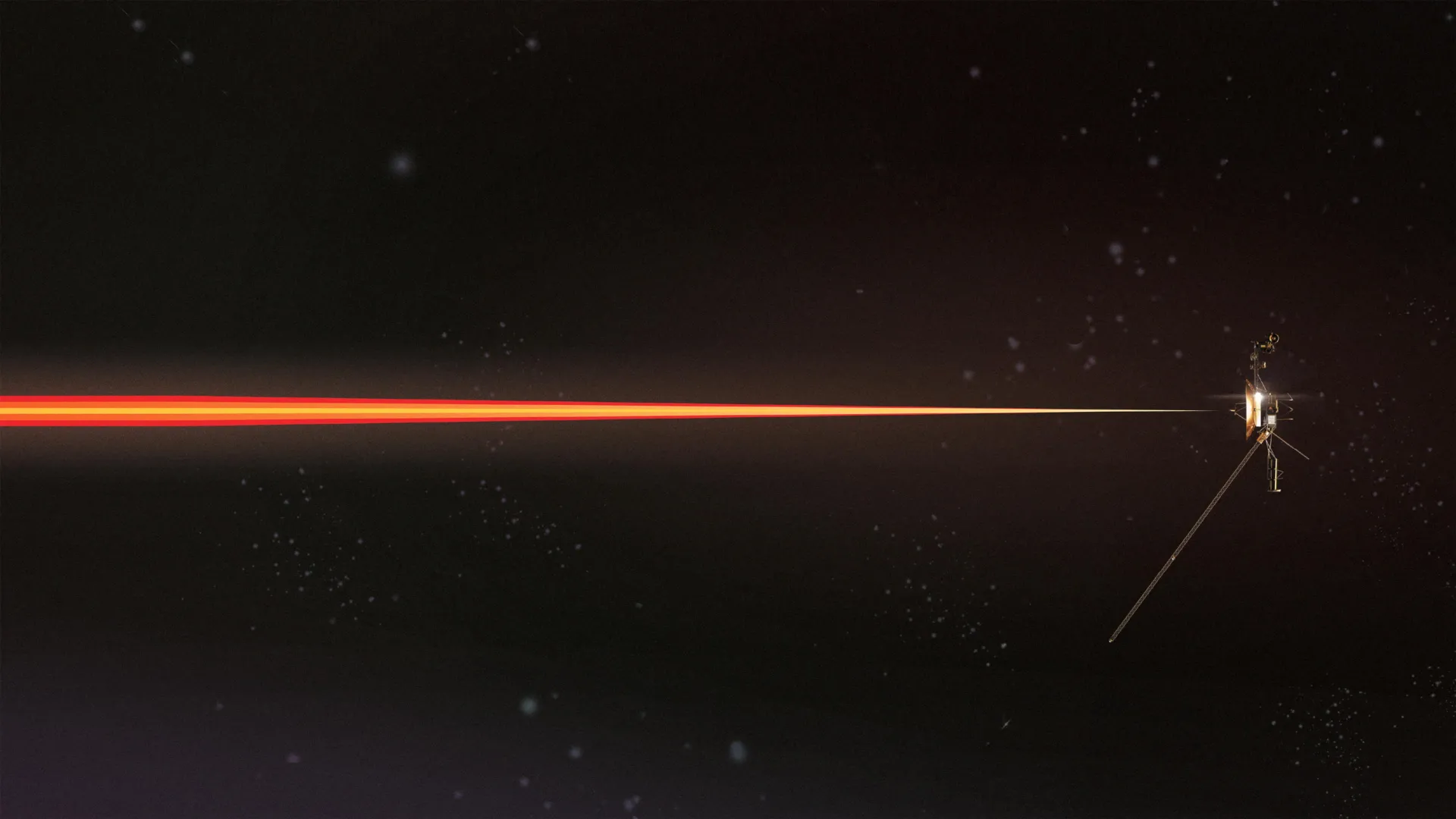
NASA's Voyager 1 reached a distance of one light-day from Earth on November 18 at 2:16 a.m. PST, becoming the first spacecraft to achieve this milestone. At approximately 16.1 billion miles (25.9 billion kilometers) away, signals traveling at the speed of light require a full 24 hours to reach the probe.
Scientists and engineers at NASA's Jet Propulsion Laboratory in Southern California, managed by Caltech, received confirmation of the milestone exactly 24 hours after Voyager 1 crossed the threshold. The achievement comes after more than 49 years of spaceflight.
The vast distance creates communication challenges. Sending a command to Voyager 1 takes 24 hours, and receiving a response requires another 24 hours, making a complete exchange span two full days even at light speed.
The milestone occurs as engineers investigate a communication problem. NASA has not received scientific or engineering data from Voyager 1 since November 14, though the probe continues transmitting a carrier signal. Mission specialists used this signal to verify the spacecraft crossed the one light-day mark and calculate its trajectory.
Voyager 1 and its twin, Voyager 2, launched in 1977 to explore the outer planets. Voyager 1 became the first spacecraft to cross the heliosphere boundary in 2012 and enter interstellar space. It currently travels at approximately 38,000 mph. Voyager 2 crossed into interstellar space in 2018.
Both probes carry Golden Records, gold-plated copper phonograph records containing images and sounds representing life on Earth, designed as potential messages for advanced extraterrestrial civilizations.
The probes continue monitoring changes in the Sun's magnetic field across immense distances, providing measurements that cannot be collected from Earth. Linda Spilker, Voyager project scientist at JPL, noted that "one big surprise is the extent to which our Sun continues to affect interstellar space, all the way out to Voyager 1."
Joe Westlake, director of the Heliophysics Division at NASA Headquarters, stated that Voyager is "central to NASA's fleet of heliophysics missions offering insights into the star that we all revolve around, the Sun."