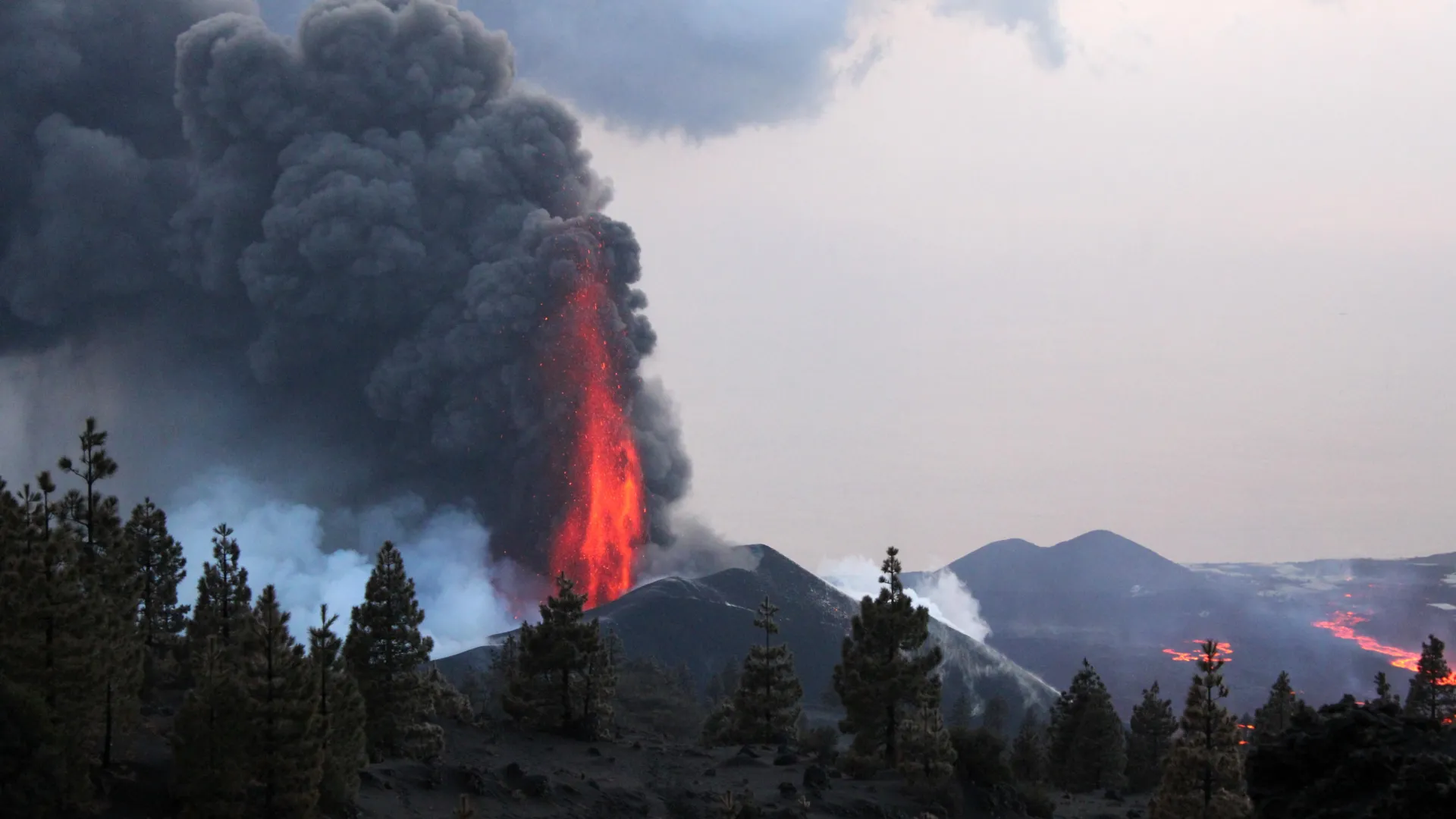
An international team led by The University of Manchester discovered that superheating in magma can dramatically delay crystal formation, potentially explaining why some volcanoes produce towering lava fountains while others erupt more gently.
The researchers studied volcanic material from the 2021 Tajogaite eruption on La Palma, Spain. They found that when magma reaches temperatures above those at which its crystals normally remain stable, this extreme heat can dissolve microscopic crystal seeds and alter the molten material's internal structure, making it less favorable for new crystals to form.
In laboratory experiments using synchrotron X-ray microtomography at Diamond Light Source, the team observed crystal development in real time. Magma that had not undergone superheating began producing crystals after approximately 20 minutes. When subjected to strong superheating, crystallization was delayed for more than eight hours.
Lead author Dr. Barbara Bonechi, Research Associate at The University of Manchester, stated: "The history of crystal and bubble growth can dramatically control how a magma erupts, in particular as more crystals grow, they eventually have a dramatic effect on magma viscosity. Until now, we did not fully understand the dynamics of crystal growth for magmas that received an injection of superheat just before ascent."
Computer simulations incorporating these findings showed that when superheating delays crystallization, magma remains relatively fluid and may travel upward more rapidly, potentially creating conditions for dramatic lava fountains. In contrast, magma that crystallizes earlier becomes more viscous, ascends slowly, and allows gases to escape gradually, favoring gentler lava flows.
The findings, published in Nature Communications, suggest that volcanic forecasting models should account for pre-eruptive thermal history and crystallization timing. Co-author Dr. Margherita Polacci noted: "Current volcanic hazard models typically focus on magma chemistry, gas content and pressure changes. This work suggests that pre-eruptive thermal history and crystallization kinetics may also play an important role in controlling magma ascent and eruptive behavior, with implications for volcanic hazard assessment."