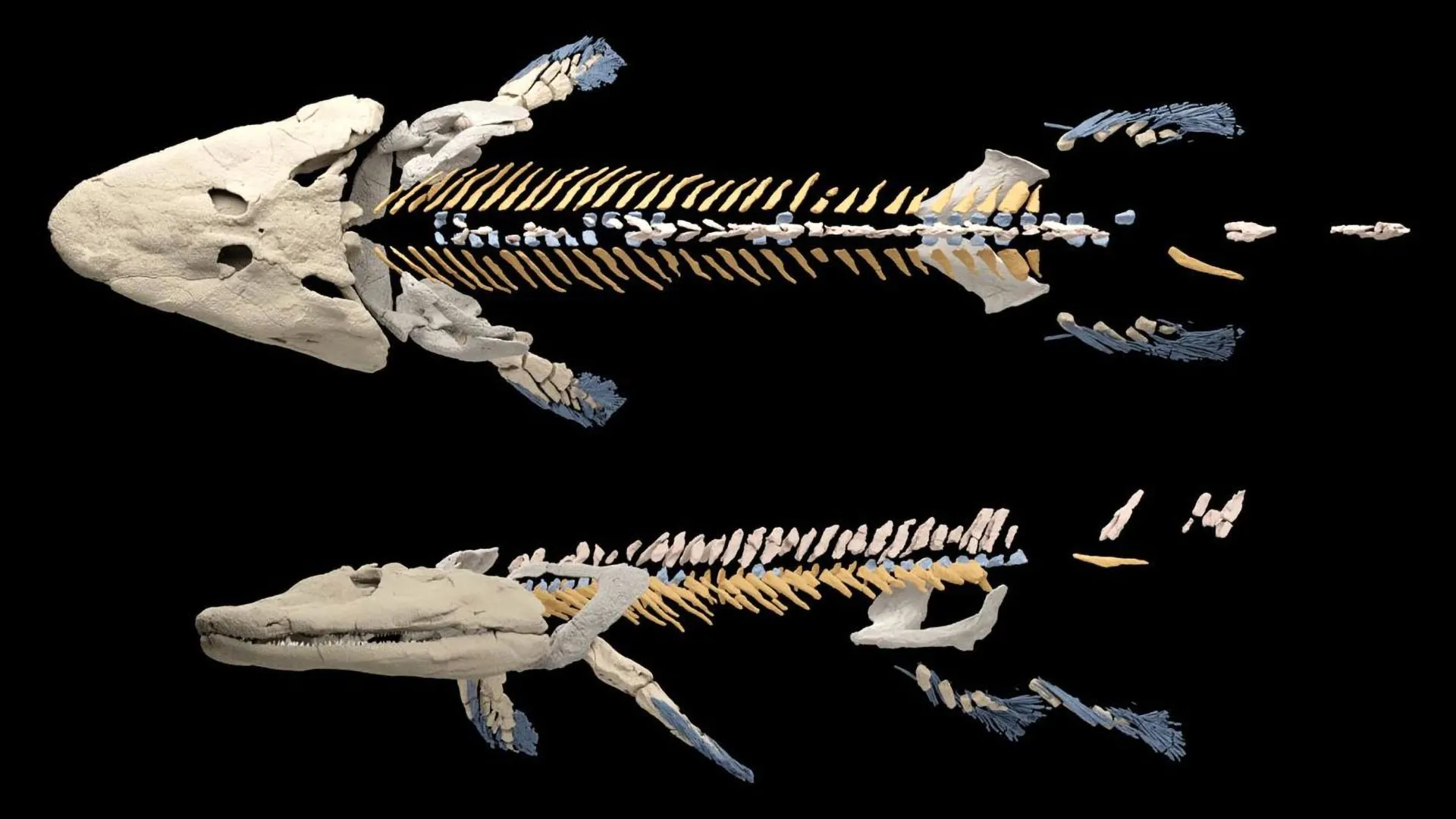
An international research team has found that early tetrapods, the first vertebrates to transition from water to land nearly 380 million years ago, had remarkably stiff necks despite having anatomically separated heads from their shoulders.
The discovery contradicts the longstanding assumption that necks evolved to improve head movement. Instead, the separation of the head and shoulders likely emerged as part of broader skeletal changes that enabled animals to use their front limbs for movement on land.
Researchers led by Tom Stewart, an assistant professor of biology at Penn State, combined fossil evidence with experiments on modern sturgeon and computer models of ancient anatomy. Their work appears in the October 14 issue of Nature.
The team investigated early fish such as Tiktaalik, a fossil discovered on Ellesmere Island in Nunavut, Canada, that lived during the Devonian Period. Rather than relying solely on fossil data, the researchers used sturgeon as models because their backbones contain a notochord, a flexible structure similar to that found in ancient tetrapods. By measuring the mechanical properties of the sturgeon notochord and applying those measurements to models of fossil animals, the team determined how much their necks could actually move.
Dana Korneisel, a postdoctoral researcher at Uppsala University in Sweden and first author of the paper, noted that the results were unexpected. "I undertook this study to find out how big of a difference this change in anatomy made for these animals," Korneisel said. "The lack of significant head mobility for almost all of these animals was a huge surprise."
The findings indicate that early tetrapods with distinct necks would have had severely restricted head movement and could barely lift their heads to survey their surroundings.