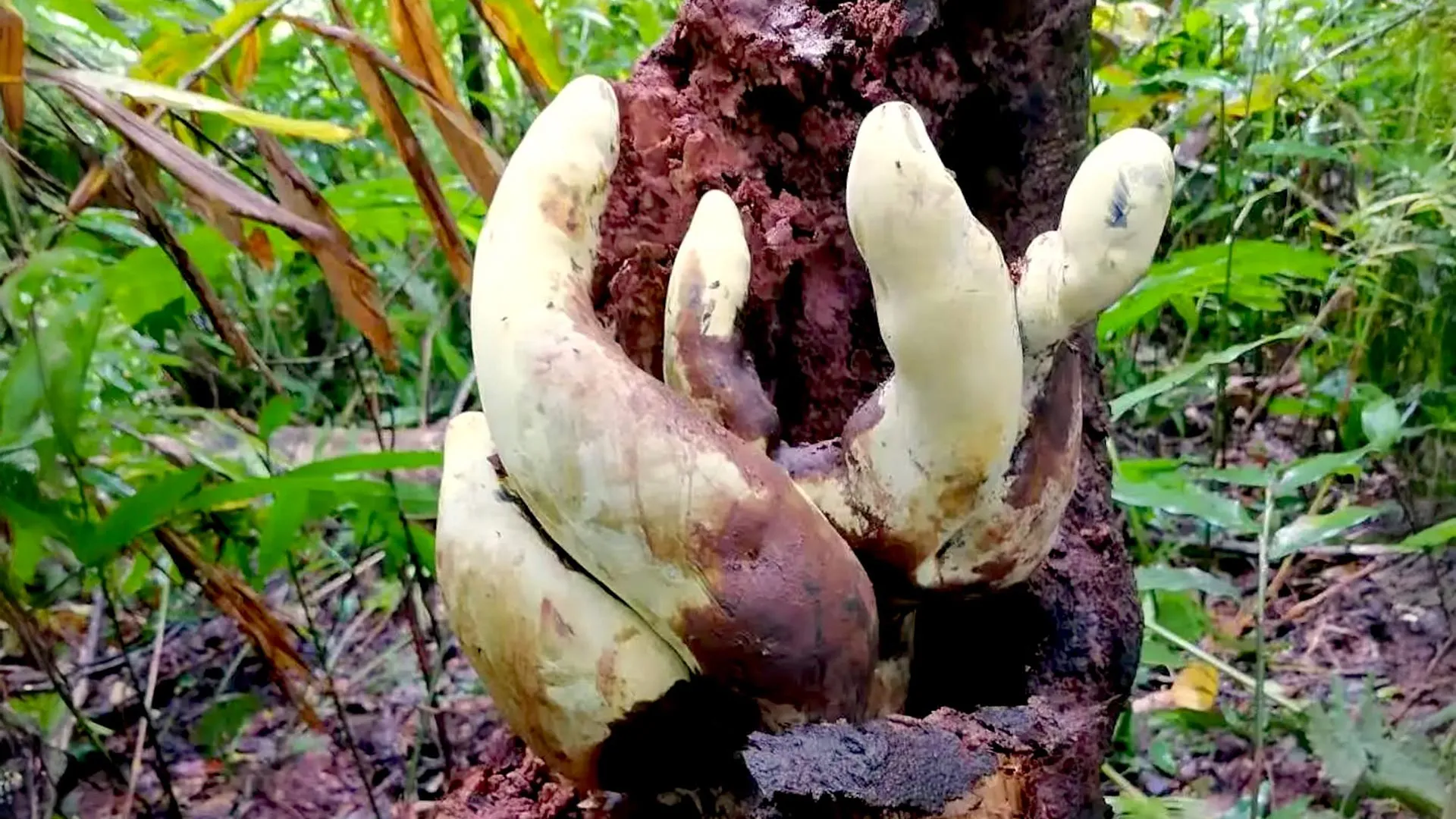
# Chinese Scientists Discover Ancient Giant Fungus with Lineage Tracing to Dinosaur Extinction
Chinese researchers have identified a previously unknown fungus species in China that dwarfs all known relatives in its taxonomic group. The organism, nicknamed "D-rex," reaches heights of up to 20 inches and weighs nearly five pounds, establishing it as the largest specimen ever documented among fungi in its classification.
The discovery carries deeper significance beyond mere size. Genetic analysis traces the fungus's evolutionary origins to approximately 65 million years ago, placing its emergence at the Cretaceous-Paleogene boundary when an asteroid impact wiped out non-avian dinosaurs. This timing raises questions about how mass extinction events reshape ecosystems and create opportunities for organisms to diversify and grow.
The naming convention reflects both its giant proportions and the historical moment of its origin. "D-rex" combines the "D" for the extinction event (sometimes called the K-Pg extinction) with "rex," invoking the dinosaurian megafauna that dominated the planet before vanishing. Such nomenclature signals to scientists that this fungus occupies an unusual evolutionary niche.
Fungi play understudied roles in terrestrial ecosystems. While most fungal species operate below ground as decomposers and symbiotic partners to plant roots, this specimen's remarkable size suggests distinct ecological pressures or evolutionary advantages in its native Chinese habitat. The fact that it remained unidentified until now underscores how incompletely catalogued Earth's biodiversity remains, particularly in groups that receive less attention than charismatic vertebrates.
The discovery's evolutionary timeline raises broader questions about post-extinction radiation, the rapid diversification of surviving lineages after mass die-offs. When dominant predators and competitors disappear, remaining organisms often expand into ecological niches previously unavailable to them. D-rex's evolutionary lineage apparently took advantage of those post-dinosaur conditions, though the specific mechanisms driving its gigantism remain unclear.
Understanding how ancient catastrophes shape modern biodiversity carries relevance today. Earth faces its sixth mass extinction event, driven by habitat loss, climate change, and human activity. Studying how fungi and other organisms responded to the dinosaur extinction provides a natural experiment in ecosystem recovery and evolutionary innovation. These historical patterns may inform predictions about which species survive future environmental upheaval and how survivors adapt.
The research also highlights China's growing prominence in biodiversity discovery. Chinese research institutions increasingly lead expeditions documenting species in East Asian ecosystems, particularly in regions rich in endemic organisms found nowhere else on Earth. Such discoveries expand the global inventory of life and challenge assumptions about how thoroughly scientists have catalogued even macroscopic organisms.
Future research on D-rex should focus on its genetics, physiology, and ecological role. Questions remain about what enables its unusual size compared to related species, whether its large fruiting bodies serve specific reproductive advantages, and how its mycelial networks beneath the soil compare to smaller relatives. Laboratory cultivation and genomic sequencing could reveal whether D-rex harbors unique biochemical compounds or metabolic pathways worth investigating for biotechnological applications.
The fungus represents one of countless species likely waiting in unexplored or under-sampled habitats across Asia, Africa, and South America. Each discovery incrementally completes the tree of life and offers glimpses into how evolution works at scales spanning millions of years.