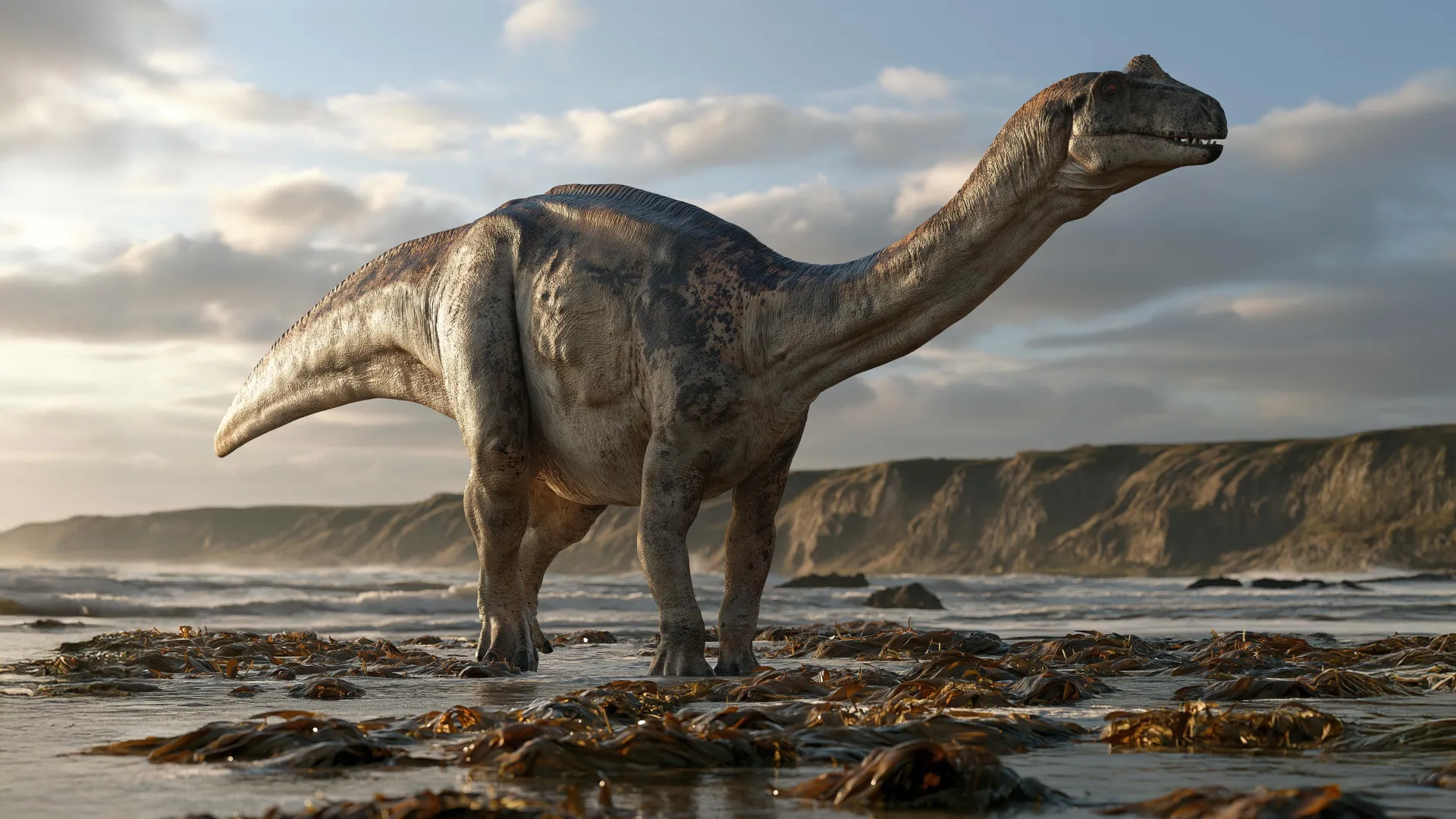
Dinosaurs living along ancient coastlines around 100 million years ago may have eaten seaweed and other marine resources that washed onto beaches, according to a study published in Frontiers in Ecology and Evolution.
Researchers led by Dr. Clayton Forster at the University of Arkansas examined carbon isotope signatures in fossils from coastal areas that once bordered the Western Interior Seaway and the Gulf of Mexico. They compared these with fossils from inland locations dating to the early Albian (113-107 million years ago) and early Cenomanian (100-96 million years ago) periods.
The team measured carbon isotopes in tooth enamel from dinosaurs, fish, crocodiles, and turtles. Coastal fossils consistently showed higher carbon-13 values than inland ones. This chemical signature indicates that marine nutrients entered the food chain on land.
"We show that coastal terrestrial organisms in the greenhouse climates of the Cretaceous relied on marine resources to supplement their diets in a similar way that modern organisms do," Forster said. "We can identify that marine resources are passed along the food chain and incorporated in the minerals of bones and teeth of dinosaurs, crocodiles, turtles, and fish."
Seaweed emerged as the most likely ocean source, since it exists along coastlines but not inland, and could be consumed by herbivorous dinosaurs and passed through food chains to other animals.
One exception appeared in the plant-eating dinosaur Tenontosaurus tilletti, whose tooth enamel showed carbon signatures consistent with land plants only, suggesting it did not eat marine resources.
The researchers note that fossil records lack specimens from polar or equatorial regions during these periods, so the geographic extent of this feeding behavior remains unknown.