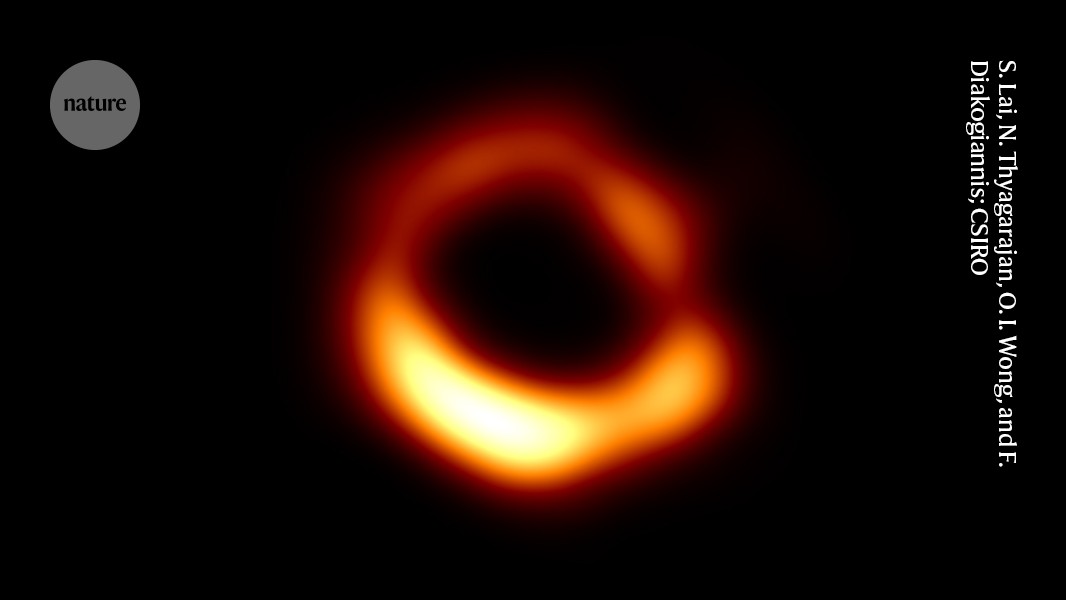
When the Event Horizon Telescope collaboration unveiled the first picture of a black hole's shadow in 2019, it was a triumph of human ingenuity and international collaboration. But not everyone accepted it at face value. Starting in 2022, Junichiro Makino and his team at Kobe University questioned whether the iconic circular ring was real or merely an artifact of the image-reconstruction techniques used by the EHT collaboration. It was a legitimate scientific challenge to an extraordinary claim. Now, with independent reanalysis published on November 11 in Nature, we have the vindication the original team deserved—and a powerful reminder of how rigorous peer scrutiny strengthens rather than weakens scientific truth.
Makino's skepticism was methodologically sound. By applying one of the data-analysis techniques the EHT collaboration had used but with slightly different assumptions, his team obtained a markedly different result: a glob of radio emissions rather than a ring. This wasn't mere nitpicking; it raised a genuine possibility that the celebrated circular shape was an algorithmic artifact rather than a physical reality. The challenge demanded a response, and the scientific community was right to take it seriously. When extraordinary claims depend on complex reconstruction methods, extraordinary scrutiny is not just warranted—it is essential.
The new independent analysis, using an algorithm to combine telescope measurements in a different way from the original analysis, has largely corroborated the EHT collaboration's original findings. This is precisely what should happen. The bright ring of roughly the correct radius, consistent with astrophysical models based on Albert Einstein's general theory of relativity, has held up under different mathematical approaches. The darker disk at the centre remains. The skeptics were not vindicated, but neither were they silenced—they were answered with data.
What makes this outcome so reassuring is not just that the original team was right, but that the process worked exactly as science should. Makino and his collaborators didn't simply accept the 2019 result. They questioned it, reanalyzed the data with different assumptions, and published their concerns. The EHT collaboration then responded by commissioning independent verification. No authoritarian appeals to fame or prestige; no dismissal of inconvenient questions. Just better data and better analysis.
This is the antidote to both scientism and anti-science sentiment. Those who claim science is infallible overlook how often we revise our understanding. Those who claim science is mere opinion ignore how often independent verification converges on truth. The black hole image story shows science as it actually works: messy, self-correcting, and ultimately reliable because it welcomes rigorous challenge rather than fear it.