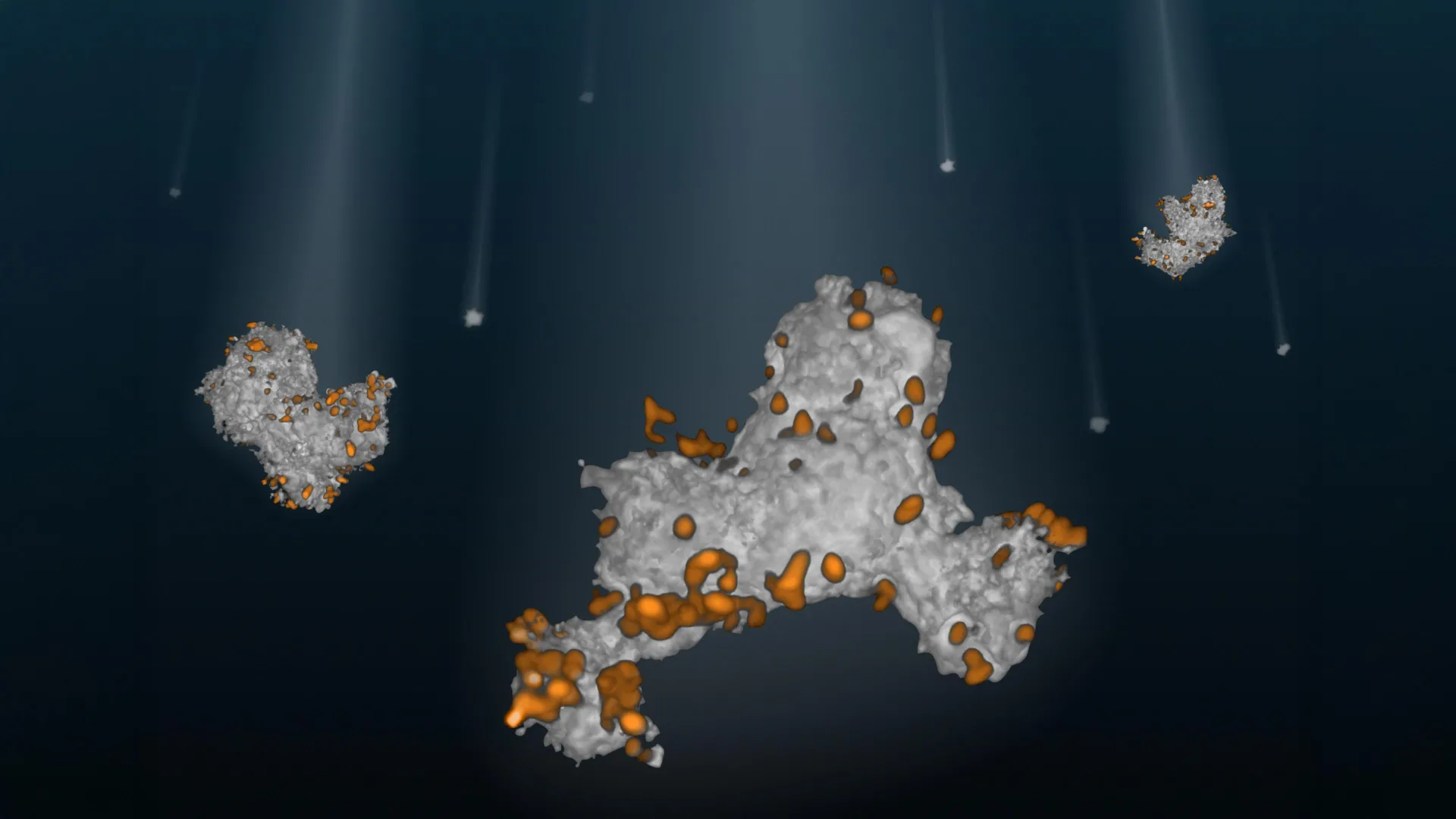
Researchers from UC San Diego's Scripps Institution of Oceanography and the University of Lincoln discovered that the stickiness of marine snow particles determines how much carbon reaches the deep ocean. Their findings, published October 8 in Science, show that the viscosity of these underwater particles influences how quickly bacteria break them apart and how far they sink. Highly viscous marine snow can transport more than six times as much carbon to the deep ocean as less viscous particles.
Marine snow consists of tiny clumps of dead organisms, mucus, animal feces, and other debris that drift through the ocean. Researchers estimate these particles remove more than 10 gigatons of carbon from surface waters each year, though only about two gigatons reach depths where carbon remains stored for centuries or longer.
Bryce Inman, a postdoctoral researcher at Scripps, spent four years developing a technique to observe bacteria interacting with marine snow at the microscopic level. Working with Farooq Azam, a microbiologist and professor emeritus at Scripps, Inman combined 3D confocal microscopy with fluorescent molecules to create detailed three-dimensional images of individual particles.
The imaging revealed that bacteria preferentially colonize less viscous areas near a particle's surface but struggle to penetrate denser, stickier regions deeper inside. Laboratory experiments showed that highly viscous particles resisted bacterial degradation longer. Computer simulations suggested these stickier particles descend to greater depths before breaking apart.
A companion study published in Nature Communications described the imaging approach. The research received funding from the Simons Foundation and the Engineering and Physical Sciences Research Council.
Inman noted that the findings have implications beyond marine systems. Understanding how bacteria interact with mucus structures could advance research in human digestive health and coral reef recovery.