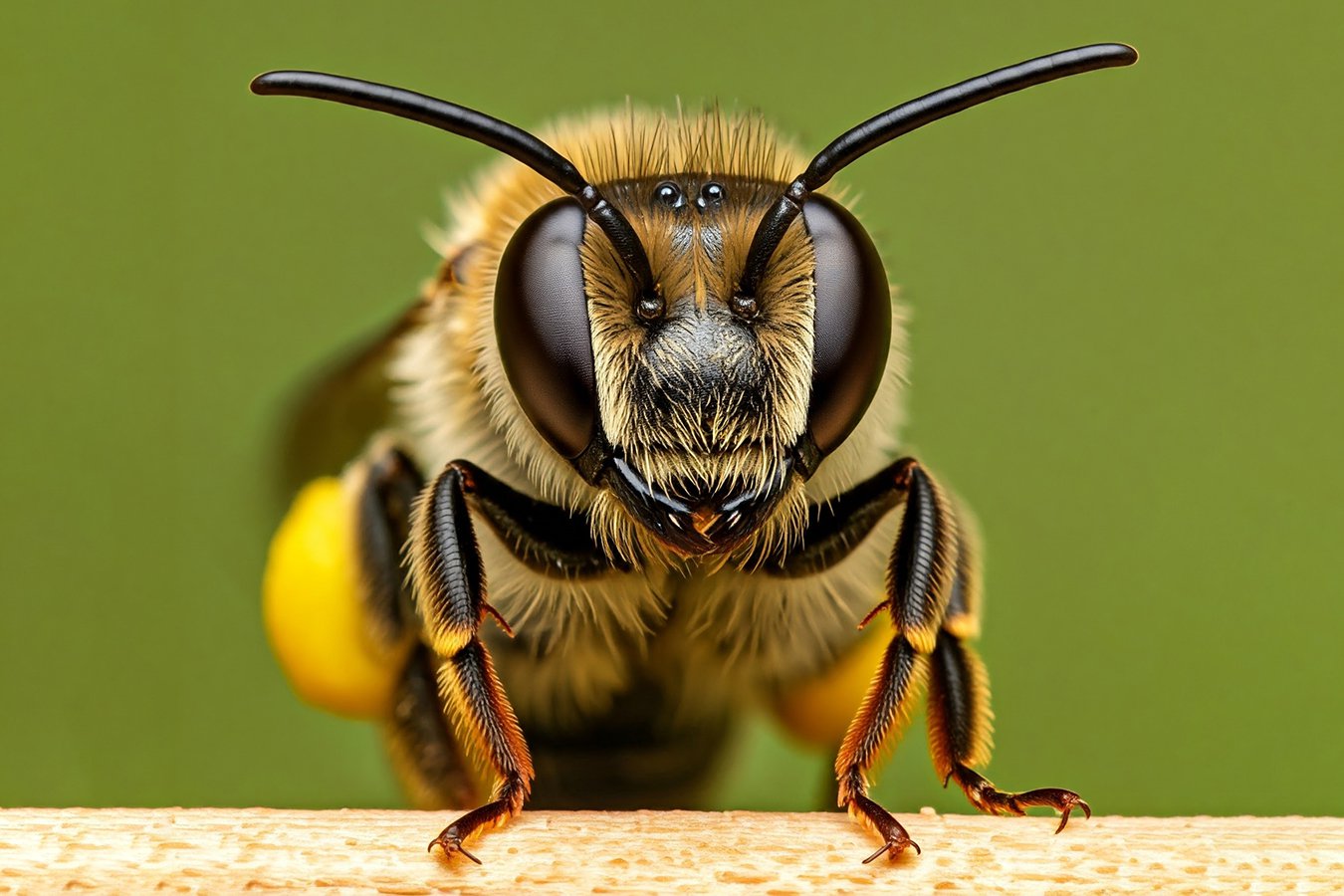
# Bees Show Emotional Complexity, Reshaping Scientific Views on Consciousness
Scientists studying bee behavior have accumulated evidence suggesting these insects experience something akin to emotional states, a finding that fundamentally challenges how researchers define and measure consciousness across species.
Recent research demonstrates that honeybees exhibit pessimistic cognitive biases when stressed, a hallmark of emotional experience in mammals. When faced with threats, bees make riskier decisions and interpret ambiguous stimuli more negatively than they would under calm conditions. This parallels depression-like states documented in vertebrates. Researchers at Queen Mary University of London and other institutions have shown bees also display what appears to be playful behavior, engaging in seemingly purposeless flight patterns that suggest subjective enjoyment rather than purely mechanical responses to stimuli.
The implications extend beyond insects. Corvids such as jays have demonstrated behaviors interpreted as apologetic or reconciliatory, responding to social conflicts with apparent attempts to restore relationships. These observations join growing documentation of octopuses displaying individual personalities, fish exhibiting pain sensitivity beyond reflexive responses, and mammals from elephants to pigs showing grief and empathy.
This convergence of evidence has sparked fundamental debate among neuroscientists and philosophers about consciousness itself. Traditional frameworks assumed consciousness required specific brain structures like a neocortex, something insects lack entirely. The bee research suggests emotional experience arises from simpler neural architectures operating on different principles than mammalian brains. The Cambridge Declaration on Consciousness in 2012 acknowledged that non-human animals possess consciousness, but defining its presence in creatures with millions rather than billions of neurons remains contentious.
Dr. Lars Chittka at Queen Mary University of London, who has studied bee cognition for decades, argues that absence of a large brain does not eliminate subjective experience. The clustering of neurons in insect brains, despite their small size, performs computations supporting learning, memory, and decision-making under uncertainty. These capabilities form neural substrates potentially capable of supporting emotional states.
The shift carries practical consequences. If insects experience suffering, the ethics surrounding agricultural pesticide use, research protocols, and pest control require reassessment. Some countries have begun extending welfare protections to cephalopods and decapod crustaceans in recognition of their apparent capacity for pain. Extending such protections to insects could reshape industries affecting billions of individuals annually.
Limitations remain significant. Distinguishing genuine emotion from sophisticated behavioral programming presents methodological challenges. Researchers cannot directly access subjective experience in any organism besides themselves. Current approaches rely on behavioral analogues, neurological similarity to known emotional systems, and evolutionary logic suggesting emotions provided adaptive advantages across taxa.
The emerging view does not claim that bee consciousness matches human consciousness. Rather, it suggests consciousness exists along a spectrum, manifesting differently across biological architectures. This perspective unifies observations from corvids appearing to play pranks to mollusks solving complex problems to insects making decisions influenced by internal states.
Future research will likely employ increasingly sophisticated neuroimaging of insects, refined behavioral experiments distinguishing emotional responses from reflexes, and computational models simulating how simple neural networks generate apparent subjective experiences. These efforts promise to clarify consciousness itself by examining its simplest known instantiations in nature.