# How the Dead Sea Reveals Secrets of the Mediterranean's Ancient Desiccation
Researchers studying the Dead Sea have identified a mechanism that could explain one of geology's most dramatic events: the near-total drying of the Mediterranean Sea roughly 5.5 million years ago. The key lies in understanding how extremely salty water behaves when isolated from the ocean.
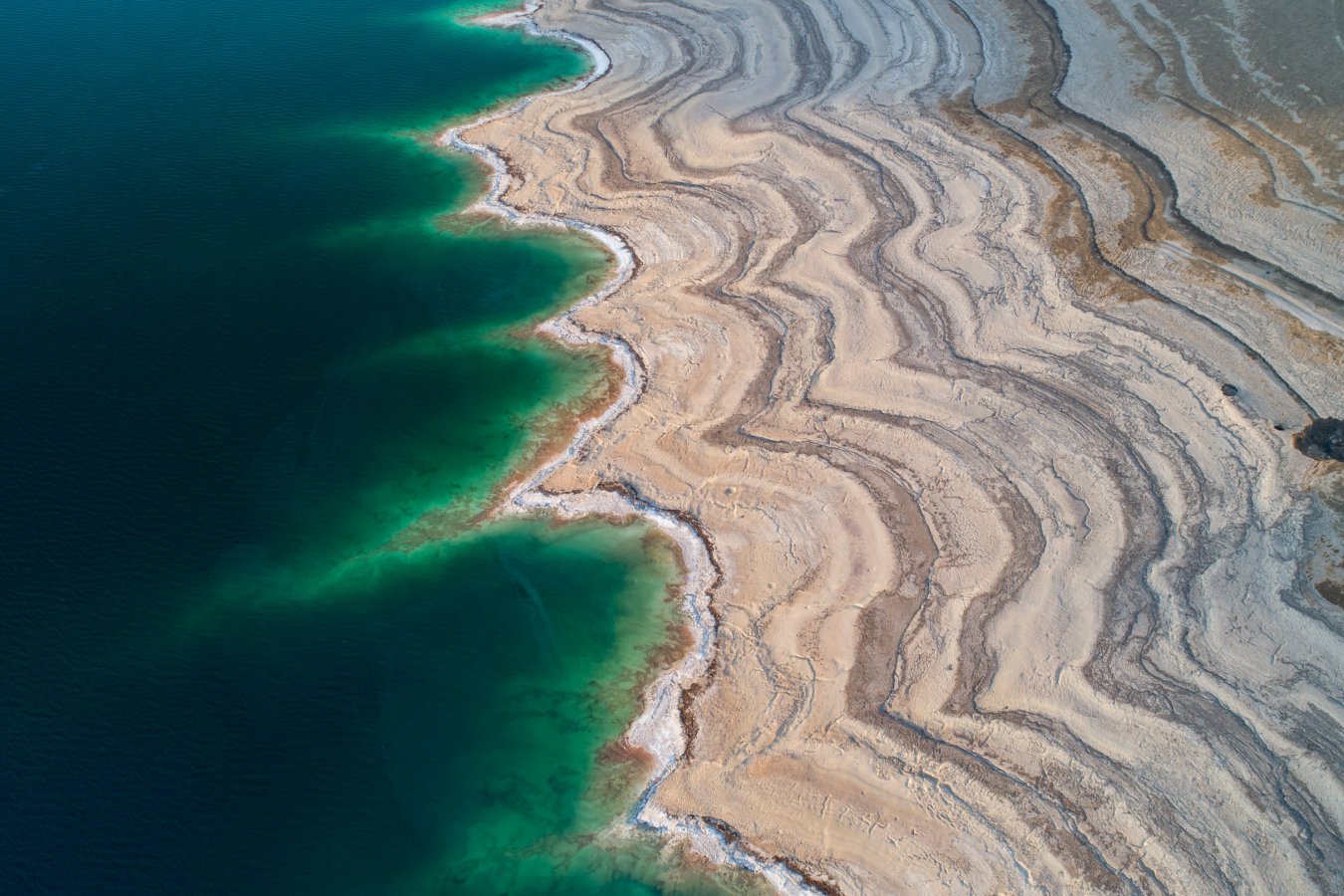
The Dead Sea, Earth's lowest point on land at 1,410 feet below sea level, contains salt concentrations nearly 10 times higher than typical seawater. Scientists have discovered that this extreme salinity drives a self-reinforcing cycle of warming and shrinking. As salt concentration increases, the water's physical properties change, causing the lake to warm more easily and lose water more rapidly through evaporation. This creates a feedback loop that accelerates the lake's decline.
The research team applied these findings to understand the Messinian Salinity Crisis, a period when the Mediterranean basin dried up almost completely between 5.97 and 5.33 million years ago. During this era, towering salt deposits accumulated across the Mediterranean floor, leaving geological evidence visible today. Scientists had long puzzled over how such complete desiccation could occur, particularly given the Mediterranean's connection to the Atlantic Ocean.
The Dead Sea model suggests that once Mediterranean water became sufficiently isolated and saline, it entered a thermodynamically driven shrinking phase. High salt concentrations altered the water's response to solar radiation and evaporation rates, creating conditions where the basin simply couldn't maintain water volume. Rather than requiring external factors to explain the drying, the chemistry and physics of salt water itself accelerated the process.
The Messinian Salinity Crisis lasted approximately 640,000 years before the Strait of Gibraltar breached again, reconnecting the Mediterranean to the Atlantic and refilling the basin with ocean water. At its peak, the Mediterranean floor sat roughly 3,000 meters below current sea level, creating a landscape of salt flats and mineral deposits. Rivers like the Nile cut deep canyons into the exposed bedrock, channels that later filled with sediment when waters returned.
The significance of this research extends beyond ancient Mediterranean history. Understanding how salt-driven mechanisms reshape water bodies helps explain the behavior of modern hypersaline lakes and inland seas worldwide. The Dead Sea continues its dramatic shrinkage today, dropping roughly 3 feet annually, making it a living laboratory for studying these processes.
The work builds on decades of geological investigation into Mediterranean paleoclimate and basin dynamics. Researchers rely on core samples, seismic surveys, and chemical analysis of salt deposits to reconstruct ancient conditions. This Dead Sea study provides a physical explanation that connects observable modern phenomena to ancient geological records.
The research underscores how feedback mechanisms in extreme environments can drive rapid environmental change. High salinity doesn't simply make water different; it fundamentally alters how that water responds to energy input and loses volume through evaporation. This principle applies whether examining a shrinking salt lake today or reconstructing the catastrophic drying of an entire sea millions of years ago.